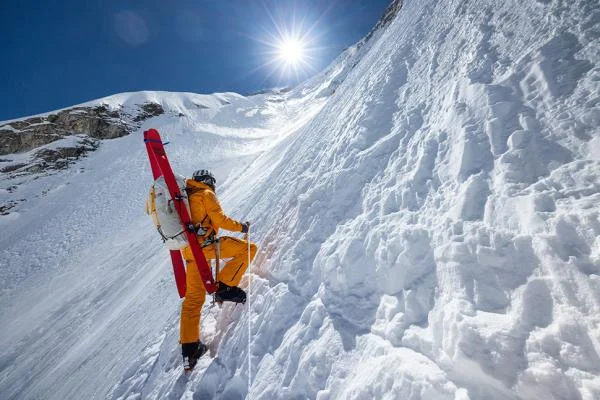
The Vertigo of Grief: Inside the High-Stakes Production of ‘Everest: The Other Side’

In the rarefied, oxygen-deprived air of the documentary film world, few names carry as much weight as Jimmy Chin and Elizabeth Chai Vasarhelyi. Having redefined the genre with Oscar-winning explorations of human limit like Free Solo and Meru, the pair has long mastered the art of capturing the intersection of extreme athleticism and profound psychological stakes. However, their latest project for National Geographic, Everest: The Other Side, arrives in theaters under a cloud of industry speculation—not just regarding the terrifying nature of the ascent, but the high-profile dissolution of the filmmakers’ own marriage, which occurred during the film’s production.
The film documents the harrowing journey of elite alpine climber and skier Jim Morrison as he attempts to conquer the North Face of Mount Everest. While the film functions as a masterclass in nonfiction suspense, it also serves as a haunting mirror, reflecting the filmmakers’ own domestic fragility while forcing the audience to confront the intersection of grief, obsession, and the desperate, often irrational, human need to climb.
The Mission: Conquering the Forbidden Face
To the uninitiated, the North Face of Everest is merely a daunting geographical feature. To the climbing elite, it is a graveyard of ambition. Prior to Morrison’s record-breaking expedition, only five individuals had successfully summited this specific, Chinese-facing side of the world’s tallest peak, and not a single soul had ever skied down it.
The premise of Everest: The Other Side is simple yet suffocating: a man attempts to complete a feat that has never been accomplished, all while carrying the weight of multiple lifetimes of loss. The film captures the raw, visceral reality of the ascent: the 9,000-vertical-foot corridor of bulletproof ice, the ever-present threat of shifting glaciers, and the brutal, unforgiving monsoons that define the climbing season. Despite the audience knowing the historical outcome—that Morrison survives—the film maintains a persistent, clammy sense of dread. Through the expert lens of cinematographers Clair Popkin and Christopher Murphy, every avalanche feels like a death knell, and every drone shot serves to remind the viewer of the insignificance of the human form against the indifference of the Himalayas.
Chronology of a Tragedy: The Burden of Loss
The narrative engine of Everest: The Other Side is not the mountain itself, but the grief that precedes the climb. Jim Morrison’s history is scarred by profound, almost unfathomable loss. In 2011, he suffered the devastating tragedy of losing his first wife and two children in an airplane accident—a trauma that would shatter most, yet somehow, for Morrison, became the bedrock of his relationship with the mountains.
The emotional stakes were heightened further by his partnership with legendary ski mountaineer Hilaree Nelson. The two were not merely climbing partners; they were a singular force of nature, having famously skied the Lhotse Couloir together in 2018. Their shared dream—to ski the North Face of Everest—was meant to be the pinnacle of their partnership. That dream was violently interrupted in 2022. While descending from the summit of Manasalu in Nepal, Nelson was struck by an avalanche and fell 5,900 feet to her death.
The documentary captures this with a brutal, documentary-style honesty. It is a cinematic "jump scare" that functions as a grim reminder of the high price of extreme sports. Following her death, Morrison’s decision to continue the North Face project in 2023, and again in 2025, transforms from a simple athletic endeavor into a form of active, dangerous mourning.

Supporting Data and Production Realities
The production of Everest: The Other Side was, by all accounts, as perilous as the climb itself. The 2023 expedition was a catastrophic failure, plagued by broken bones, extreme weather, and the psychological toll of the previous year’s losses. The team was forced to turn back, yet the decision to return two years later speaks to the "death drive" that Chin and Vasarhelyi have spent their careers documenting.
Technically, the film is a triumph of endurance. Using a combination of GoPro footage, high-altitude drone cinematography, and traditional telescopic lenses, the team creates an immersive experience that forces the viewer to share in the claustrophobia of the oxygen-deprived zones.
The film also gains necessary grounding through its inclusion of supporting figures, most notably the Nepalese Sherpa Yukta. His presence provides a vital "emotional ethnography," acting as a counterpoint to the Western obsession with "conquering" the mountain. While Morrison struggles with his internal demons, Yukta offers a perspective that is at once pragmatic and deeply spiritual, keeping the film from veering into the hollow, spectacle-driven tropes often found in modern adventure documentaries.
The Filmmakers: A Parallel Narrative of Separation
Perhaps the most intriguing layer of Everest: The Other Side is the one that remains largely offscreen. As Chin and Vasarhelyi directed the camera toward Morrison’s grief, they were simultaneously navigating the collapse of their own partnership.
In their previous work, such as the 2015 hit Meru, the filmmakers allowed the tension of their personal lives to permeate the narrative. In Everest, the approach is more clinical, yet the emotional resonance is arguably stronger. Critics have noted that the film feels like an "intimately suffocating" study of relationship dynamics. By focusing on Morrison’s attempt to reconcile his past, Chin and Vasarhelyi seem to be asking the same question they are asking of their own lives: How do you keep moving when the thing you built your world around is gone?
There is no easy answer provided. As Morrison mutters to himself while traversing a particularly lethal crevasse, "The things we do for fun," the audience is left to grapple with the realization that for these individuals, the mountain is not an escape, but an altar.
Implications: The Ethics of the "Climbing Doc"
The success of this film raises uncomfortable questions regarding the genre of extreme sports documentary. Are filmmakers merely exploiting the grief of their subjects for "prestige" content? Or is the camera an essential tool for processing the kind of trauma that defies traditional verbal expression?

In Everest: The Other Side, the line between therapy and spectacle is perpetually blurred. However, the film avoids the pitfalls of exploitation by maintaining a consistent, clear-eyed focus on the human cost. It does not romanticize the climb; it highlights the masochism inherent in the sport. It acknowledges that when a person hits rock bottom, the only direction left to look is up—even if the path leads to 29,000 feet.
Conclusion: A Clear-Eyed Stare into the Abyss
Ultimately, Everest: The Other Side is not a film about mountain climbing. It is a film about the persistence of the human spirit in the face of absolute, crushing tragedy. While the technical achievements of the photography are undeniable, the film’s real power lies in its ability to mine suspense from a story where the outcome is already known.
National Geographic’s decision to push this film into theaters on October 30 signals a clear play for awards season, and given the craft involved, it is well-deserved. Despite the cliches that often haunt the genre—the "defiance of nature," the "triumph of the will"—this film feels different. It feels like a confession. By the time Morrison finally hits the summit and is forced to navigate the harrowing, treacherous ski back down, the audience is no longer watching a documentary about a record-breaker; they are watching a man trying to survive his own life.
Chin and Vasarhelyi have once again proven that they are the preeminent chroniclers of the edge of the world. In doing so, they have created a work that is as much about the tectonic shifts in our personal lives as it is about the shifting ice of the Himalayas. Everest: The Other Side is not just a film; it is a profound, albeit painful, meditation on what we are willing to lose to find ourselves.
Grade: B+
Everest: The Other Side premiered at the 2026 Venice Film Festival. National Geographic will open the film in theaters starting October 30.