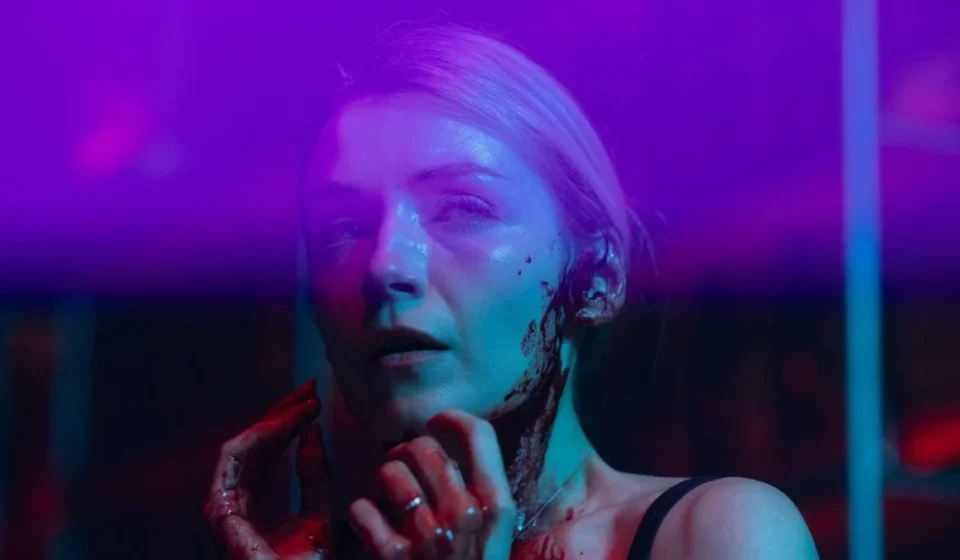

The FrightFest stage has always been a proving ground for bold, unconventional horror, and this year’s opening night film, Nervous, has certainly left its mark. Directed by Abner Pastoll—known for his taut directorial work on Road Games and A Good Woman Is Hard to Find—Nervous is a chilling psychological exploration of isolation, gaslighting, and the frailty of human perception. Co-written with Richard Hobley, the film serves as a masterclass in atmospheric dread, utilizing a unique auditory conceit to force the audience into the disorienting, isolating reality of its protagonist.
The Premise: A Descent into Auditory Isolation
The narrative follows Sarah (Sarah Bolger), an American investigative journalist, and her South Korean partner, Sungsoo (Sungsoo Yune). Seeking a reprieve from the stresses of their professional and personal lives, the couple relocates to a remote, scenic home in South Korea for an extended retreat.
The inciting incident is deceptively simple: while exploring the attic of their new dwelling, Sarah unearths a vintage record player. Shortly after interacting with the device, she begins to experience a terrifying, inexplicable phenomenon—she finds herself losing the ability to process male voices. As the world around her continues to function, the voices of men, including her partner, begin to distort or vanish entirely, replaced by an unsettling, hollow silence.
When she seeks medical help, the doctors insist her hearing is physically perfect, a diagnosis that forces Sarah into a harrowing downward spiral. Is she suffering from a psychological break, a neurological condition, or is there something more sinister—perhaps supernatural—lurking within the walls of their retreat?
Chronology of a Breakdown
The pacing of Nervous is deliberate, mirroring the gradual erosion of Sarah’s sanity.
- The Discovery: The initial act establishes the fragile state of Sarah and Sungsoo’s relationship. The discovery of the record player acts as a catalyst, bridging the gap between the couple’s existing interpersonal friction and the film’s central horror.
- The Medical Gaslighting: Sarah’s attempts to find clinical answers are met with skepticism. This phase of the film acts as a sharp critique of how medical institutions often dismiss women’s experiences with their own bodies, particularly when those experiences fall outside of standard diagnostic parameters.
- The Investigative Pivot: Utilizing her background as a journalist, Sarah attempts to treat her condition as a story to be solved. She begins to track patterns, collect data, and scrutinize her surroundings, moving from victim to investigator.
- The Social Friction: A standout sequence occurs in a local restaurant, where Sarah overhears two South Korean women speaking about her. Because she can understand the language, the scene captures a visceral, relatable frustration—the feeling of being discussed as an object rather than a person, exacerbated by the fact that she cannot fully trust her own sensory input.
- The Climax: As the lines between the physical and the psychological blur, Sarah forms an alliance with a neighbor, Eunbyeol (Ko Asung). This relationship introduces a new layer of ambiguity, leaving the viewer to wonder if they are witnessing a genuine bond or the final stage of a dangerous, manipulative game.
Supporting Data: The Power of Sound Design
What elevates Nervous from a standard psychological thriller to a standout entry in the genre is its impeccable sound design. Pastoll and his team have crafted an audio landscape that is as much a character as any of the actors on screen.
As the film progresses, the viewer is placed directly in Sarah’s perspective. The "drowning out" of male voices is handled with clinical precision; the audience finds themselves straining to hear, subconsciously tilting their heads or turning up the volume, only to be met with the same frustration that plagues Sarah. This technical feat ensures that the viewer’s empathy is never in doubt.
Furthermore, the film’s restraint is its greatest weapon. Nervous does not rely on a high body count or constant jump scares. Instead, it employs infrequent but visceral bursts of violence that are all the more shocking because of the quiet, contemplative atmosphere that precedes them.
![‘Nervous’ Review: An Enigmatic Mystery Which Requires You To Fill In The Blanks [FrightFest]](https://www.dreadcentral.com/wp-content/uploads/2026/08/nervous2-e1787333829297-1200x675.jpeg)
Official Perspectives and Performances
The success of Nervous rests heavily on the shoulders of its lead, Sarah Bolger. Her portrayal of Sarah is a tour de force of vulnerability and grit. Bolger captures the desperation of someone losing their grasp on reality while simultaneously showcasing the intellectual defiance of a woman who refuses to be silenced by her own mind.
Sungsoo Yune provides a necessary counterweight as Sungsoo. His performance is nuanced, depicting a man who is genuinely trying to be a supportive partner while reaching the end of his emotional rope. The film functions as an autopsy of a failing relationship, suggesting that even the most well-intentioned patience can be weaponized or exhausted when faced with the unknown.
Ko Asung, celebrated for her work with Bong Joon Ho, delivers an equally compelling performance as Eunbyeol. Her presence introduces a sense of mystery; she is at once a beacon of support and a potential architect of Sarah’s undoing. Her chemistry with Bolger is electric, grounding the film’s more abstract, nightmarish elements in a believable human connection.
Implications: The Social Commentary of Silence
Beyond its narrative thrills, Nervous invites deep thematic interpretation. The most prominent reading is that of the "ignored woman"—a metaphor for the way society often tunes out or misinterprets the cries of women. By rendering Sarah’s voice—and her ability to process the voices of men—problematic, Pastoll forces the audience to confront the difficulty of being heard in a world that is inherently biased toward specific viewpoints.
The film intentionally avoids "spoon-feeding" its audience. It refuses to confirm whether the phenomena are a manifestation of trauma, a supernatural intrusion, or a social commentary on the instability of objective truth. By leaving these questions unanswered, the filmmakers invite a post-screening dialogue that is rare in modern horror.
Some viewers may find this lack of closure frustrating, but it is precisely this ambiguity that makes Nervous an essential watch. It is a film that lingers long after the credits roll, compelling the audience to return to the scenes in their mind and re-evaluate the clues left behind.
Conclusion: A New Standard for Psychological Horror
Nervous is a bold, challenging, and deeply unsettling addition to the horror canon. It succeeds not by overwhelming the audience with spectacle, but by inviting them into a private, terrifying world where the most basic human function—hearing and being heard—is stripped away.
For those who appreciate cinema that trusts the intelligence of its audience, Nervous is a triumphant experience. It stands as a testament to the power of sound, the importance of performance, and the enduring ability of the horror genre to explore the deepest fissures in our social and personal lives. As FrightFest concludes, Nervous remains one of the most enigmatic and talked-about entries of the year, solidifying Abner Pastoll’s reputation as a director who is not afraid to push his audience to the edge of their seat—and leave them there, wondering what is real and what is merely the sound of their own anxiety.