
The Myth of Realism: How Christopher Nolan’s The Odyssey Redefined Cinematic Spectacle

In the annals of cinematic history, few challenges are as daunting as adapting Homer’s The Odyssey. For centuries, the epic poem has served as the bedrock of Western literature, yet its transition to the silver screen has often been hampered by the limitations of technology or the sheer scope of its supernatural elements. In 2026, Christopher Nolan—a director renowned for his obsession with tactile, in-camera authenticity—has taken the $250 million gamble to bring this ancient journey to life.
The result is a landmark achievement in visual effects (VFX) and cinematography. By becoming the first feature film shot entirely on IMAX 70mm film, Nolan’s The Odyssey does not merely depict myth; it attempts to ground it in the physical laws of our own world.
The Genesis of a Mythic Vision
At the heart of the production lies a fundamental creative question: how does a director known for the grounded physics of Interstellar and Oppenheimer tackle the whims of gods and monsters? The answer, according to visual effects supervisor Andrew Jackson and the team at DNEG, was to reject the "all-digital" paradigm.
The production of The Odyssey was an exercise in "invisible VFX." Rather than relying on green screens to generate creatures from scratch, the team utilized a hybrid methodology. They combined live-action photography with plates and meticulously crafted practical effects to ensure that the audience never feels the seams of the digital world. For Matt Damon, who stars as the weary, battle-hardened Odysseus, this meant acting against real-world weights, textures, and dimensions—a departure from the detached nature of modern blockbuster acting.
Chronology of the Production
The journey of the film began long before the cameras rolled in Greece.

- Pre-Production (2024): Nolan and Jackson established the "Tactile First" mandate. Every creature, from the Laestrygonian giants to the fearsome Polyphemus, was designed to have a physical presence on set.
- Principal Photography (2025): The crew moved to Nestor’s Cave in Greece, utilizing the natural architecture of the landscape to frame the scale of the Cyclops.
- Post-Production (2025-2026): DNEG integrated the practical plates with subtle digital enhancements. Unlike standard CGI-heavy films, the digital work here was designed to augment, not replace, the performances.
- Release (July 2026): The film hit IMAX theaters globally, setting a new bar for high-resolution visual storytelling.
The Polyphemus Protocol: Prosthetics and Performance
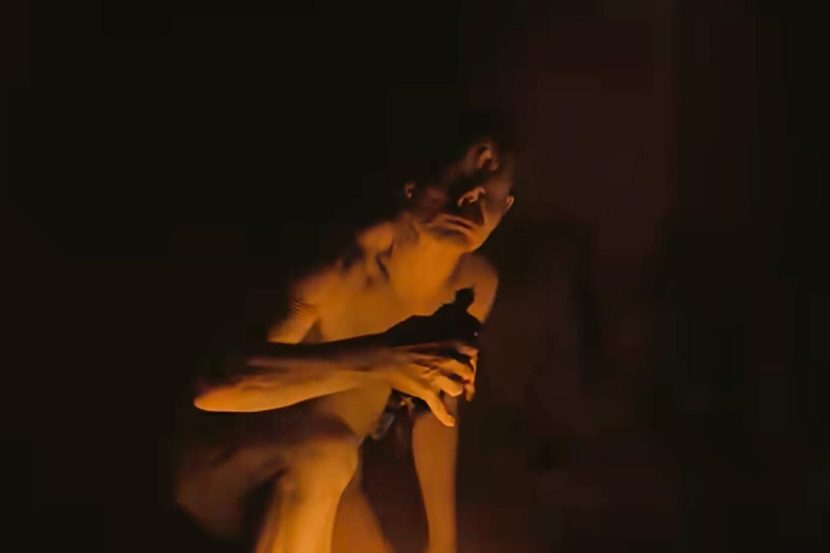
One of the most striking sequences in the film involves the confrontation between Odysseus and the Cyclops, Polyphemus. To achieve the terrifying reality of a sixty-foot monster, the production bypassed traditional CGI character models.
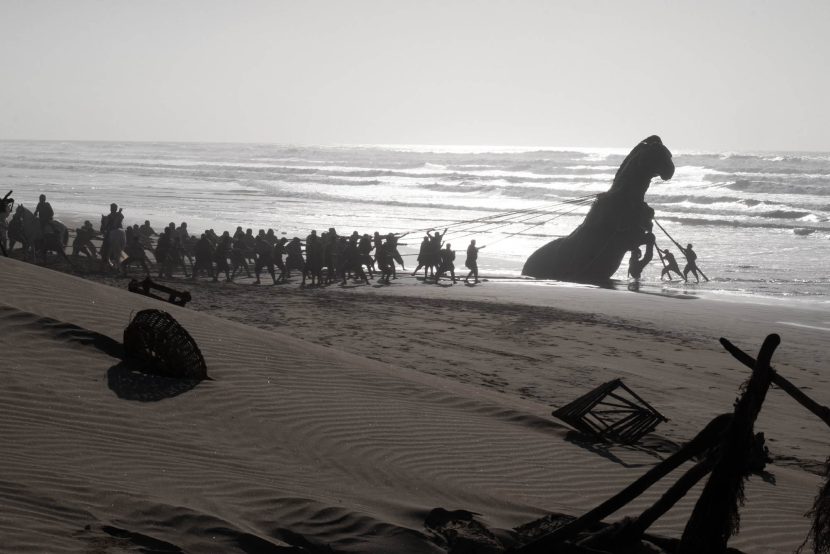
Instead, they turned to Bill Irwin, the veteran theatrical clown and actor who previously provided the motion and performance foundation for the robots in Interstellar. Irwin performed the role in full-body prosthetics, filmed on a specialized stage to allow for the massive scale manipulation. During the location shoots in Greece, a colossal, practical puppet was used on set, with Irwin providing the Cyclops’s voice in real-time. This provided the actors—specifically Damon—with a genuine physical anchor. They weren’t reacting to a tennis ball on a stick; they were reacting to a breathing, groaning, and terrifying presence.
For the Laestrygonian giants, the team employed a different "sleight of hand." By utilizing forced perspective, seven-foot stunt performers, and carefully selected undersized doubles, Nolan managed to distort the viewer’s perception of distance and size. It is a technique that harkens back to the golden age of cinema, updated with 21st-century optics.
Supporting Data: The Economics of Immersion
The $250 million budget for The Odyssey is a significant investment in the "Nolan method." Industry analysts have noted that while the production costs are higher than a purely digital alternative, the film’s unique selling point—the IMAX 70mm "purity"—has driven record-breaking engagement.
DNEG’s contribution cannot be overstated. By acting as the "invisible" layer, they allowed the cinematography to remain the star of the show. In scenes where the gods intervene, the film avoids glowing portals and laser-light shows. Instead, Nolan opts for natural phenomena—the shifting of tides, the sudden onset of storms, or the play of light through a cave—that ancient civilizations might have interpreted as divine intervention. This creative choice serves to reconcile Homeric fantasy with the cold, hard reality of the Mediterranean landscape.
Official Responses and Critical Discord
As is customary with a Christopher Nolan release, the critical reception has been marked by spirited, often polarized, debate. The VFXShow podcast, a long-standing authority on the intersection of technology and film, recently dedicated an entire episode to the technical merits of The Odyssey.
The hosts—Matt Wallin, Jason Diamond, and Mike Seymour—found themselves in a familiar position: total disagreement. While there is universal praise for the sheer ambition of the cinematography, the debate regarding the efficacy of the "practical-first" approach remains heated.
"The question," says Mike Seymour, "is where the practical filmmaking ends and the visual effects begin. Does the attempt to ground these myths in reality actually diminish the sense of wonder, or does it heighten the stakes?"
The disagreement underscores a broader shift in Hollywood. We are currently witnessing a tug-of-war between the convenience of generative digital effects and the painstaking, labor-intensive craft of physical production. Nolan remains the vanguard of the latter, pushing for a version of cinema that feels weighted, tactile, and dangerously real.
The Implications for Future Filmmaking
The success (both commercial and technical) of The Odyssey carries profound implications for the film industry. By successfully utilizing IMAX 70mm for a fantasy epic, Nolan has proven that scale does not require a total departure from reality.
- The Death of the "Volume": As films shift away from LED-wall dependency, we may see a resurgence in location-based, practical-heavy production.
- Performance Integrity: The use of actors like Bill Irwin in prosthetic roles challenges the current industry reliance on motion-capture performance, suggesting that human presence still holds a unique, irreducible value.
- The IMAX Standard: By pushing the boundaries of what IMAX cameras can capture, Nolan has set a new technical floor for "Event Cinema." Future blockbusters will now be compared against the visual fidelity of The Odyssey.
Conclusion: A Mythic Disagreement
Can a ten-year, perilous voyage finally bring us to a shared opinion on Christopher Nolan’s work? If the recent discourse is any indication, the answer is a resounding no. Yet, in that disagreement lies the true value of the film.
The Odyssey is not a passive viewing experience. It is a provocation. It demands that the audience engage with the spectacle, debate the ethics of its production, and grapple with the sheer, overwhelming effort required to put the impossible onto a 70mm strip of film.
Whether one finds the film to be a masterpiece of tactile realism or an exercise in over-engineered stubbornness, one thing is certain: the gods of Olympus have been brought to Earth, and they look exactly as frightening and as real as Homer intended. As we continue to dissect the techniques—the puppetry, the prosthetics, and the invisible digital work—we find that Nolan hasn’t just made an adaptation; he has created a new point of reference for what it means to tell a story on the grandest possible scale.
The podcast continues, the debates rage on, and the "suitors" of modern film criticism are left with a screen that is as vast as the sea itself. One thing is for sure: the industry will be chasing the ghost of this production for years to come.