
Thirty years ago, the Hollywood satire Bowfinger used the absurd concept of "Chubby Rain"—aliens hiding inside raindrops—as the ultimate punchline for a low-budget, Z-grade sci-fi disaster. It was a joke about the desperation of failing producers and the lack of imagination in the film industry. Today, Netflix’s latest thriller, The Last House, has taken that very joke, given it a high-budget polish, and presented it with a straight face as a serious COVID-19 parable. The result is a film that feels less like a cinematic evolution and more like a soggy, 100-minute exercise in narrative dissonance.
The Premise: A Pandemic Parable in a Downpour
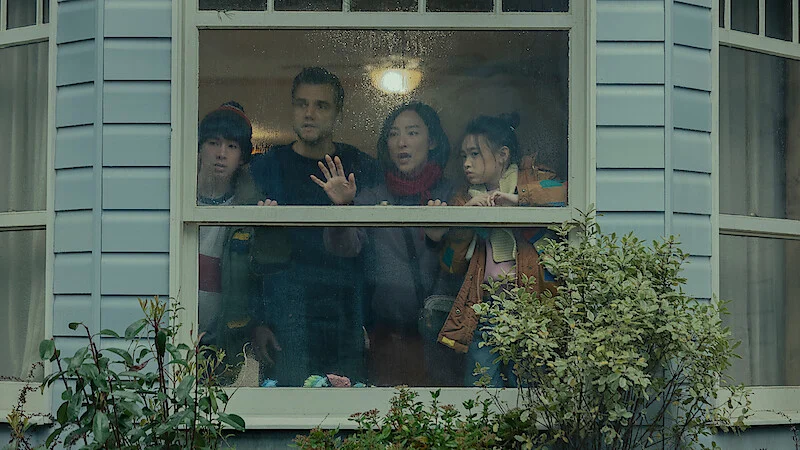
Directed by Louis Leterrier (Fast X, Lupin), The Last House traps a family in their Seattle home during an inexplicable, seemingly sentient rainstorm. The precipitation is so thick and "chubby" that it acts as a physical barrier, sealing doors and rendering windows unbreakable. The outside world is essentially deleted, forcing the Delgado family—father Jason (Wagner Moura), mother Ann (Greta Lee), and their two children, Graham and Ruth—to survive in a state of indefinite, forced quarantine.
The film leans heavily into the aesthetics of the early 2020s social-distancing era. Neighbors communicate via poster boards through windows, digital connectivity is severed, and the family is left with nothing but their own domestic dynamics and a handful of physical media. It is a premise that attempts to mine the collective trauma of the global pandemic, yet it does so with a logic so flimsy that it collapses under the slightest scrutiny.
Chronology of a Failed Survival Thriller
The narrative trajectory of The Last House follows a predictable, albeit frustrating, path:
- The Onset: The rain begins as a standard Seattle storm, but quickly shifts into something supernatural. The "welding" of the home creates immediate, high-stakes tension.
- The Adaptation: The middle act focuses on the family’s attempt to maintain normalcy. They establish routines, scavenge for food, and attempt to maintain morale. This is where the film attempts to find its "heart," focusing on the domestic ingenuity of the parents.
- The Unraveling: As resources dwindle and the psychological toll of isolation mounts, the family begins to fracture. The "chubby rain" monsters—shadowy figures that stalk the yard—begin to manifest more frequently, driving the family toward a breaking point.
- The Climax: The film concludes with a reveal that aims for grand scale but lands with a thud. The mystery behind the rain is solved in an anticlimactic sequence that leaves more questions than answers, providing little satisfaction for the viewer who has spent an hour and a half watching the family stare out of windows.
Supporting Data and Production Context
While the script by Matthew Robinson is thin, the production design by Kevin Jenkins stands out as the film’s only truly realized element. Jenkins created the Delgado home from the ground up, designing it to reflect the psychological state of the family. The house rots, shifts, and "sinks" alongside the characters, providing a visual metaphor for their deteriorating sanity.

However, the film’s reliance on CGI to depict the rain and the shadowy antagonists frequently undermines the grounded, character-driven story the director claims to be telling. The visual effects, while polished, often distract from the performances of leads Wagner Moura and Greta Lee. Both actors, clearly overqualified for the material, bring a level of gravitas to the roles that the script simply does not support. They are tasked with portraying profound loss and existential dread, yet they are trapped in a film that moves too quickly to allow for any genuine emotional catharsis.
The Implications: Streaming Content and the "Clip-Farm" Aesthetic
The most striking implication of The Last House is its existence as a "streaming-first" product. The film is paced with an urgency that suggests it was designed for viewers who might be multitasking. Scenes rarely last longer than 20 seconds before a shift in tone or a jump-scare occurs. It feels tailor-made for the era of social media fragmentation, where films are increasingly edited to be sliced into clips for TikTok or Instagram, rather than consumed as a cohesive narrative experience.
This "clip-farm" aesthetic is detrimental to the film’s character development. We know almost nothing about the children, Graham and Ruth, other than their function as plot devices meant to heighten the danger of the monsters appearing behind them. The lack of depth makes the family’s inevitable unraveling feel manufactured rather than earned.
Official Reception and Critical Consensus
Since its release on Netflix, the film has faced significant backlash for its lack of internal logic. When the characters wonder about the government’s involvement, the audience is left wondering why the film bothered to raise the question at all. It is a "witless" endeavor, according to critics, that fails to reconcile its own internal rules.
- Logic Gaps: The film never explains the physics of the "chubby rain" or why it chooses to lock doors instead of simply invading the home.
- Thematic Inconsistency: While it touches on environmentalism and the fragility of modern society, these themes are abandoned in favor of generic, monster-movie jump-scares.
- The Verdict: The consensus is that the film is a wasted opportunity. By trying to combine the trauma of the pandemic with a B-movie creature feature, it fails to succeed at either.
A Puddle of Potential
The Last House ultimately serves as a case study in why some concepts are better left as punchlines. In Bowfinger, "Chubby Rain" was a joke about the absurdity of film production. In the hands of modern streamers, that same absurdity is presented as a high-concept thriller, and it is revealed to be hollow.

The film is a "washout" in every sense. It is a movie that attempts to be a mirror to our recent history, yet it lacks the depth to reflect anything other than its own confusion. With a run-time of 100 minutes that feels double that length, it is destined to be forgotten as quickly as the rain it depicts dries up.
Final Analysis
For those seeking a thoughtful exploration of isolation, this film offers only a superficial glance at the topic. For those seeking a thrill, the monsters are too poorly defined to provide genuine scares. It is a "thimble of pandemic PTSD" spread thin across an hour and a half of unrewarding footage.
In the final assessment, The Last House earns a Grade: C. It is a testament to the fact that while technology can create a house that sinks and rots on command, it cannot manufacture the soul required to make a story matter. The rain may be chubby, but the narrative is dangerously thin.
Technical Specifications:
- Director: Louis Leterrier
- Writer: Matthew Robinson
- Starring: Wagner Moura, Greta Lee, Noah Alexander Sosnowski, Riley Chung
- Platform: Netflix
- Run Time: 100 minutes