Beyond the Spotlight: Alden Ehrenreich on Craft, Complexity, and the Lessons of a Career in Flux

[Editor’s note: This interview was originally conducted on September 15, 2026, at the Toronto International Film Festival. Bleecker Street is set to release "A Talent for Murder" in theaters nationwide on Friday, October 23.]
The atmosphere inside the Toronto hotel suite is, to put it mildly, incongruous. It is 10:00 AM, yet the room is saturated with the kind of swelling, cinematic orchestral score typically reserved for the third-act revelation of a psychological thriller. It is music that demands gravity, that insists on profound confessions. Sitting across from Alden Ehrenreich, it becomes clear that we are caught in a strange, performative vacuum.
"This is not a room that you usually spend time in in the morning," Ehrenreich notes with a wry smile, acknowledging the absurdity of our soundtrack. It is a fitting backdrop, however, for an actor whose career has been defined by a constant navigation between the crushing weight of blockbuster expectations and the quiet, rigorous pursuit of artistic integrity.
A Talent for Complexity
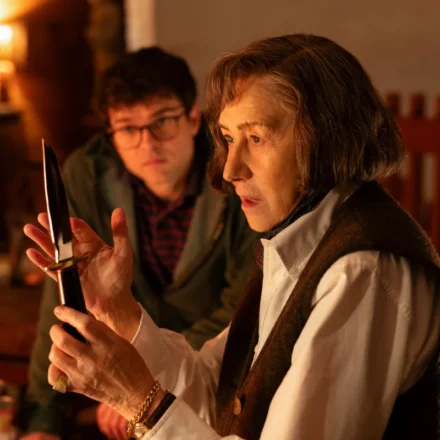
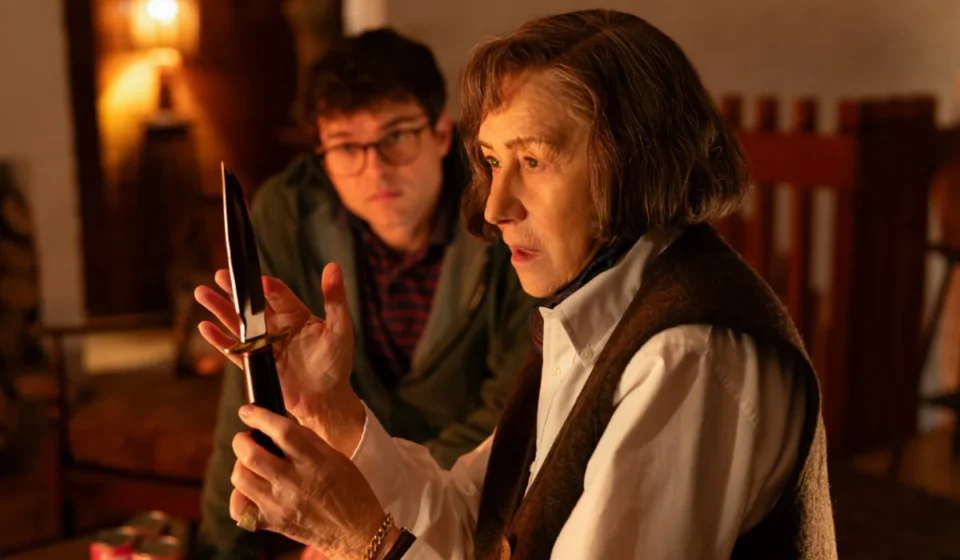
Ehrenreich is in Toronto to support Anton Corbijn’s latest feature, A Talent for Murder, which has already begun to generate significant buzz following its festival debut. In the film, Ehrenreich portrays Edward, a representative for a New York publishing house tasked with a daunting mission: traveling to Switzerland to convince the legendary Patricia Highsmith—played with formidable intensity by Helen Mirren—to pen a sixth Tom Ripley novel.

The film is not merely a literary exercise; it is a meta-commentary on the nature of identity and influence. As the narrative unfolds, Edward and Highsmith begin to collaborate on a story that envisions Edward himself inhabiting the Tom Ripley persona. For Ehrenreich, the appeal of the role lay in its subversion of the "Ripley" archetype.
"It’s a much more interesting way into that character than just it being ‘a Tom Ripley movie,’" Ehrenreich explains. "When you step into a role that has such massive, established preconceived notions, the audience comes in with a set of expectations. By framing it through this collaborative, almost voyeuristic lens, we get to explore the sociopathy of Ripley without being beholden to the traditional beats."
The Chronology of a Craftsman
Ehrenreich’s journey to this moment has been anything but linear. From his early days as a young talent to the high-stakes pressure of headlining a Star Wars franchise film, he has navigated the industry with a mix of cautious optimism and a self-imposed distance from the "noise" of the press.
His recent career trajectory, however, marks a pivot toward theater and character-driven drama. Earlier this year, Ehrenreich secured a Tony Award for his powerhouse performance in Becky Shaw, a production that allowed him to flex muscles he had been developing since his twenties, when he first managed a theater company.

"I’ve always had a theater company in my twenties, and I’m opening a theater in Los Angeles at the moment," he says. "It’s a huge part of my life, but I’d never done a professional play. There was something about Becky Shaw—I just knew I was this guy. I couldn’t wait to do it."
This transition into theater has fundamentally altered his approach to film. By treating his cinematic roles with the same physical and psychological rigor required for the stage, Ehrenreich has found a new level of creative autonomy. Even in Oppenheimer, where he played a pivotal supporting role, he channeled the "old school classical patriotism" of a Jimmy Stewart-esque archetype, downplaying the historical irony of his character’s interactions with the Kennedy legend to emphasize a sense of misplaced, albeit earnest, optimism.
The "Urkel" Theory of Acting
In a moment of levity that breaks the heavy atmosphere of the room, Ehrenreich draws a surprising comparison to explain the dual nature of his performance in A Talent for Murder. When discussing the challenge of balancing two disparate versions of his character, he invokes the transformation of Steve Urkel in the classic sitcom Family Matters.
"He gets to play the cool version of Urkel—Stefan Urquelle," he says, laughing. "It’s a very exciting draw to get to do both of those things at the same time and figure out how to do them."

It is a charming, self-deprecating observation, but it speaks to the core of his process: the ability to compartmentalize and inhabit different psychological states. By shooting the "Ripley-esque" sequences first in Rome, Ehrenreich established the physicality of the character, allowing him to ground his later, more contained scenes with Helen Mirren in a lived-in, dangerous reality.
The Price of Public Scrutiny
One of the most defining aspects of Ehrenreich’s maturation as an actor is his decision to stop reading his own press. It is a defensive mechanism born of hard experience. Reflecting on his early roles, such as Beautiful Creatures—a project that arrived with the weight of being the "next Twilight" only to result in a "non-event"—Ehrenreich articulates a philosophy of detachment.
"I was 22, 23 at the time," he recalls. "It’s been a gradual learning over the years that that side of things is just not my purview. How well things or how poorly things go changes in an instant. The main thing that’s real is that I just feel really grateful that I get to work."
This outlook serves him well when discussing his time in the MCU or his tenure as Han Solo. Rather than dwelling on the "what-ifs" or the box office disappointments of the past, he focuses on the collaborative spirit of the projects. "I’m pretty illiterate when it comes to the MCU," he admits, "but I approach it the same way I approach everything. You throw yourself into it, and you do your best."

Implications: The Long Game
As we discuss the broader implications of his career, Ehrenreich shifts the conversation toward his artistic inspirations. He speaks with reverence about Marlon Brando and John Cassavetes—artists whose careers were often marked by "disappointment" in the eyes of their contemporaries, yet whose legacies remain untarnished by the pursuit of short-term success.
"The short-term gain of a certain success can cost you the integrity of a lifetime," he reflects. "And then no one really cares or remembers anyway about how the thing did or didn’t do. It really is about the thing itself."
This is the central takeaway of our forty-minute conversation: Alden Ehrenreich is no longer interested in the "thumbs up or thumbs down" of the coliseum. He is focused on the work, the theater, and the "flame at the center" that keeps his artistic drive lit.
As our time concludes, the dramatic music continues to hum in the background, but the irony is no longer as sharp. It feels less like a manufactured soundtrack and more like the appropriate ambient noise for an actor who has finally learned to embrace the quiet, meaningful work that exists beyond the headlines.

"I’m still kind of in it at that point," he says of his process. "Little rituals to get out of it and shift gears… that’s the process."
With A Talent for Murder, and a slate of upcoming creative ventures, it is clear that Ehrenreich is not just shifting gears—he is driving, with newfound clarity, into a future of his own making.