The Ghost in the Machine: Dong Jie’s Zoom In, Zoom Out Explores the Digital Afterlife of Human Connection

In the landscape of contemporary Chinese cinema, few debuts have arrived with as much conceptual weight as Dong Jie’s Zoom In, Zoom Out. Premiering at the prestigious Venice Critics’ Week, the film serves as a poignant, genre-bending meditation on the nature of intimacy in the digital age. While the film is ostensibly structured around a missing-person mystery, Dong—a graduate of the Beijing Film Academy and a former editor of critically acclaimed works like Summer Blur—is far less interested in the mechanics of a disappearance than in the haunting, fragmented portrait it leaves behind.
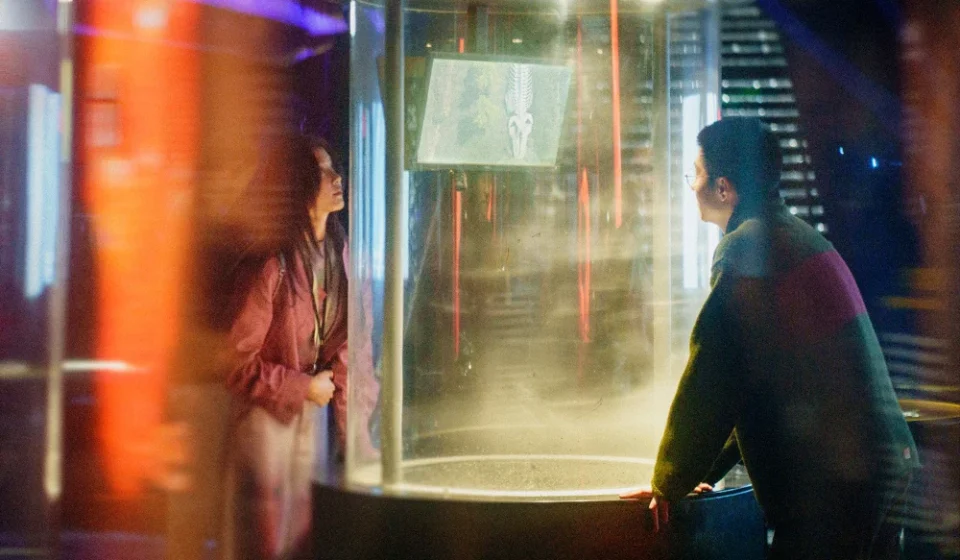
Zoom In, Zoom Out follows Shi, a young game designer tasked with navigating the void left by his missing roommate, Gao. As Shi traverses the city, his search pulls him into an unlikely orbit with Gao’s girlfriend, YY. Together, they attempt to reconstruct the missing man’s identity, not through physical presence, but through the digital detritus of a life lived online: chat logs, saved game avatars, and the lingering echoes of stored memory.
The Chronology of a Creative Vision
Dong Jie’s journey to the Venice stage is the result of a deliberate, multi-disciplinary evolution. Growing up in Shanghai, Dong first honed his craft in the editing rooms of notable independent films, including Are You Lonesome Tonight?. His transition to director was signaled by his short story collection, The Gap of Migration, and his 50-minute thesis film, Break, which garnered attention at the Pingyao International Film Festival and the Beijing International Short Film Festival.
For his feature debut, Dong assembled a team capable of balancing technical precision with emotional vulnerability. Starring Sun Yang and Zhao Tian’ai, the film was produced by Cao Shanshan of Do Something Films, with cinematography by Li Zhong and an evocative score by Hank Lee. The film’s development was characterized by a meticulous commitment to its central conceit: that the digital world is not a separate sphere of existence, but a woven layer of our daily reality.
Digital Traces and the Architecture of Absence
A central pillar of the film’s narrative is the use of an in-house, custom-built video game. Rather than relying on high-budget visual effects to simulate a "virtual world," Dong’s team chose to build a functional, intentionally rough-hewn game.
"We did not want to turn the game into a spectacle," Dong explains. "The game is simply the game, and visually, it should feel like itself." This decision proved to be an aesthetic triumph; the mechanical movements and unpolished modeling of the avatars paradoxically made it easier for audiences to perceive the human emotions invested in them. By refusing to artificially distinguish between reality, memory, and the virtual, Dong allows the film’s emotional current to flow seamlessly between these mediums.
The digital footprints left by the missing Gao act as a Rorschach test for the characters who remain. As Shi and YY sift through data, they are driven by a complex cocktail of motives: a sincere desire to understand their friend, a voyeuristic impulse to pry, and an inherent need to play. Dong suggests that the picture they eventually piece together says far more about their own insecurities than it does about the missing man.
Official Insights: The Director’s Philosophy
In a series of exclusive reflections provided to Variety, Dong Jie articulated the core questions that drove his script. "Why is it that we only begin to reconsider what someone means to us after they disappear?" he asks. "Do we really care about them, or are we confronting a deeper sense of unease within ourselves?"
Dong views this "delayed reckoning" as the defining paradox of modern social life. In an era where we can remain constantly connected via instant messaging and social media, the full weight of a person’s significance often only hits us once they "go offline forever."
Perhaps most provocative is Dong’s exploration of jealousy. While the genre often sidelines this emotion, Dong places it at the center of the Shi-Gao-YY dynamic. "We are often ashamed to talk about jealousy, but to me, it is one of the most universal and authentic emotions between people," he notes. "Ultimately, this jealousy transcends the boundaries of love or sexuality. What it truly exposes is Shi’s deep recognition of and longing for Gao."
Implications: The Spiritual Outlook of a Generation
Producer Cao Shanshan has characterized the film as a definitive reflection of the "spiritual outlook" of China’s youth. Dong agrees, noting that his generation is marked by a deep, almost paralyzing sense of contradiction.
"Today, my generation is unusually preoccupied with the self," Dong observes, pointing to the modern obsession with psychological categorization and the constant cultural messaging surrounding the mandate to "love oneself." He argues that when people have no clear space to anchor their morality and meaning, those needs migrate into abstract digital narratives. Zoom In, Zoom Out functions as a reclamation of the tangible—an attempt to prove that meaning can still be found in the difficult, messy work of living alongside others.
Furthermore, the film challenges the standard cinematic tropes surrounding technology. While many filmmakers gravitate toward dystopian, anti-tech narratives, Dong consciously opts for a more nuanced, even optimistic, perspective. "I wanted to accept the reality we live in and ask how we can live with technology now that it has fundamentally changed our lives," he says. "I believe we have to start by trusting that our world is real, and that our feelings, experiences, and relationships are real." When pressed on the inherent pessimism of his genre, he remains steadfastly, perhaps "blindly," optimistic.
Looking Toward the Future
The international debut of Zoom In, Zoom Out in Venice marks the beginning of a significant career trajectory for Dong Jie. For the director, the most meaningful aspect of the premiere is the realization that a story deeply rooted in his personal cultural context in Shanghai can resonate with audiences from radically different backgrounds.
As he looks toward his next project, Dong is already planning to pivot, expressing a desire to work within more defined genre frameworks while maintaining his distinct authorial voice. He views himself not as a traditional director, but as a polymathic creator—a writer, podcaster, and filmmaker who sees no hard boundaries between mediums. "Different mediums force me to think and create in different ways, while also inspiring one another," he says. "Ultimately, they are all ways of trying to understand people and the world."
For now, the film stands as a testament to a burgeoning talent who is unafraid to examine the gaps in our lives. By focusing on the "ghostly third presence" of a missing friend, Dong Jie has created a film that asks us to look closely at the screens we stare at every day—not to find an escape, but to find the reflection of our own humanity.
Variety is exclusively unveiling a clip from "Zoom In, Zoom Out," which can be viewed below:
[Link to embedded clip: https://www.youtube.com/embed/jlYbaqOKecY]
Key Takeaways
- Narrative Focus: The film centers on a missing person, but the "mystery" is a conduit for exploring jealousy, intimacy, and the lingering presence of the dead in a digital age.
- Aesthetic Choice: Rather than relying on CGI to simulate the digital world, the production developed a custom, low-fidelity game to ground the film in authentic human emotion.
- Thematic Depth: The director argues that our digital footprints are incomplete, and our attempts to assemble them tell us more about ourselves than the individuals we are tracking.
- Generational Commentary: The project acts as a critique of the hyper-individualistic "self-care" culture prevalent among modern Chinese youth, suggesting that real meaning is found in interpersonal connection rather than internal focus.
- Director’s Outlook: Dong Jie rejects the common dystopian cliches regarding technology, choosing instead to find a path for human connection within the reality of our current digital landscape.