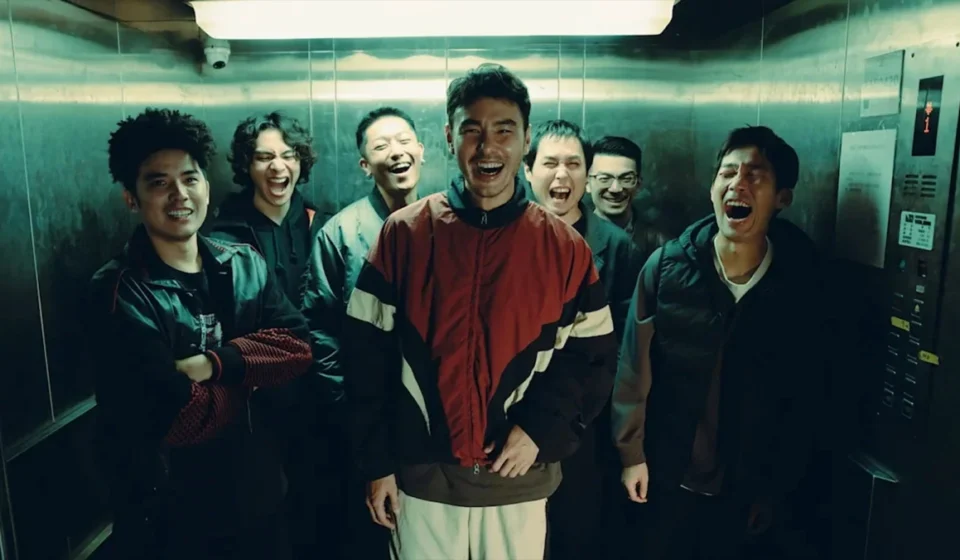
Venice 2026: Sabu’s ‘Arrested Memory’ is a Breezy, Bumbling Masterclass in Action-Comedy

By Alex Billington | September 7, 2026
In a film landscape often dominated by heavy-handed prestige dramas and somber, sociopolitical critiques, the 2026 Venice Film Festival has offered a much-needed jolt of adrenaline and absurdity. Veteran Japanese auteur Hiroyuki Tanaka—known globally by his mononym, Sabu—has returned to the international stage with Arrested Memory, a vibrant, chaotic, and relentlessly goofy action-comedy that serves as a reminder that cinema, at its core, is meant to be fun.
Filmed on location in the neon-drenched streets of Taiwan, Arrested Memory made its world premiere at the Venice Film Festival this week. It is scheduled to continue its festival circuit at the Toronto International Film Festival, where it has secured a coveted slot in the "Midnight Madness" program—a fitting home for a film that leans so heavily into the eccentricities of the genre.
The Premise: A Detective Who Can’t Remember the Crime
At the heart of Arrested Memory is Ethan Juan, who stars as Captain Lee, a high-octane police detective in Taipei with a reputation for being the city’s finest. However, the film subverts the "hard-boiled detective" trope almost immediately. Following a drug sting that spirals into a violent, trauma-inducing disaster, Captain Lee wakes up in a hospital bed with a severe case of amnesia.
The narrative hook is as simple as it is brilliant: Lee is tasked with solving a high-stakes kidnapping case involving the son of a prominent Japanese businessman, but he frequently loses the thread of his own investigation. As he navigates the criminal underworld, he suffers from intermittent dizzy spells and total memory lapses. One moment, he is interrogating a triad lieutenant; the next, he is staring blankly at a wall, wondering why he is holding a service pistol.
Sabu, who wrote and directed the project, wears his influences on his sleeve. The film functions as a love letter to the Hong Kong police comedies of the late 80s and early 90s, blending slapstick humor with stylized, kinetic action. Yet, there is a structural nod to Akira Kurosawa’s High and Low in the kidnapping plot, which serves as a grounding wire for the otherwise flighty, unpredictable protagonist.
A Chronology of Chaos
The film’s pacing is its greatest asset. Clocking in at a brisk 87 minutes, Arrested Memory refuses to overstay its welcome. It follows a rigid, yet intentionally fractured, chronology:
- The Setup: We are introduced to Captain Lee at the height of his powers, established through a series of flashy, high-energy sequences.
- The Incident: The botched drug raid, which serves as the film’s inciting incident, transitions the movie from a standard police procedural into a surrealist comedy of errors.
- The Middle Act: As Lee attempts to solve the kidnapping, the film leans into the "forgetful cop" trope. Scenes are constructed as miniature puzzles where the audience knows the stakes, but the protagonist remains blissfully unaware of his surroundings.
- The Climax: The plot converges in a chaotic, neon-lit showdown that avoids the usual "epic" conclusion in favor of something more understated, intimate, and—true to form—utterly ridiculous.
Supporting Data: Why It Works
While Arrested Memory may not be a candidate for the Golden Lion, it succeeds where many more ambitious films fail: it executes its premise with absolute commitment.
The film’s humor is derived from the unpredictability of Lee’s condition. Because the lead character cannot remember why he is in a room or who he is chasing, every scene becomes an exercise in improvisation. Sabu expertly balances the "dumb" humor with genuine, if lightweight, societal commentary.
The police force in the film is depicted as a collective of buffoons—inept, ego-driven, and largely useless in the face of actual crime. In a brilliant subversion of the genre, the "brains" of the investigation ends up being a local junkie who happens to possess the information Lee keeps forgetting. This creates a fascinating dynamic: the hero is a man of status who has lost his mind, while the "savior" is a man of no status who holds the truth.
Furthermore, Sabu uses Lee’s memory lapses to highlight the peripheral victims of urban crime. Because Lee is frequently distracted by his own cognitive failures, he inadvertently stumbles into the lives of citizens—mostly women—who are being ignored by the hyper-masculine, drug-obsessed police force. It is a subtle, effective way to critique the tunnel vision of modern law enforcement.

Official Responses and Industry Reception
The initial reaction at Venice has been largely positive, with many critics praising the film’s refreshing lack of pretension. During the post-screening Q&A, Sabu noted that he wanted to capture the "feeling of living in a world that is moving too fast for us to keep track of."
"We are all Captain Lee sometimes," Sabu remarked. "We walk into a room and forget why we are there. We chase things—money, success, power—and forget the people we are supposed to be protecting."
Industry insiders have noted that while the action choreography is not as visceral as some of the high-budget martial arts epics coming out of the region, the film’s "propulsive energy" makes up for the lack of technical polish. The decision to set the film in Taiwan was praised for its aesthetic, though some critics pointed out that the location functions more as a backdrop than an essential character.
Implications: The Future of Action-Comedy
Arrested Memory arrives at a pivotal time for global cinema. As audiences grow increasingly fatigued by the weight of massive franchise tentpoles, there is a renewed appetite for "smaller" genre films that prioritize character, humor, and inventive storytelling over CGI spectacle.
The film suggests a potential shift in the "action" genre toward more character-driven, self-aware narratives. By stripping away the ego of the protagonist, Sabu invites the audience to laugh with the absurdity of the situation rather than just observing it.
Is the film perfect? Far from it. The kidnapping plot is undeniably flimsy, and the antagonists are, for the most part, two-dimensional caricatures of gangsters. However, these flaws feel intentional. Sabu isn’t trying to make a gritty crime thriller; he is using the framework of one to build a playground for his own brand of chaotic, character-focused humor.
Conclusion: A Smiling Recommendation
For those who can appreciate a film that doesn’t take itself seriously, Arrested Memory is a delightful, satisfying experience. It is a testament to the fact that you don’t need a massive budget or a complex narrative to make an impact—sometimes, you just need a great lead actor, a bizarre concept, and the confidence to let things fall apart.
As I sat in the theater, surrounded by the laughter of a diverse international audience, it became clear that Sabu has once again proven his longevity. He understands the mechanics of a "good time." While the style may be considered "generic" by some high-brow purists, the execution is anything but.
Arrested Memory is a breezy, charming, and genuinely funny film that reminds us that, even when the world is upside down and our memory is failing, we can still find a reason to smile.
Alex’s Venice 2026 Rating: 7 out of 10
Follow Alex on Twitter @firstshowing / Or Letterboxd @firstshowing