
[Editor’s Note: This feature contains significant spoilers for the series premiere of "Lanterns," including the episode’s closing sequence. For a spoiler-free analysis of the series’ trajectory, please refer to our full season review.]
"Shit, am I dead?"
The first words uttered by the holographic projection of Hal Jordan (Kyle Chandler) serve as a haunting punctuation mark to the premiere of HBO’s Lanterns. It is a question that lingers long after the credits roll, challenging the audience to parse through the dense, atmospheric mystery established by showrunners Chris Mundy, Damon Lindelof, and Tom King. In an opening hour that balances grounded police procedural tropes with the cosmic stakes of the DC Universe, the series has managed to pull off a narrative bait-and-switch that leaves the status of its lead character in profound doubt.

The Main Facts: A Decade-Spanning Mystery
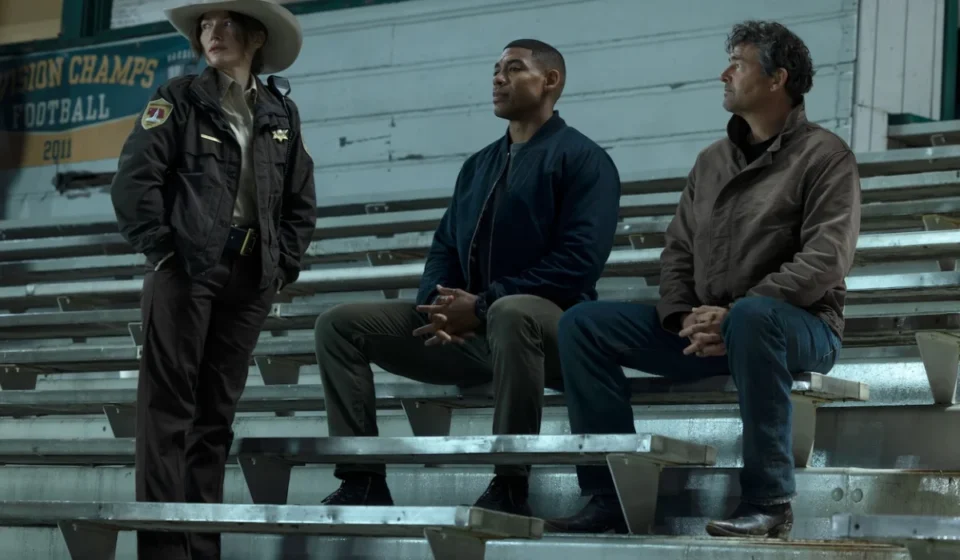
The premiere episode, titled "Pilot," wastes little time establishing a dual-timeline narrative. We are introduced to the central inciting incident: a mass casualty event on a high school football field in rural Nebraska, circa 2016. Four victims—all appearing human, all discovered wearing identical attire—lay dead in a scene that defies conventional forensic explanation.
However, the episode’s most shocking revelation arrives in its final moments. The narrative leaps forward ten years to 2026, dropping the viewer into a frozen, desolate Nebraska landscape. We find John Stewart (Aaron Pierre), now sporting a weary, bearded countenance, arriving via a standard SUV to identify a corpse. The body is that of his former mentor, Hal Jordan. The scene is grim: Jordan is dead, his iconic Power Ring is missing, and a singular bullet hole marks his forehead. The presence of snow on his graying hair suggests he has been exposed to the elements for some time. The contrast between the high-octane, neon-drenched mythology of the Green Lantern Corps and this cold, quiet, and profoundly human death is jarring, signaling that Lanterns is not a traditional superhero epic, but a meditation on mortality, legacy, and the heavy toll of power.
Chronology of a Crisis
To understand how the story arrived at this tragic flash-forward, one must examine the progression of the "Pilot." The case begins with a call from the "Hal-o-gram," a sophisticated, albeit limited, backup consciousness of Jordan that monitors regional anomalies.

- The Inciting Incident: A winning field goal at a Rushville, Nebraska, football game triggers a stampede. Amid the chaos, four individuals are killed. While local law enforcement, led by Sheriff Kane (Kelly Macdonald), suspects a tragic outburst of human violence, Jordan’s intuition—honed by decades of dealing with extraterrestrial threats—suggests otherwise.
- The Investigation: Jordan and Stewart engage in a tense investigation that highlights their disparate backgrounds. Jordan’s suspicion is validated when they encounter a survivor, "Waylon Sanders," who proves to be an alien infiltrator. The revelation leads to a high-stakes confrontation where the truth about an intergalactic "war" of vengeance is teased just before the suspect detonates a self-destruct mechanism.
- The Flash-Forward: The episode concludes with the 2026 discovery, fundamentally changing the viewer’s perception of the preceding hour. If the "Hal-o-gram" is the only version of Jordan we see in the future, is the "real" Hal Jordan truly gone? Or is this a sophisticated misdirection?
Supporting Data: The Anatomy of a Genre Shift
The stylistic choices made by Mundy, Lindelof, and King suggest a deliberate pivot away from the "Green Lantern" tropes that hampered previous adaptations. By placing the characters in the heart of Nebraska, the show leans into the "small-town conspiracy" aesthetic, reminiscent of Lindelof’s previous work on Watchmen.
- The Power Dynamics: The relationship between Jordan and Stewart is defined by friction. Jordan is presented as a man who has traded personal connections for a sense of "fearlessness," a trait that Sheriff Kane astutely deconstructs as profound loneliness. In contrast, Stewart’s arc is defined by generational trauma—specifically, his history with an abusive father who used him for "William Tell" style target practice.
- The Visual Language: Noticeably absent is the heavy reliance on CGI costumes. The showrunners have opted for a more grounded, cinematic look, favoring character-driven drama over the "pulsing veins" and "digital masks" that alienated audiences in the 2011 film. This is a "boots on the ground" approach where the ring is a tool, not a costume accessory.
- The Supporting Cast: The inclusion of characters like William Macon (Garret Dillahunt)—a wealthy, isolationist rancher—adds a layer of geopolitical tension. Macon’s concerns about "alien colonizers" serve as a mirror to the xenophobia often found in rural, insular communities, grounding the show’s sci-fi elements in recognizable contemporary anxieties.
Official Responses and Creative Intent
In interviews surrounding the premiere, the creators have emphasized that Lanterns is intended to be a "space-cop drama" first and a superhero show second. By focusing on the investigative process, the show avoids the common pitfalls of the genre.
"We wanted to see what happens when you take the most powerful weapon in the universe and put it in the hands of people dealing with very human problems," noted a production source. The choice to cast Kyle Chandler and Aaron Pierre was intentional, aiming for a grounded, dramatic gravity that standard comic book casting often overlooks. The decision to kill off—or seemingly kill off—a major character in the first episode is a statement of intent: in this series, no one is safe, and the mystery is the primary engine of the narrative.

Implications: The Road Ahead
The implications of the premiere are far-reaching. If Jordan is indeed dead in 2026, the series effectively transforms into a character study of John Stewart’s growth into his own as a hero, stepping out from the shadow of a mentor who was arguably more broken than he let on.
However, the "Hal-o-gram" leaves the door open for ambiguity. If Jordan can manifest tangible matter at will, is it possible he engineered his own "death" to investigate a deeper, more existential threat? The mention of a "war" and "vengeance" implies that the events in Rushville are merely the tip of the iceberg.
Furthermore, the show’s subtle nods to other HBO staples—such as the rhythmic ticking of a clock, a hallmark of the Watchmen series—suggests a meticulously layered puzzle. The audience is invited to play detective alongside Stewart, parsing through the lies told by local ranchers and the secrets hidden within the Corps itself.

As Lanterns continues its run, the primary question will not just be "who killed Hal Jordan," but "what kind of world requires a hero to be so lonely?" The show has set a high bar, offering a dark, contemplative, and highly compelling start that challenges the very foundation of what we expect from a Green Lantern story. By trading the emerald city of Oa for the dusty, unforgiving fields of Nebraska, HBO has successfully turned a cosmic myth into a visceral, human tragedy.
Whether this leads to a resurrection or a permanent departure for Hal Jordan remains to be seen, but one thing is certain: the mystery has only just begun.