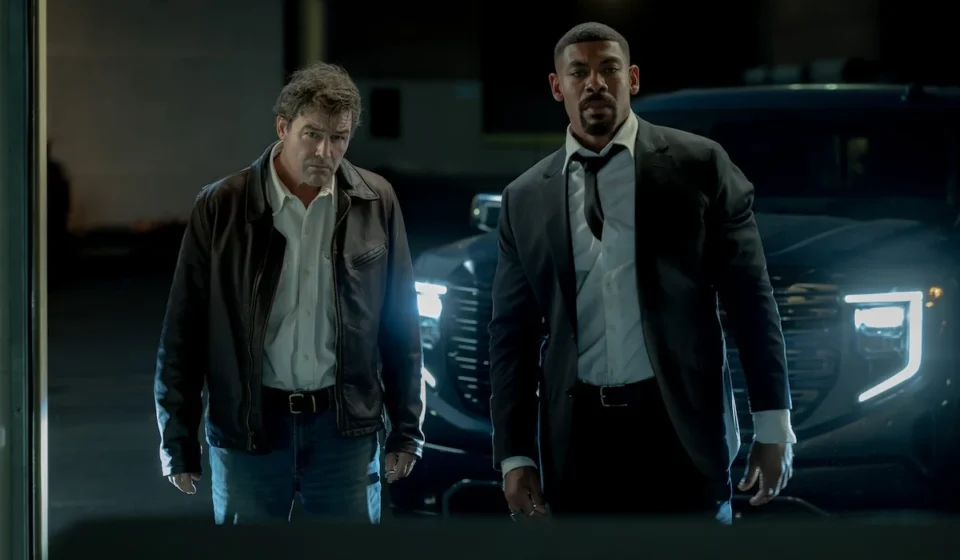

Editor’s Note: The following review contains major spoilers for "Lanterns" Episode 7, "The Jordan Boys," including plot resolutions and character developments. For a spoiler-free analysis of the series’ trajectory, please refer to our full season review.
The legacy of Hal Jordan—portrayed with a rugged, defiant brilliance by Kyle Chandler—has always been defined by a singular, stubborn refusal to yield. Whether he was instigating high-stakes intergalactic skirmishes or stubbornly guarding a pitching mound against a Little League coach, Jordan lived by his own code. It was a life lived at the edge of chaos, leaving a trail of bruised egos and international incidents in his wake. Yet, as Episode 7, "The Jordan Boys," poignantly reveals, that stubbornness was not merely a personality quirk; it was a psychological fortification, a shield constructed to hide a deep-seated fear of being "broken."
The Weight of Inheritance
The narrative of Episode 7 pivots on the "Jordan boys’ legacy," a chilling concept introduced by Hal’s father, Martin (Jake B. Miller). In a series of flashbacks that haunt the episode, we learn that the senior Jordan viewed his own depressive struggles as a hereditary curse, one he felt justified ending through a fatal plane crash. This generational trauma is the ghost that haunts Hal throughout his life.
The "Hal-o-gram"—the digital, backdated consciousness of Hal—serves as the vessel for this revelation. Unlike the living Hal, who was far too guarded to admit vulnerability, the Hal-o-gram provides the emotional honesty required for John Stewart (Aaron Pierre) to truly understand his partner. The episode masterfully contrasts the two: the man who could never let anyone in and the digital echo that, in its own strange way, is becoming something more human than the original ever allowed himself to be.

Chronology of the Investigation
While the episode is light on traditional detective work regarding Hal’s murder, it makes significant strides in world-building and character alignment. The investigation enters a surreal phase as John exhumes Hal’s grave, not for the body, but for the ring and the "fail-safe" box.
- The Fail-Safe Reveal: The container, an oddly mundane collection of gear—a canteen, protein bars, a gun, and a "dark matter manhole"—highlights Hal’s eccentric preparation. The inclusion of a portal to an alien world stored in a grocery bag is a masterclass in the show’s unique tone.
- The Antaan Connection: John and the Hal-o-gram venture through this portal to an inverted, floating city on an alien plane. Here, the horror of the Manhunter’s influence is laid bare: a gas-induced madness that forced a civilization to its death.
- The Sinestro Encounter: The journey culminates in a tense confrontation with Sinestro (Ulrich Thomsen). Contrary to early theories, Sinestro does not appear to be the primary suspect in Hal’s death, but rather a captive of a much larger, more existential mystery.
Supporting Data: Dissecting the Suspects
The narrative has spent seven episodes building a web of intrigue, yet "The Jordan Boys" intentionally narrows the field while adding layers of ambiguity.
The Case Against the Sheriff
Sheriff Kerry (Kelly Macdonald) remains a central figure, yet the theory that she is the killer feels increasingly like a red herring. The Hal-o-gram’s initial accusation of the Sheriff is treated with skepticism; the writers have displayed a penchant for using the Hal-o-gram as an unreliable narrator whose own biases—and perhaps corrupted data—lead to false conclusions. Her reaction to seeing the Hal-o-gram is one of genuine, raw emotion rather than the cold calculation of a murderer.
The "Noah" Factor
If the show is adhering to classic mystery tropes, the culprit must be someone currently hovering in the periphery. Noah (Shea Pritchard) has been positioned as a character of growing leadership. His "hat ceremony" this week, while seemingly disconnected from the central space-cop drama, serves to keep him relevant. Should the finale reveal Noah as the architect of the chaos, it would serve as a chilling reflection of the generational cycles of violence the show is so keen to explore.

The Sinestro Variable
The hooded figure holding a knife to Hal’s throat in past flashbacks is now clearly linked to the Sinestro storyline. However, the logistical gap—how a prisoner of intergalactic renown would access Hal’s private fail-safe—suggests that Sinestro is a piece of a larger puzzle rather than the perpetrator. He is a man desperate for an escape, not necessarily a man on a mission of retribution.
Official Perspectives: Man vs. Machine
One of the most fascinating aspects of this episode is the existential debate surrounding the Hal-o-gram. Is he merely an AI, or a digital consciousness capable of soul-level growth?
The scene between the Hal-o-gram and Sheriff Kerry is the episode’s emotional anchor. The Hal-o-gram explicitly states, "I’m not him. I’m not your Hal." This acknowledgment of his own limitation is what makes him endearing. He seeks closure not for himself, but for those the real Hal left behind.
Furthermore, the dynamic between John and the Hal-o-gram has shifted from adversarial to a burgeoning father-son bond. When John finally calls him "Hal," the weight of that word carries the history of their shared trauma and the potential for a new, healthier future. As noted by the Sheriff, Hal viewed John with the same exasperated, unconditional love one feels for a failing sports team—a "big fan" dynamic that serves as a beautiful, albeit melancholic, summation of their partnership.

Implications: A New Legacy
"The Jordan Boys" suggests that the ultimate resolution of the series will not be found in a court of law, but in the reconciliation of legacies. The gun provided in the fail-safe box might not be for a conventional killer, but for the existential threat posed by Sinestro or the "something" that Hal was trying to keep contained.
The episode ends with the realization that John Stewart is not just solving a murder; he is stepping into the void left by a man who couldn’t save himself. John’s willingness to pay "reparations" to the child of a victim—despite the astronomical cost—shows a moral clarity that Hal lacked.
Final Takeaways
- Character Depth: Aaron Pierre’s performance, particularly his commitment to portraying John’s lack of musical ability, grounds the character in a relatable reality that contrasts with the high-concept space opera.
- Thematic Resonance: The show is effectively using the "Jordan boys" concept to explore the cycle of trauma, specifically how men in the DC universe often use "stubbornness" as a proxy for emotional intelligence.
- Production Quality: The visual depiction of the upside-down alien city is a highlight of the season, showcasing the high-budget ambition of the series.
As we head into the season finale, the primary question is no longer "Who killed Hal Jordan?" but rather, "Can the survivors break the cycle?" The Hal-o-gram may be a synthetic creation, but the emotions he has helped elicit from John Stewart are undeniably real. He is, as the episode suggests, perhaps a "better" version of the man he was modeled after—and in a world as dark as this one, that is exactly what the Corps needs.
Grade: A-

Lanterns releases new episodes Sundays at 9 p.m. ET on HBO and HBO Max.