The Digital Cinematographer: How Framestore Redefined Virtual Production for Project Hail Mary

There is a profound, almost primal satisfaction in handing a cinematographer a dial that controls the sun. In the high-stakes, high-science world of Project Hail Mary—the eagerly anticipated adaptation of Andy Weir’s acclaimed novel—that level of control was not just a luxury; it was the foundation of the film’s production philosophy. Directed by Phil Lord and Christopher Miller, the film follows Ryland Grace (Ryan Gosling) on a desperate, physics-defying mission to save Earth. To bring this interstellar odyssey to life, the production team turned to Framestore Pre-production Services (FPS) to bridge the gap between imagination and physical set construction.
The collaboration, which spanned roughly a year at Shepperton Studios, saw FPS Realtime Supervisor Michael Zaman and Virtual Production Supervisor Connor Ling working in lockstep with VFX Supervisors Paul Lambert and Mag Sarnowska, DOP Greig Fraser, and VFX Producer Barrie Hemsley. The objective was clear: transform the digital environment into a responsive, intuitive film set that behaved with the same tactile reliability as a soundstage.
The Genesis of a Digital Set: Chronology of Collaboration
The integration of virtual production began in the earliest stages of the film’s development, nestled within production designer Charlie Wood’s art department. Because the spacecraft interiors were designed as disparate, modular sets, the team faced a spatial puzzle: how would these sections connect, and how would gravity—or the lack thereof—influence the audience’s perception of the ship’s internal geometry?

Phase 1: Virtual Prototyping
FPS created a complete digital twin of the spacecraft. This allowed the directors and department heads to "walk" through the ship long before a single bolt was tightened on the physical build. This phase was critical for identifying structural obstructions. By testing focal lengths and camera positions in VR, the team identified specific wall panels that would impede desired shots, allowing for "removable" design decisions to be made while the plans were still just pixels.
Phase 2: The Volume and Motion Capture
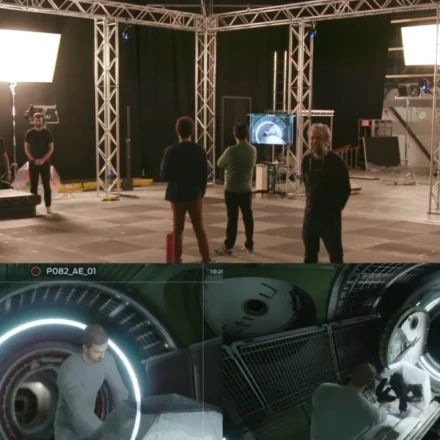
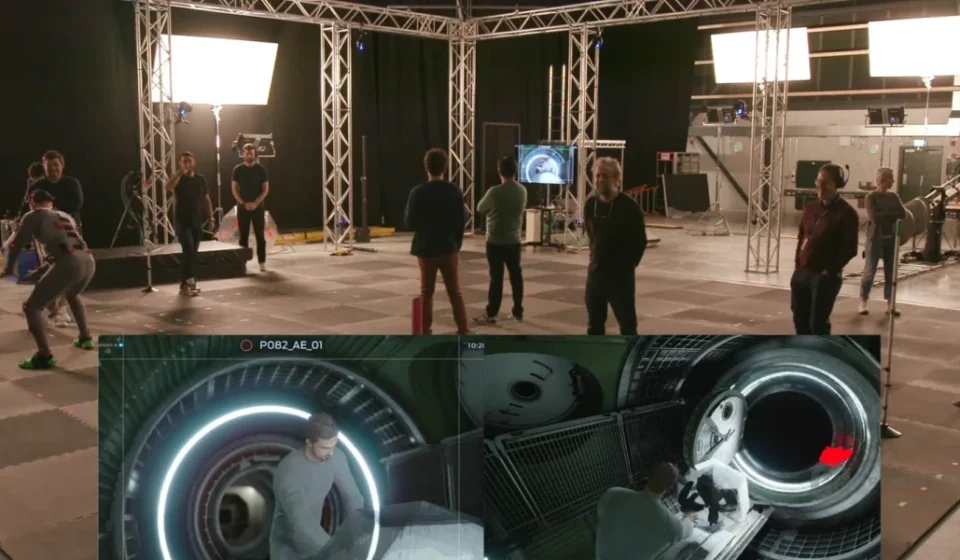
As the project transitioned into the motion-capture volume, the team utilized performer Josh Wichard to block out action. Rather than forcing the director into a pre-determined path, the FPS team maintained an "information-first" approach. They treated virtual cameras as tools for discovery, allowing Lord and Miller to experiment with blocking and framing without committing to a rigid, unchangeable direction.
Phase 3: The Simulcam Integration
Once the physical sets were built, the process moved to the stage. Using an Amazon MGM Studios Simulcam system, FPS provided live composites. Greig Fraser could stand on a partial set and look at a monitor to see the finished, digital exterior of the ship in real-time. This allowed him to adjust practical engine lighting to match the virtual environment, ensuring that the final, rendered image would have the cohesive look of a single, unified photograph.

Engineering the Intuitive: Technical Infrastructure
The success of Project Hail Mary relied on the ability of FPS to make digital tools feel "analog." As Michael Zaman astutely observed, "Digital can do anything; that doesn’t mean it should." The team’s goal was to restrain the infinite possibilities of the computer to serve the specific, disciplined language of cinematography.
Tactile Control and Bespoke Hardware
To keep Greig Fraser in his comfort zone, FPS built a bespoke physical mixing deck. This interface featured tactile dials, trackballs, and joysticks. Through these, Fraser could control exposure, manipulate the virtual sun along individual axes, and adjust the relationship between the ship and its astronomical surroundings.
The Optics Challenge
One of the most complex technical hurdles involved the film’s lens package. The production utilized an ALEXA 65 paired with vertically oriented anamorphic lenses to capture the specific IMAX-tall framing intended for the film’s space sequences.

Standard virtual camera software is often calibrated for horizontal sensors, making the vertical de-squeeze of these vintage-rehoused anamorphics a significant mathematical headache. FPS had to rewrite their virtual filmback calculations to accommodate these optics. When automated tracking systems failed to interpret the vertical, anamorphic data correctly, the recorded metadata—preserved by the team’s custom tooling—became the "ground truth" that VFX artists used later in the pipeline to ensure the digital environment matched the physical footage.
Data Management: FarSight Studio
FPS utilized FarSight Studio to record every virtual camera property, asset version, and lighting state. By capturing 60 hours of footage and roughly 2,000 video files during the virtual shoot, the team created a "digital archive" of the creative process. This was not just a backup; it was an active record of directorial intent. If a scene was revisited months later, the team could hit "reset" on the environment to match the exact conditions of the original shoot.
Supporting Data: By the Numbers
The scale of the virtual production effort on Project Hail Mary highlights the shift in how major tentpole films are managed:

- Timeline: Approximately one year of intensive development and pre-production at Shepperton Studios.
- Virtual Volume Intensity: The team operated within the motion-capture volume for 65 days.
- Creative Output: 1,096 distinct virtual-camera shots were captured during the volume sessions.
- Editorial Throughput: Two daily deliveries of rushes—morning and afternoon—ensured that the editorial team was always working with the latest versions of the virtual sets.
- Data Volume: 60 hours of total recorded footage and 2,000+ individual video files from the virtual sessions.
Official Responses and Methodology
"The goal was to render what he [Fraser] shot, not to change it at all," says Zaman. This philosophy permeates the entire Framestore approach. By providing the cinematographer with the ability to pull focus, adjust iris, and shift lighting in real-time, the virtual production team essentially gave the DP a camera that could see through the vacuum of space.
Connor Ling emphasizes that the technology functioned best when it functioned as an invisible support system. By mirroring the VR headset to a monitor in a "cinematic" view—stabilized and with controlled lens settings—the team avoided the motion sickness associated with raw VR feeds. This enabled the entire creative team to discuss shots collaboratively, turning the virtual space into a "digital village" where lighting, framing, and movement could be vetted by all stakeholders simultaneously.
Implications for the Future of Filmmaking
The work done on Project Hail Mary represents a maturing of virtual production. We have moved past the era where "volume" simply meant high-end projection screens. Instead, the focus has shifted toward the data pipeline—the ability to record, store, and translate the creative choices made in a virtual environment so they remain intact through the final render.

The Hybrid Future
The project proves that the future of cinema is not purely digital or purely practical, but a hybrid. By using LiDAR to map the physical set into Unreal Engine, the FPS team created a seamless marriage between physical construction and digital extension. This allows for a "fluid" production schedule where a planned jib shot can be converted to handheld on the fly, with the virtual background tracking perfectly behind the performer.
Democratizing Post-Production
Perhaps the most significant implication is the shortening of the feedback loop. By involving editorial from day one, and providing post-visualization that allowed for the refinement of characters like the alien "Rocky," the team ensured that emotional beats were locked in before final pixels were ever calculated.
In conclusion, the collaboration between Framestore and the Project Hail Mary production team serves as a masterclass in how to leverage modern technology to serve, rather than replace, traditional artistry. Greig Fraser was given the reach to move the sun, but he did so with the same light meter, the same lens logic, and the same creative intuition he would use on any film set. By providing a digital canvas that respects the constraints of physics and the demands of the lens, the team has set a new benchmark for what is possible in the modern sci-fi epic.