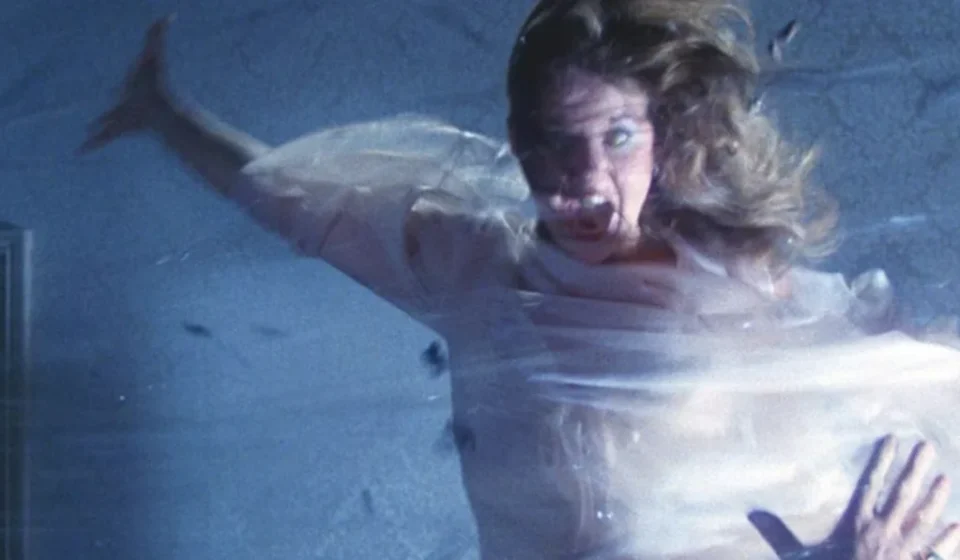
The Curse, The Craft, and The Heretic: Unpacking David Kittredge’s ‘Boorman and the Devil’

Editor’s note: This review was originally published on October 24, 2025, following its premiere at the 2025 Brooklyn Horror Film Festival. Yellow Veil Pictures will release the film at NYC’s Quad Cinema on Friday, August 28, with a national expansion to follow.
In the annals of cinematic history, few films have been as aggressively maligned, misunderstood, or memed as John Boorman’s 1977 production, Exorcist II: The Heretic. For nearly half a century, the film has served as a cautionary tale of hubris, a punchline for late-night talk shows, and a bewildering anomaly in the career of one of cinema’s most visionary auteurs. However, director David Kittredge’s revelatory new documentary, Boorman and the Devil, offers a profound, poetic, and ultimately necessary reframing of the project. It is a work as strange, ambitious, and deeply human as the ill-fated sequel it examines.
A Legacy Defined by Memes, Not Meaning
To the modern internet observer, Exorcist II is little more than a collection of bizarre artifacts. It is the film where James Earl Jones dons a giant, feathered locust costume; where Linda Blair tap-dances away the manifestations of her internal trauma; and where the narrative hinges on the "Synchronizer," a psychic apparatus so conceptually opaque that it allegedly forced unionized crew members to engage in heated, protracted debates over whether the device was intended to be a light source or a literal plot-driving prop.
Yet, as Boorman and the Devil argues with striking clarity, an embarrassment of behind-the-scenes chaos does not negate the artistic intent behind the lens. Kittredge’s documentary isn’t a simple "making-of" retrospective; it is a meditation on the cost of creativity. While it may not convince the hardened cynic that Exorcist II is an objective masterpiece—few documents could bridge that gap—it serves as a sparkling, sophisticated on-ramp to the history of New Hollywood and the idiosyncratic, boundary-pushing career of John Boorman.
The Architect of the Audacious: A Chronology of Risk
To understand why a director of Boorman’s caliber would touch the radioactive wreckage of an Exorcist sequel, one must look at the trajectory of his career leading up to 1977. Now 92 years old, Boorman’s resume is a testament to an artist who never once played it safe. From the black-and-white British New Wave sensibilities of Catch Us If You Can (1965) to the primal, visceral tension of Deliverance (1972) and the surreal, hallucinatory sci-fi bravado of Zardoz (1974), Boorman was a man who thrived in the margins of the mainstream.
When the studio system approached him to direct the original Exorcist, Boorman famously declined, preferring to pursue his own audacious visions. Yet, when they returned to him for the sequel, the landscape of Hollywood had shifted. The success of The Godfather Part II had signaled a new era of studio-sanctioned sequels, and Boorman, ever the philosopher of the screen, saw a unique opportunity. He was not interested in rehashing the demonic possession tropes of the first film; he was interested in the internal landscape of a traumatized psyche. He wanted to explore the "devil" not as a physical entity, but as a metaphor for the struggle between light and darkness within a survivor.
The Anatomy of a Near-Biblical Failure
Boorman and the Devil does not shy away from the cold, hard metrics of the film’s failure. It was a financial disaster that failed to recoup its $15 million budget and garnered no critical acclaim upon its initial release. However, Kittredge positions this failure as a "nightmare" that was, for those involved, far more poignant than a mere box-office flop.

The production was a masterclass in mismanagement. Warner Bros. had engaged in a blind bidding war for the project, purchasing the rights based on a scant pitch and the promise of talent. As the budget ballooned from an initial $12.5 million to $15 million, the schedule fractured under the weight of the film’s increasingly abstract ambitions.
The documentary highlights a particularly fascinating historical "what-if": the fact that Stanley Kubrick was offered the job before Boorman. Kubrick’s refusal was grounded in the pragmatic, albeit cynical, belief that a successful Exorcist sequel would require a saturation of violence and gore. Boorman, in his interviews with Kittredge, admits that Kubrick was likely correct in his assessment of what the audience wanted, yet he stands by his desire to create a spiritual successor—a film that might have soared had it not been shackled to the massive, terrifying shadow of William Friedkin’s original.
The Curse of the Set: Inexplicable Plagues
The documentary delves deeply into the rumors of a "curse" surrounding the production, and while Kittredge maintains a grounded perspective, the list of incidents is staggering. The set was a nexus of bad luck, illness, and misfortune.
Linda Blair, then one of the highest-paid young actors in Hollywood, was frequently late to set, while Richard Burton, grappling with the emotional turbulence of his second divorce from Elizabeth Taylor, was often absent or distracted. Louise Fletcher, fresh off her Academy Award win for One Flew Over the Cuckoo’s Nest, brought professional discipline to the set but openly admits to Kittredge that she never truly grasped the film’s intended direction.
The production’s physical woes were even more severe. Boorman himself was hospitalized with San Joaquin Valley fever after inhaling dust on a soundstage, causing a five-week shutdown. Accidents plagued the cast, and the marketing campaign was a disaster of epic proportions. It is here that Kittredge’s film excels: he presents the disaster not as the result of hubris, but as a "torrent of mismatched expectations." Boorman wasn’t a victim of ego; he was a victim of a studio system that didn’t know how to handle the singular, poetic vision he was attempting to translate to the screen.
Philosophical Insights and The Creator’s Penance
One of the documentary’s most compelling elements is the inclusion of contemporary directors like Mike Flanagan and Karyn Kusama. Their analysis of Boorman’s process lends a philosophical weight to the proceedings, transforming the documentary into a masterclass on the dangers of "self-made circles of hell."
Kittredge’s presence as a narrator and guide is equally crucial. He approaches the material with the same fervor Boorman once applied to his scripts. By using illustration and archival footage to romanticize the anecdotes, Kittredge creates a "possession" of his own—a warm, respectful, and deeply religious investigation into the act of filmmaking itself.

Implications for Modern Cinema
The primary takeaway from Boorman and the Devil is that art, even when it fails, is never wasted. The "curse" of Exorcist II is that it became a shorthand for failure, effectively silencing the conversation about what Boorman was actually trying to achieve: a film about the resilience of the human spirit in the wake of unspeakable terror.
As the film prepares for its wider release, it stands as a reminder that the history of cinema is not just written by the winners. It is written by the bold, the confused, the cursed, and the dreamers who dared to try something different. Boorman and the Devil is a triumph of documentary filmmaking—a film that, much like its subject, is destined to be discussed, debated, and perhaps finally understood for the ambitious, flawed, and beautiful work that it is.
For those interested in the intricacies of New Hollywood, the psychology of the creative process, or simply the history of one of the most infamous productions ever to grace the silver screen, this documentary is mandatory viewing. It is a testament to the fact that, in the eyes of a true auteur, even a disaster can be a divine, albeit painful, revelation.
Grade: B+
“Boorman and the Devil” premiered at the 2025 Venice Film Festival and was a standout at the 2025 Brooklyn Horror Film Festival.