The Beautiful Rot: Inside the Unsettling World of Karim Aïnouz’s ‘Rosebush Pruning’

Editor’s Note: This review was originally published during the 2026 Berlin Film Festival. Mubi releases "Rosebush Pruning" in select theaters starting Friday, July 24.
In the landscape of contemporary cinema, few directors possess the visual audacity of Karim Aïnouz. With Rosebush Pruning, his second English-language feature, Aïnouz crafts a sensory experience that is as repellent as it is intoxicating. It is a film that demands to be watched, even as it actively repels the viewer through a calculated, systematic dismantling of human decency. While the film’s narrative occasionally buckles under the weight of its own nihilism, it stands as a provocative, high-fashion descent into the madness of the ultra-wealthy.
The Anatomy of Discomfort: A Study in Domestic Decay
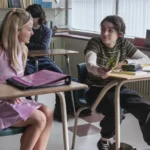
The most uncomfortable scene in Rosebush Pruning does not rely on the graphic violence or the perverse sexual entanglement that permeates the film’s DNA. Instead, the true horror occurs during a simple, excruciatingly awkward family lunch. Jack (Jamie Bell) brings his new girlfriend, Martha (Elle Fanning), home to meet his kin—a collection of individuals so profoundly detached from reality that they resemble specimens in a glass box.
The sequence is a masterclass in social cruelty. As silence hangs thick, punctuated only by the sound of silverware against porcelain, the blind patriarch (played with chilling detachment by Tracy Letts) demands that his daughter, Anna (Riley Keough), describe Martha’s appearance in agonizingly granular detail. What begins as a seemingly innocent inquiry rapidly devolves into a ruthless dissection of Martha’s socio-economic status. The price gap between her modest Zara dress and the opulent Bottega handbag gifted to her by Jack is teased out with surgical precision, transforming a standard "meet the parents" scenario into a predatory ritual.
The malice reaches a crescendo when the father requests that Anna describe Martha’s anatomy. The demand is made without a flicker of shame, and Anna, ever the opportunist, weaponizes the request to vie for Jack’s attention. It is here that the audience realizes the true nature of this household: a vacuum where human connection has been entirely replaced by competitive manipulation.
A Visual Feast of Grotesque Elegance
If the film’s behavior is ugly, its aesthetic is nothing short of sublime. Cinematographer Hélène Louvart has shot Rosebush Pruning with a devotional intensity that elevates the film to the level of a high-fashion editorial. Every frame is saturated with color—blood-rich reds and luminous, aggressive yellows—that defy the murky, desaturated palettes currently dominating the Hollywood landscape.

The film feels like a fever dream ripped from the pages of a luxury magazine, a stylistic choice that perfectly mirrors the internal rot of its characters. It evokes the early, transgressive spirit of Pedro Almodóvar, though arguably with a significantly meaner, sharper streak. The cast serves as an extension of this visual language; Callum Turner’s sharp, angular cheekbones, Fanning’s wide, innocent eyes, and Keough’s icy, statuesque presence are all used as architectural elements. They are beautiful, yes, but they are also draped in thorns.
Chronology of the Absurd: The Rituals of the Elite
The film’s narrative is loosely rooted in the 1965 Italian classic Fists in the Pocket, but it feels unmistakably shaped by the "Weird Wave" sensibilities of co-writer Efthimis Filippou. The plot, if it can be called such, is a series of perverse vignettes that chart the family’s descent into madness.
The backstory is established early through a bizarre, fairytale-like mythology: the death of the mother (played by a game Pamela Anderson), who was allegedly torn apart by wolves in a forest near their Catalonian estate. Each month, the family makes a pilgrimage to the site of her death, leaving behind a sacrificial lamb to appease the wolves. It is a ritual that has nothing to do with mourning and everything to do with the performative nature of their grief. In a world where the family has everything, they must manufacture trauma to stave off the crushing boredom of their existence.
As the film progresses, the focus shifts to the younger brother, Ed, who begins "pruning"—a metaphorical and literal culling of his siblings’ romantic rivals. The story moves from these initial, strange rituals into increasingly shocking, farcical territory. By the third act, the film has fully abandoned any pretense of grounded reality, choosing instead to lean into the grotesque.
Supporting Data: The Cast and the Collaborative Vision
The performances in Rosebush Pruning are remarkably unified in their commitment to this heightened, stilted reality. The dialogue is deliberately rhythmic, eschewing naturalistic patterns to ensure that the audience feels the distance between themselves and these characters.
- Riley Keough: As Anna, she is the film’s gravitational center. Her performance is a peculiar, hypnotic mix of desperation and malice. Clad in baby-blue thigh-high boots, she embodies the film’s "John Waters-meets-Lanthimos" aesthetic perfectly.
- Jamie Bell: As Jack, Bell plays the "sane" one, the middle brother who wants to escape the household’s suffocating grip. His melancholy and alien detachment provide the necessary foil to the more volatile members of the family.
- Elle Fanning: Her portrayal of Martha serves as the audience’s proxy, the outsider who initially believes she can navigate the shark tank, only to find herself slowly being devoured.
- Tracy Letts: As the father, he brings a gravitas that makes the absurdity of his requests even more jarring. His performance is a chilling reminder of the power dynamics at play.
Official Responses and Interpretive Implications
Critics and festival attendees have remained divided on the film’s ultimate purpose. Is Rosebush Pruning a biting satire on the emptiness of inherited wealth, or is it merely an exercise in nihilistic shock?

Aïnouz clearly intends to unnerve, yet the film’s lack of a clear, coherent moral compass leaves it floating in a liminal space. There are moments where the film seems poised to offer a profound critique of privilege—such as when Martha’s wealth is revealed to be a mere pittance compared to the family’s generational assets—but these moments are often interrupted by a jarring shift in tone or a focus on the characters’ bizarre sexual fixations.
The title itself, "Rosebush Pruning," is a phrase coined by the character Ed to create a sense of intellectual superiority over those who do not understand it. In a way, the film treats its audience with similar condescension. It is a movie that invites you to search for meaning, only to mock you for looking.
Conclusion: A Satire Without a Target
Ultimately, Rosebush Pruning is a film that pushes the viewer to the edge, but it doesn’t always know what to do once it gets them there. It is a visceral, often hilarious, and undeniably beautiful piece of filmmaking, but it lacks the narrative direction to make its message stick.
While it certainly succeeds as a stylistic experiment in social satire, the potential for a truly biting critique of the ultra-rich is often sacrificed at the altar of its own shock value. Like the wolves in the forest, the film is dangerous and captivating, but it remains trapped in its own cycle of repetition. One wishes Aïnouz had spent as much time pruning the film’s excesses as he did perfecting its exquisite, terrifying frames.
Grade: C+