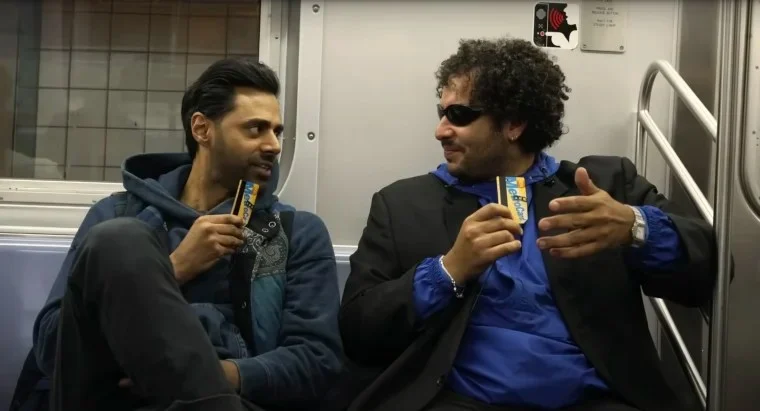
The Art of the Commute: How ‘SubwayTakes’ Became the Definitive Pulse of New York Culture

In the frenetic, neon-drenched landscape of modern digital media, few properties have managed to capture the quintessential spirit of New York City quite like SubwayTakes. What began as an experimental, guerrilla-style video series has evolved into a cultural touchstone, transforming the mundane reality of public transit into a theater for the 21st century’s most vital art form: the "hot take."
Spearheaded by creator and host Kareem Rahma, the show features man-on-the-train interviews that feel less like traditional journalism and more like a high-wire act of comedic performance. From A-list celebrities like Jennifer Lopez and Ethan Hawke to underground local luminaries, Rahma invites his guests to plant a flag in the ground over trivialities, absurdities, and micro-observations. In doing so, he has tapped into a universal human trait: the irresistible, often hilarious urge to have an opinion and defend it to the death.
The Genesis of a Moving Studio: A Chronology of Success
The origin of SubwayTakes is as scrappy as the city that birthed it. Rahma, a veteran of digital media, sought to strip away the artifice of the polished, studio-bound talk show. He recognized that the most authentic conversations often happen in transit—in those liminal spaces between work and home where people are most prone to pondering the bizarre mechanics of their daily existence.
The project grew out of a personal affinity for debate and, more importantly, a commitment to play. In the early stages, the production was lean, focusing on the sheer velocity of the subway system as a backdrop. As the series gained traction, the "bit"—a rapid-fire exchange of views punctuated by Rahma’s binary, authoritative "100 percent agree" or "100 percent disagree"—solidified into a brand.
What started as a spontaneous experiment quickly matured into a sophisticated production. The show’s evolution mirrors the rise of short-form, high-impact content, where the "Larry David-ian" observation—micro-critiques about social etiquette, transit habits, or the absurdity of modern life—became the gold standard for audience engagement.
Behind the Curtain: The Logistical Complexity of Chaos
While the finished product feels effortless, the production of SubwayTakes is a masterclass in logistical precision. Filming a talk show on a moving, underground train car presents a unique set of variables that would paralyze most traditional television crews.
"The challenges of doing a talk show in public are plentiful," Rahma explained in a recent interview with IndieWire. "The biggest one is the fact that we have literally no control over our setting."

To mitigate this, Rahma’s team treats the subway not as a set, but as a dynamic, unpredictable partner. The production utilizes a multi-camera setup—typically four cameras—and five distinct audio channels. This technical investment is the backbone of the show’s success; without it, the ambient screech of subway tracks and the cacophony of a moving train would render the dialogue unintelligible.
Investing in Content Over Location
Rahma’s philosophy on production value is a direct critique of the traditional media model. "It came out of a need for free studio space," he noted, reflecting on the show’s infancy. "I would rather invest in the quality of the content than invest in the physical location where the content is created. We invested in the team and making sure we had the best equipment possible."
This dedication ensures that, despite the chaotic environment, the final product remains "legible." It is a testament to the team’s skill that they can deliver professional, cinematic audio-visual quality while navigating the unpredictable reality of the MTA.
The "Plane in Flight" Philosophy: Narrative Crafting
For Rahma, the true art of the show lies in the editing room. Unlike a scripted program, SubwayTakes relies on the serendipity of the moment. "I’m definitely writing the episode while it’s happening," Rahma admitted. "We build a plane while we fly it. Almost every episode I’m sitting there saying, ‘Oh shit, how am I going to land this plane?’ Because I don’t know what they’re going to say."
This narrative uncertainty is exactly what makes the show compelling. The editing process requires a keen eye for story structure, identifying the peak of an argument or the funniest point of contention within a rambling conversation. By steering these debates, Rahma and his team curate a narrative arc that moves from the premise of the take to the inevitable, often absurd, conclusion.
Supporting Data: Why "Micro-Takes" Resonate
The success of SubwayTakes is not merely anecdotal; it is symptomatic of a broader shift in digital consumption. Data from the current media landscape suggests that audiences are increasingly fatigued by heavy, high-stakes political discourse and are gravitating toward "low-stakes, high-investment" content.
- The "Larry David" Effect: Observations that target the mundane—how one stands on an escalator, the correct way to order coffee, or the social contract of the subway seat—create a sense of communal belonging.
- Engagement Metrics: Because the show is built on strong, binary opinions, it encourages audience participation. Viewers don’t just watch; they comment, argue, and share, effectively extending the conversation beyond the screen.
- The Power of Authenticity: By stripping away the studio lights and professional makeup chairs, Rahma fosters a "safe space" for guests. When a celebrity is stripped of their PR apparatus and placed on a train, their humanity—and their capacity for childlike wonder—becomes the focal point.
Official Perspective: A Culture of Play
Rahma’s primary objective, above all else, is to demonstrate that conversation can be a form of joy. "Really, the show is about having fun, and about showing the world how much fun a conversation can be," he stated.

His approach to guests is intentionally disarming. By framing the discussion as a non-competitive, purely entertainment-based endeavor, he bypasses the defensive posturing typical of celebrity interviews. There is no "winning" in a SubwayTakes segment; there is only the pleasure of the exchange.
"I wanted to create an environment that was safe for discussion, for humor, for play, and for childlike wonder," Rahma concluded. By providing this platform, he has essentially reclaimed the subway—often seen as a space of anxiety and isolation—as a space of creative community.
Implications for the Future of Media
The success of SubwayTakes carries significant implications for the future of digital content. It proves that the "professionalization" of media does not necessarily require a controlled environment. Instead, it requires a commitment to a specific, high-quality craft and a willingness to embrace the friction of the real world.
As media conglomerates look for ways to reach younger, more cynical demographics, the SubwayTakes model offers a blueprint. It suggests that:
- Constraints breed creativity: By limiting the environment to a subway car, the team was forced to innovate on audio and visual capture.
- Personality-driven content is paramount: The show works because Rahma acts as both the audience surrogate and the comedic foil.
- The "Hot Take" is a universal language: Whether in New York, London, or Tokyo, the urge to debate trivialities is a powerful, unifying force.
As the show continues to expand, it remains a vital, pulsing testament to the idea that the best stories are found in the most unlikely places. By transforming the commute into a stage, Kareem Rahma has not only created a successful show—he has created a mirror in which the city, and indeed the world, can see itself, argue with itself, and ultimately, laugh at itself.
This conversation is presented in partnership with YouTube.