The Architecture of Memory: Christopher Nolan, Jennifer Lame, and the Cinematic Geometry of The Odyssey

In the landscape of modern blockbuster filmmaking, few partnerships have redefined the grammar of the medium as profoundly as the collaboration between director Christopher Nolan and editor Jennifer Lame. Their latest venture, the 2026 epic The Odyssey, represents the culmination of a six-year creative dialogue that began with the high-concept chaos of Tenet and matured through the psychological intensity of Oppenheimer. As they tackle Homer’s ancient epic, Nolan and Lame have moved beyond mere chronological experimentation, crafting a film that functions less like a linear narrative and more like the synaptic firing of a human memory.
The Evolution of a Creative Partnership
When Christopher Nolan first approached Jennifer Lame to edit Tenet (2020), the industry viewed the pairing as an intriguing gamble. Lame had built her reputation on character-driven, intimate cinema, including Noah Baumbach’s Frances Ha and Marriage Story, Kenneth Lonergan’s Manchester by the Sea, and the visceral horror of Ari Aster’s Hereditary. Transitioning from the domestic claustrophobia of those projects to the massive scale of Tenet—a film featuring inverted car chases and complex, non-linear action—was, by Lame’s own admission, a daunting prospect.
"I started having to just imagine the cars in these big action sequences as people, giving each car a personality, and having them talk to each other," Lame reflected in a 2020 interview. "Basically, treating them like dialogue scenes because I think dialogue scenes are that exciting."
This approach—treating kinetic action with the same rhythmic scrutiny as intimate conversation—became the hallmark of the Nolan-Lame aesthetic. While Nolan had spent two decades honing a signature style of "propulsive" editing, beginning with his self-edited micro-budget debut Following (1998) and later working with veterans Dody Dorn and Lee Smith, his synergy with Lame has pushed his work toward a new, impressionistic apex.
Chronology as a Weapon: From Memento to The Odyssey
Nolan’s fascination with time is foundational, yet the nature of his temporal manipulation has shifted. In Memento (2000), the reverse-chronological structure was a structural puzzle meant to force the audience into the protagonist’s headspace. However, in The Odyssey, the timeline is not a puzzle to be solved; it is a fluid, unstable medium.
The film opens with a framing device featuring Travis Scott as a bard reciting the Trojan War. This sequence alone exists across three disparate timelines, introducing us to Odysseus (Matt Damon), the deceiver Sinon (Elliot Page), and an anxious Penelope (Anne Hathaway) who interrupts the bard’s performance. By refusing to establish a stable "present," Nolan and Lame strip away the comfort of traditional exposition.

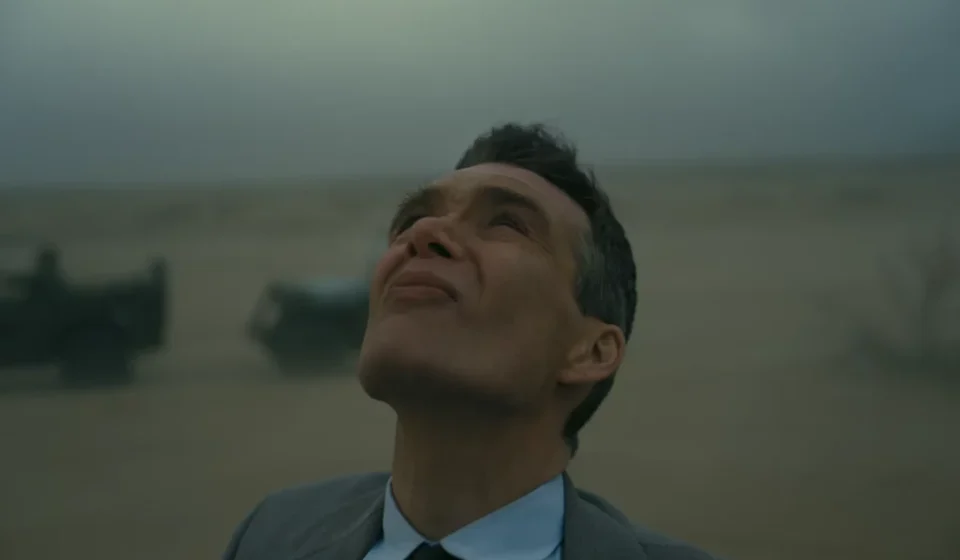
This technique follows a trajectory established in Oppenheimer (2023). During the editing of the latter, Lame employed a "character-pass" method, ensuring that even minor figures—like Michael Angarano’s Serber or Trond Fausa’s Kistiakowsky—registered emotionally, even if their screen time was fleeting. In The Odyssey, this strategy is expanded. The film frequently hops between Odysseus’s harrowing, drug-induced haze in the presence of Calypso and the fragmented recollections of his past. By disregarding conventional scene establishment, the film forces the viewer to experience the story as a collection of sensory impulses rather than a historical summary.
The Emotional Calculus: Supporting Data and Technique
To understand why The Odyssey feels so distinct from traditional sword-and-sandal epics like The Robe or Kingdom of Heaven, one must look at the specific editing choices made by Lame. Traditional epics utilize the widescreen format to luxuriate in scale; The Odyssey, by contrast, uses scale as a backdrop for intense, claustrophobic focus.
The "Staccato" Rhythmic Shift
The cutting pace of The Odyssey is deliberately breathless. Shots rarely last longer than a few seconds. This creates a dissonance that mirrors the character’s psychological state. When the narrative does slow down—such as in the rare, long-take sequence of Penelope behind a strung loom, watched by Antinous (Robert Pattinson)—the impact is magnified. The "frisson" of this human interaction provides a necessary tether to reality amidst the dizzying temporal shifts.
Emotional Logic vs. Narrative Clarity
Nolan has long maintained that his films operate on a "gut level." Despite the complex layering of Interstellar or the nesting flashbacks of Batman Begins, the core of his work is emotional. Lame reinforces this, citing her work on Manchester by the Sea as her training ground for emotional transitions. "Every time we switch timelines, it has to be incredibly emotional," she noted in 2024. In The Odyssey, this is achieved by using decontextualized flashes of the sacking of Troy as emotional anchors, allowing the audience to feel the horror of war before the narrative explicitly explains the cause.
Official Perspectives and Industry Implications
The critical reception of The Odyssey suggests a turning point for the "blockbuster" genre. By moving away from the "theatrical opulence" of historical epics, Nolan and Lame have proposed a new model for big-budget filmmaking: the "impressionistic epic."
In industry discussions, experts have noted that the success of this collaboration hinges on the trust Nolan places in his editor to prioritize the "emotional beat" over the "narrative beat." This represents a significant departure from the studio-mandated clarity that dominated the 2010s. By demanding that the audience engage with the film on a subconscious level, Nolan is effectively asking for a more active, sophisticated viewing experience.

"With Oppenheimer, Chris and I wanted to treat the audience with the utmost respect," Lame stated. "You don’t want them to feel like you’re using something frivolously that doesn’t have any meaning. They’ll stop caring." This philosophy is clearly the guiding light of The Odyssey.
Implications for the Future of Narrative Cinema
The implications of The Odyssey are twofold. First, it cements the status of the film editor as a co-author of the narrative structure, moving far beyond the mechanical task of cutting. Lame’s influence on the film’s pacing is arguably as significant as the screenplay itself.
Second, the film proves that audiences are willing to accept highly abstract, non-linear storytelling even within the context of a "mythic" epic. By treating Homer’s ancient text—which is itself a labyrinth of tangents and perspectives—not as a holy script to be preserved, but as a series of fragmented memories to be reconstructed, Nolan and Lame have unlocked a way to make the ancient feel shockingly immediate.
As the film reaches its final act, the disparate threads—the sacking of Troy, the beach-side reunions, the bard’s song, and the drug-addled visions of Calypso’s isle—begin to converge. It is a testament to the power of the cut. The final shot of the film does not merely conclude the story; it provides a unified whole that justifies the preceding hours of dizzying, impressionistic velocity.
Ultimately, The Odyssey is a film about the instability of the human mind. It captures the terror of forgetting and the desperation of remembrance. By aligning their editing style with the "synaptic logic" of memory, Nolan and Lame have created a masterpiece that functions as an epic of both the individual mind and the collective unconscious. It is a landmark achievement that will likely influence the language of action and historical cinema for years to come, proving that the most powerful special effect in a filmmaker’s arsenal remains the simple, decisive cut.