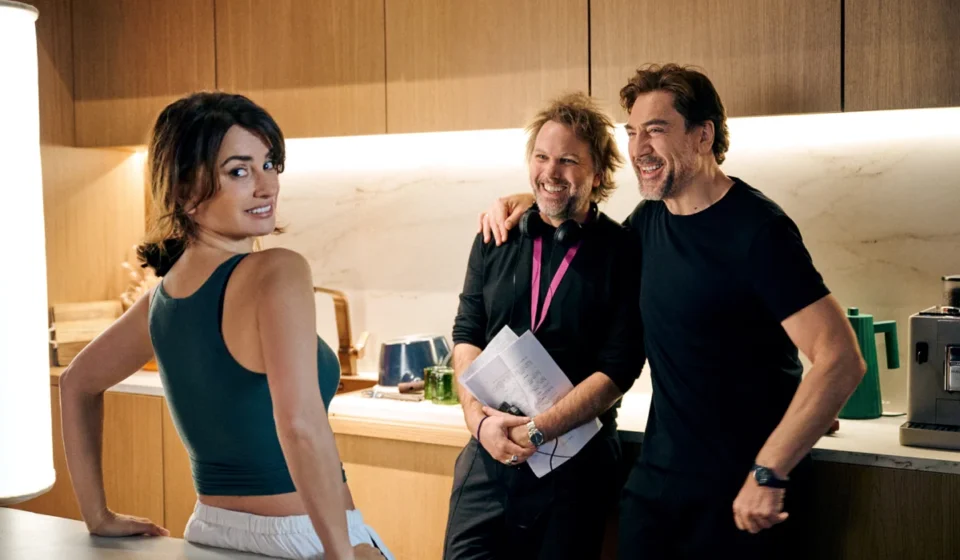

Four years after the release of The Son, Academy Award-winning filmmaker Florian Zeller is returning to the global stage with Bunker, a project that signals a profound shift in his directorial trajectory. While Zeller has built his reputation on translating high-stakes stage plays into intimate, heartbreaking cinematic experiences—most notably with the Oscar-winning The Father—his latest endeavor sees him stepping into uncharted territory.
Bunker is a departure: it is his first original screenplay for the screen, his first time in the producer’s chair, and a deliberate expansion of his thematic canvas. By casting real-life power couple Penélope Cruz and Javier Bardem as a married couple navigating the slow-motion collapse of their relationship, Zeller is engaging in a meta-cinematic experiment that pushes the boundaries of performance and reality.
The Genesis of an Idea: From Daydreams to Reality
The inception of Bunker did not begin with a plot outline or a thematic exploration of societal collapse; it began with a singular, persistent image in Zeller’s mind: the faces of Cruz and Bardem. Having been partners for nearly two decades, the duo has worked together on numerous projects, yet they have never shared the screen as a married couple.
For Zeller, the opportunity to bridge the gap between the actors’ private lives and their public personas was irresistible. He cites Stanley Kubrick’s Eyes Wide Shut as a foundational influence, particularly the way Kubrick utilized the then-marriage of Tom Cruise and Nicole Kidman to blur the lines between performance and authentic tension.
“I loved Eyes Wide Shut—this ambivalent proposition presented to the audience where you’re not quite sure what you’re being invited to watch,” Zeller explains, seated at the understated luxury of Paris’s Royal Monceau hotel. “With Penélope and Javier, I wanted to use who they are, in the noblest sense of the term, to touch on something more authentic and more unsettling for the audience. Is it fiction? Is it another version of reality? Where is the line?”
Chronology: A Career of Precision
Zeller’s ascent has been marked by a rigorous commitment to the psychological interiority of his characters. A celebrated novelist and playwright before his transition to film, his works have consistently garnered international acclaim, with his stage productions earning Tony and Olivier awards.
- The Breakthrough: Zeller’s transition to film via The Father (2020) was a resounding success, earning him an Academy Award for best adapted screenplay and securing Anthony Hopkins the Oscar for best actor.
- The Sophomore Challenge: The Son (2024) followed, receiving a more tempered critical response, which Zeller openly acknowledges as a period of reflection.
- The Reset: Bunker represents a deliberate pivot. Written entirely by Zeller, the script avoids the adaptation path he previously traveled, allowing him to weave personal experiences into a narrative about professional ambition and the cost of security.
The production of Bunker was itself a psychological experiment. Rather than shooting on location in London, Zeller chose to build the couple’s modern home in a Madrid studio. The deliberate lack of natural light and the confined, glass-walled design served to mirror the characters’ emotional states. “We experienced that bunker ourselves, in a studio without any light for several weeks,” Zeller notes. The isolation served to heighten the performances, stripping away the polish and forcing the actors into a raw confrontation with the material.
The Narrative Core: Wealth, Fear, and Survival
At its heart, Bunker follows Miguel (Bardem), a celebrated architect who is offered a lucrative, morally murky commission by an elusive tech billionaire named Andrew (Paul Dano). The project: to build an impenetrable survivalist bunker. This opportunity forces his wife, Sofia (Cruz), to confront the foundations of their 17-year marriage and the shifting values of her husband.
The inspiration for this narrative, Zeller reveals, came from reading about real-life tech moguls—specifically Mark Zuckerberg—constructing vast, private underground shelters in Hawaii. “I was fascinated by this story,” Zeller says. “This man had made his fortune connecting people with one another, yet at the same time was preparing a plan B to completely cut himself off from the rest of humanity. It’s a metaphor for the folly of extreme wealth—the belief that one can buy their way out of the human condition.”

While the film addresses contemporary anxieties—rampant individualism, environmental catastrophe, and social injustice—Zeller insists the film is not a didactic political essay. “It’s an experience seen through the eyes of a couple,” he emphasizes. “It explores the fear of the future and the desperation to protect what we have, even when that protection comes at the expense of our morality.”
Supporting Data and Production Details
The film is bolstered by a meticulous attention to detail. Zeller’s "code-based" approach to filmmaking involves weaving in visual and auditory cues that may not be consciously registered by the audience but work to create a cohesive, poetic universe.
- The Odyssey Influence: References to Homer’s Odyssey—a tale of homecoming—permeate the film, from sculptures in the office to the subtle inclusion of Siren-like voices in composer Volker Bertelmann’s score.
- The "Anti-Interaction" Strategy: To preserve the detachment between the characters of Miguel and Andrew, Zeller kept Bardem and Dano entirely apart during production. Dano, playing the tech billionaire, was filmed in a way that suggests a digital presence, with Zeller focusing on granular details like the specific shoes Dano wears to define his "archetypal" persona.
- The Neighbor: A critical role, the neighbor who instills fear in the usually imposing Miguel, was written specifically for Stephen Graham. Zeller notes the irony: “Usually, it’s Javier who scares others. Here, we see a man who is physically smaller than him, yet possesses a menacing power.”
Implications for the Awards Season
The acquisition of Bunker by Sony Pictures Classics signals high confidence in the film’s potential. Given the studio’s success in campaigning for The Father, industry analysts expect a robust push for both Cruz and Bardem.
Cruz’s portrayal of Sofia is already being tipped for best actress contention. Her performance serves as the emotional anchor of the film, as she grapples with the disillusionment of seeing her husband seduced by the very system she despises. Zeller notes that for Cruz, these scenes were an outlet for a "genuine anger" regarding modern power dynamics.
The film’s focus on the "destabilization" of a marriage, rather than the cliché of infidelity, sets it apart in a crowded marketplace. Zeller resisted the temptation to turn the plot into a traditional drama about cheating, opting instead for a more cerebral, unsettling look at how individuals lose their way.
A Personal Reckoning
Perhaps the most revealing aspect of Bunker is its resonance with Zeller’s own life. The script was penned following a two-year residency in Los Angeles, a period he describes as one of professional success but personal stagnation for his family.
“Los Angeles was a lot of fun, but at some point, there wasn’t much room for my wife to thrive,” he admits. The decision to move back to France was a choice to prioritize personal life over the siren call of Hollywood—a narrative arc that finds its way into the film’s central conflict.
Ultimately, Zeller views Bunker as an optimistic work. Despite the harsh disputes and the existential dread that permeates the frame, the film is, in his eyes, a story about reconciliation. “It’s about figuring out how to find one’s place as a family or as a couple in a world that feels increasingly like a bunker,” he concludes.
As the film prepares for its premieres at the Venice and Toronto film festivals, the industry will be watching to see if Zeller’s latest architectural feat—a construction of light, sound, and raw human truth—will secure his place as one of the most vital voices in contemporary cinema. Through the interplay of Cruz and Bardem, Zeller has created a film that is as much about the endurance of love as it is about the fragility of the walls we build to keep the world out.