Narrative Ambition and Genre subversion: An In-Depth Look at Casey Affleck’s ‘Company’

The Venice Film Festival has long been a sanctuary for bold, auteur-driven cinema, a place where established actors often debut their most experimental directorial efforts. In this tradition, Casey Affleck returned to the Lido with his second feature as writer-director, Company. However, unlike his somberly received but critically respected 2019 debut Light of My Life, Company has emerged as a polarizing, perversely structured exercise in narrative nesting. By blending the lyrical pacing of a revisionist Western with a late-game supernatural pivot, Affleck has created a film that is as technically curious as it is narratively exhausting.
The film represents a significant departure for Affleck, who opted to remain entirely behind the camera this time, handing the protagonist’s mantle to his teenage son, Atticus Affleck. While the film boasts an ensemble of heavyweight talent—including Nick Nolte, Ben Mendelsohn, and Scoot McNairy—its reception suggests a work that may struggle to find its footing in a crowded marketplace, hampered by its own insistence on "hiding the genre" for more than half of its runtime.
Main Facts: A Triple-Layered Narrative Experiment
Company is structured as a series of Russian nesting dolls, where stories are told within stories, each receding further back into the American past. The film begins as a contemporary-feeling period piece set in 1975, only to dive into 1953, and finally settle into its primary setting of 1903.
The central conceit of the film is its "hide-the-genre" approach. For the first hour, Company presents itself as a melancholic, "molasses-paced" drama—the kind of revisionist Western one associates with Affleck’s previous collaborations with writer Ron Hansen, such as The Assassination of Jesse James by the Coward Robert Ford. Hansen, who co-scripted Company, brings his signature dour lyricism to the dialogue, though critics argue the payoff for this slow build is "distinctly muted."
The film’s "grabbiest story hook"—which is revealed late in the proceedings—is that it is, in fact, a vampire movie. By using the mythic conventions of the heartland vampire subgenre, Affleck attempts to craft a fable regarding human kindness, mercy, and the "American spirit of community." However, the film’s refusal to engage with these elements early on has left many festival-goers perplexed by its "coy obfuscation."
Chronology: From the 1970s to the Turn of the Century
To understand the mechanics of Company, one must trace its deliberate, staggered timeline. The film employs a recursive narrative structure that mirrors the old "it was a dark and stormy night" trope.
1975: The Frame Story
The film opens in a rain-drenched 1975. Evelyn (Emily Alyn Lind), a reserved and soberly dressed young woman, arrives at a wealthy suburban home during a Christmas party. To the tune of Bob Dylan’s "Shelter From the Storm," she is invited in by a host who doesn’t recognize her but offers hospitality. In return, Evelyn offers to tell the party guests a story.
1953: The Second Layer
Evelyn’s story transports the viewer to 1953, where an elderly rural widower named Tom (Nick Nolte) discovers a young woman, Alice (Caylee Cowan), collapsed in the Colorado snow. He brings her into his cabin to warm up, and in a mirroring of the first act, Alice offers him a story in exchange for his kindness.
1903: The Core Narrative
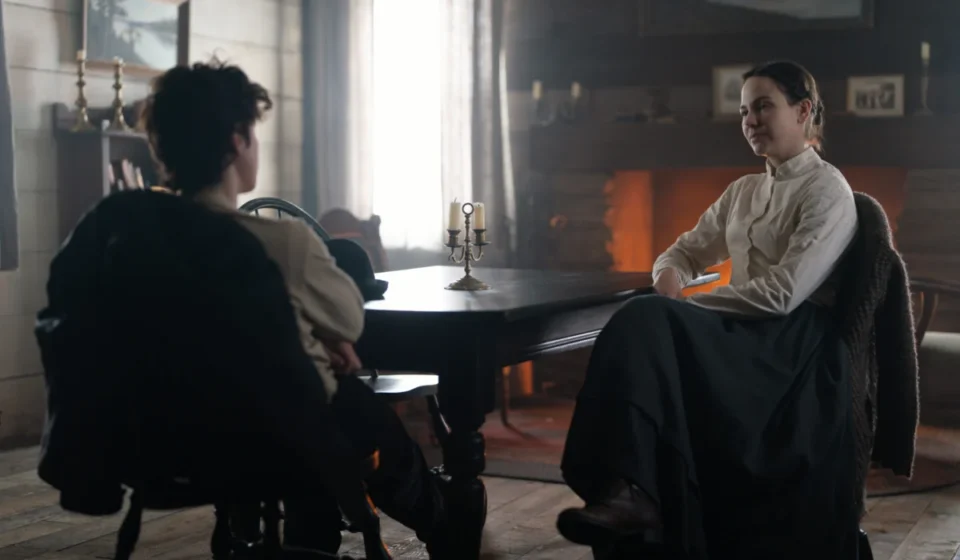
Alice’s story takes us to the turn of the century, where the bulk of the film’s runtime is spent. We meet Rebecca (Adelaide Clemens) and Emmett (Scoot McNairy), a struggling farming couple in Colorado. They find a young, unconscious drifter named Caleb (Atticus Affleck) in the snow. Despite Emmett’s vocal suspicions, Rebecca insists on nursing Caleb back to health and eventually hiring him as a farmhand. It is in this timeline that the film’s true nature begins to bleed through, as a series of brutal local murders coincides with Caleb’s arrival.
Supporting Data: Cast Performances and Technical Oddities
The film’s effectiveness is largely tied to its performances, particularly those of the younger Affleck and the veteran character actors surrounding him.
The Lead: Atticus Affleck
In his debut lead role, Atticus Affleck portrays Caleb with a "willowy insolence." While critics noted that his inexperience occasionally shows, his physical resemblance to a blend of Timothée Chalamet and Troye Sivan, combined with a "pale-eyed, tacitly judgmental presence," provides the film with its few moments of genuine tension. His performance is characterized by a "stillness" that hints at the supernatural nature of his character long before the script confirms it.
The Ensemble
- Ben Mendelsohn: Playing a neighboring farmer named Kleinschmidt, Mendelsohn is widely cited as the film’s "MVP." His verbal confrontation with Caleb is described as the point where the film’s "dourly lyrical dialogue finally crackles with something like foreboding."
- Nick Nolte: Bringing his trademark "maximally grizzled" energy, Nolte provides a grounded, humanistic element to the 1953 segment, serving as the bridge between the various eras.
The "Eight DPs" Mystery
Perhaps the most discussed technical aspect of Company is its cinematography credits. The film boasts eight different Directors of Photography (DPs), including:
- Masanobu Takayanagi (Springsteen: Deliver Me From Nowhere)
- Adam Arkapaw (Macbeth)
- Marcell Rév (White God, Euphoria)
- Casey Affleck himself.
While one might expect such a diverse lineup of cinematographers to create distinct visual identities for each timeline, the final product reportedly maintains an "earthy visual consistency." This has led to industry speculation regarding whether the film faced a troubled production or if the "many hands" were an intentional, albeit unnoticeable, artistic choice. The film is described as "handsome in an appropriately ascetic, chambray-textured way," though the sheer number of DPs remains an anomaly for a production of this scale.
Official Responses and Festival Reception
The premiere of Company at the Venice Film Festival was met with what has been described as a "muted" reception. While Casey Affleck’s filmmaking "chops" were praised—specifically his ability to conjure a "starkly mournful atmosphere"—the narrative execution faced significant criticism.
Critical Consensus
Journalists at Venice expressed frustration with the film’s pacing and its "inflated sense of its own poetry." The primary critique centered on the "diminishing returns" of the nested story structure. By the time the film reveals its vampire lore, many viewers felt the "payoff was distinctly muted." Unlike other successful genre-blending films, Company is said to lack a sense of humor, playing instead as a "protracted shaggy-dog tease."
Distribution Challenges
Marketing experts have pointed out the "significant challenge" Company poses to potential distributors. The film’s most marketable element—its status as a period vampire thriller—is also the secret it guards most fiercely. Promoting the film without spoiling the twist is difficult, yet promoting it as a slow-burn 1900s drama may alienate the very horror/genre fans who would appreciate the third act. Given the "dull peculiarity" of the film and the lukewarm festival response, a wide theatrical release is by no means guaranteed.
Implications: The Future of "Prestige Horror"
The existence of Company speaks to a broader trend in contemporary cinema: the rise of "Prestige Horror" or "A24-style" genre exercises where the supernatural is used as a metaphor for grief, community, or the American psyche.
A New Vampire Mythos
Affleck’s film attempts to subvert vampire tropes by presenting these creatures as "bloodthirsty raconteurs" capable of "grace and mercy." This "novel mythos" suggests a move away from the predatory monsters of traditional cinema toward a more philosophical, fable-like interpretation of the undead. While this adds intellectual depth, the film’s failure to generate "great urgency" suggests that the "Prestige" element may have overshadowed the "Horror" element to the film’s detriment.
The Auteur’s Path
For Casey Affleck, Company serves as a reminder of the difficulties of the sophomore slump. While Light of My Life was a focused, intimate survival drama, Company is an expansive, perhaps over-ambitious project that struggles to justify its complex structure. It raises questions about the balance between "earnest seriousness of purpose" and the need for narrative momentum.
Industry Takeaways
The production of Company highlights the risks of "story-within-a-story" mechanics in the modern era of short attention spans. If even seasoned festival critics found the "tedious roundelay of story introductions" difficult to navigate, general audiences may find the barrier to entry too high. Furthermore, the reliance on a "twist" that recontextualizes the previous hour is a gamble that requires the initial hour to be compelling in its own right—a mark that Company reportedly misses.
As the film looks toward a potential life on streaming or limited theatrical release, it stands as a testament to the uncompromising, if sometimes waylaid, vision of Casey Affleck. Whether it will be remembered as a misunderstood masterpiece of atmospheric horror or a "perversely ponderous exercise" remains to be seen, but it has certainly provided the industry with a unique case study in genre-defying storytelling.