Meta Unveils “Meta One”: A Strategic Pivot Toward Power Users and Creator Monetization

In a significant move to reshape its digital ecosystem, Meta, the tech giant behind the world’s most pervasive social platforms, has announced the launch of "Meta One." This new, tiered subscription architecture represents a departure from the company’s traditional reliance on advertising-first models, signaling a concerted effort to capture value from professional creators, power users, and enterprise clients who have long sought more robust, integrated functionality.
While Meta’s core services—Facebook, Instagram, and WhatsApp—remain free and ad-supported, the introduction of Meta One signals that the company is no longer content with being merely a social utility. Instead, it is positioning itself as a comprehensive operating system for the modern digital economy.
The Core Facts: What is Meta One?
Meta One is a modular subscription suite designed to cater to users who have outgrown the standard, "one-size-fits-all" interface. The offering is segmented into individual product plans and comprehensive bundles, designed to provide a more streamlined professional experience.
Pricing and Tiers
The pricing structure is designed for scalability:
- Individual Product Plans: Instagram Plus and Facebook Plus are priced at $3.99 per month, targeting casual power users who want enhanced customization for their specific feeds.
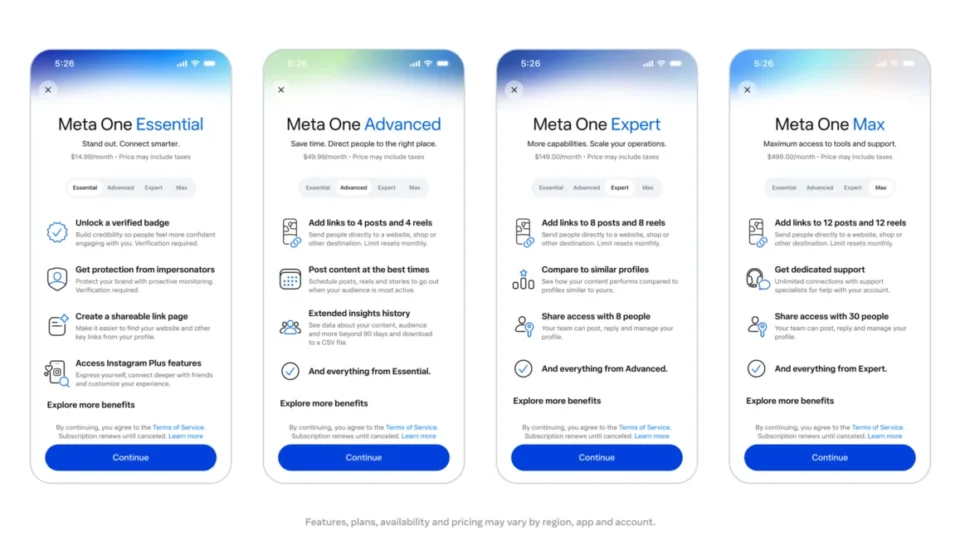
- The Bundle Hierarchy: For creators and businesses, Meta has introduced a tiered "Core-to-Max" structure. The entry-level "Core" plan begins at $7.99 per month, scaling upward to the "Max" tier, which is priced at $499 per month.
These tiers are not final; Meta has indicated that the roadmap for Meta One is iterative. As the company gathers data on user behavior, they expect to refine, expand, and perhaps rebrand specific tiers to better align with the evolving demands of their professional user base.
Chronology: The Evolution of a Subscription Strategy
The path to Meta One has been a calculated, multi-year progression.
Early Experiments (2022-2023): Meta’s initial forays into subscriptions were cautious, primarily focused on "Meta Verified," which prioritized account security and badge verification. These early tests proved that users were willing to pay for utility and prestige, setting the stage for more functional, software-as-a-service (SaaS) style offerings.
The Internal Pivot (Early 2024): Behind the scenes, the formation of the "Subscriptions" division—led by VP Helen Ma—signaled that this was no longer a side project. The division began synthesizing feedback from Instagram chief Adam Mosseri and various creator advisory boards, identifying a "feature gap" where professional users were forced to leave the Meta ecosystem to manage their business operations.
The Official Briefing (Monday): In a briefing held for creators and industry journalists, the company officially pulled the curtain back on Meta One, framing it not as a "pay-to-play" scheme, but as an efficiency-focused "power suite."
The Launch (Tuesday): Meta officially announced the global rollout, marking the beginning of a new era where the platform offers a distinct divide between "casual social" and "professional power-user" experiences.
Supporting Data: The Case for Fragmentation vs. Integration
The logic behind Meta One rests on a fundamental pain point: the "disjointed stack." According to Helen Ma, the average professional creator currently manages a chaotic ecosystem of third-party tools to maintain their presence.
The Fragmented Workflow
To maintain a high-level presence on Instagram or Facebook today, a creator typically utilizes:
- Scheduling software: To queue content across time zones.
- "Link-in-Bio" services: To funnel traffic to external stores or websites.
- Analytics platforms: To track engagement beyond the basic in-app metrics.
- Cloud storage: To manage high-definition video assets.
- AI suites: To generate captions, edit images, or perform background noise removal.
Meta One aims to collapse this entire stack into a singular, native suite. By moving these functions inside the Meta interface, the company argues it can offer better performance because the tools have "context." A scheduler built into Instagram knows the user’s audience better than a third-party API, and an AI image editor integrated into the app can access the user’s brand assets instantly.
Official Responses and Strategic Philosophy
Helen Ma, VP of Subscriptions at Meta, has been the primary architect and spokesperson for this transition. During Monday’s briefing, she addressed the elephant in the room: Why pay for something that has been free for nearly two decades?
"There are users who want to do more," Ma stated. "They want capabilities that, unfortunately, an app designed for billions may not necessarily deliver for them. Our goal is to provide a specialized layer for those who need it."
Addressing the "Pay-to-Win" Concern
A recurring fear among the creator community is that Meta will degrade the free experience to push users toward paid tiers. Ma was emphatic in debunking this: "We are very committed to keeping the experience for creators free. There are many more people building free experiences than people working on subscriptions. Our intention is not to degrade anything or force people to pay. This is all optional."
This rhetoric aligns with the company’s broader goal of diversifying revenue. By keeping the core product free, Meta ensures that the network effect—the very thing that makes its platforms valuable—remains intact. The subscription model is intended to be an accelerator, not a gatekeeper.
Implications: A New Business Model for the Social Web
The launch of Meta One has profound implications for the social media landscape.
1. The Death of the "Link-in-Bio" Industry
By offering native "link-in-post" and "link-in-Reel" capabilities, Meta is directly challenging third-party services like Linktree or Beacons. If a creator can drive traffic directly from a post, the need for a secondary landing page diminishes, effectively centralizing the user journey within Meta’s "walled garden."
2. The AI Integration
Meta One is one of the company’s most aggressive moves to monetize its generative AI investments. By placing higher usage limits on AI image generation, "Restyle" features, and voice effects behind a paywall, Meta is betting that AI will transition from a "cool party trick" to a "business necessity" for creators who need to produce high-volume, high-quality content to remain competitive.
3. The Enterprise Shift
For businesses, the integration of the "Business Agent" (a sophisticated AI customer service bot) suggests that Meta is positioning itself to compete with CRM (Customer Relationship Management) platforms like Salesforce or Zendesk. If a small business can manage its customer service queries directly within the Meta Business Suite, the barrier to entry for digital commerce becomes significantly lower.
4. Market Dynamics
Investors will be watching closely to see if Meta One can successfully increase the "Average Revenue Per User" (ARPU). For years, Meta’s revenue has been almost entirely tied to ad cycles and privacy regulations (such as Apple’s ATT). Subscription revenue is recurring, predictable, and less sensitive to the fluctuations of the digital advertising market.
Conclusion: The Road Ahead
Meta One is a watershed moment for the company. It marks a transition from a platform that sells attention to one that sells productivity.
While the $499-per-month "Max" tier may seem steep for the average user, for a professional creator managing a multi-person team or a small business handling thousands of customer inquiries, the value proposition is clear: consolidation. By reducing the "friction of tools," Meta hopes to keep creators on its platform longer, producing more content, and ultimately, keeping their audiences engaged.
As Meta continues to refine these plans, the success of Meta One will depend on its ability to prove that these premium features are not just "nice-to-haves," but essential upgrades for anyone serious about building a business in the modern digital age. For now, the move remains a test of the market’s appetite for professional-grade social media, a gamble that could fundamentally alter the relationship between the platform and its most valuable users.