
Editor’s Note: This review was originally published during the 2026 Sundance Film Festival. Grasshopper Film releases "Zi" in select theaters starting Friday, November 6.
In the landscape of contemporary independent cinema, few directors have charted a trajectory as fascinating—or as fraught—as Kogonada. Known initially for his precise, meditative video essays that dissected the architectural geometry of film masters, he transitioned into feature filmmaking with the grace of a surgeon. Yet, after the high-profile, somewhat polarizing release of his studio debut, "A Big Bold Beautiful Journey," the director found himself at a crossroads. His latest feature, "Zi," arrives not as a grand statement, but as a quiet, urgent act of reclamation. It is a film that feels less like a product of a studio system and more like a handwritten letter from a director attempting to remember why he started filming in the first place.
The Premise: A Collision of Time and Memory
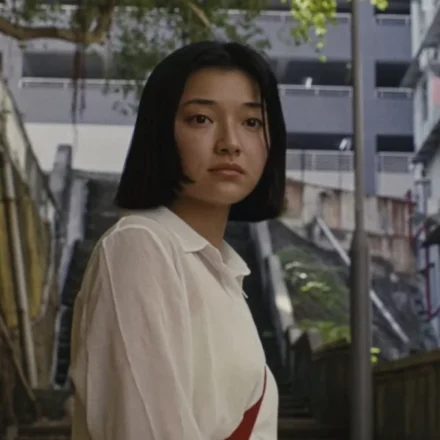
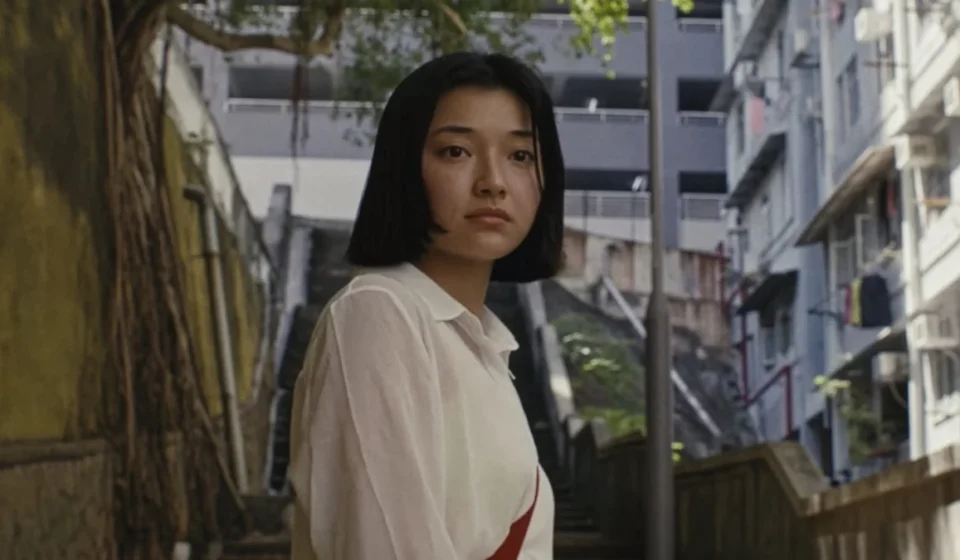
The narrative of "Zi" is deceptively simple, echoing the structural minimalism of the French New Wave. We meet Zi (Michelle Mao), a young Hong Kong violinist whose relationship with reality is fracturing. She is haunted by visions—or perhaps memories—of her future self. When she seeks medical counsel, doctors suggest she may be suffering from the early stages of a neurological condition, specifically a brain tumor.
The heart of the film lies in the agonizing 24-hour waiting period for her diagnostic results. In this state of suspended animation, Zi becomes a vessel for the viewer’s own anxieties about time, legacy, and the ephemeral nature of the present. As she wanders the concrete staircases of Lantau Island, she is joined by L (Haley Lu Richardson), an American expatriate with a disarming, somewhat jarring blonde wig and an air of weary wisdom. L, a former dancer turned drifter, acts as the anchor for a story that threatens to drift into the ether of high-concept abstraction.

Together, these two women, separated by culture but united by a shared sense of displacement, attempt to recalibrate their internal clocks. They are not merely waiting for medical news; they are attempting to resynchronize with the world around them, searching for the creative sparks that once defined their identities.
Chronology of a Creative Retreat
The genesis of "Zi" is inextricably linked to the reception of Kogonada’s previous work. Following the "soul-crushing" experience of his studio debut, the director retreated to Hong Kong, a city that serves as a mirror for the film’s central theme of "temporal relativism."
- Pre-Production: Conceived in the immediate aftermath of a professional setback, "Zi" was shot without a traditional script or a significant budget. The production functioned as a guerilla-style experiment.
- The Shoot: Kogonada utilized the streets of Hong Kong, eschewing the polished aesthetic of modern blockbusters for a raw, handheld visual language. The goal was to capture the "here-and-now" anxiety of his protagonist.
- Post-Production: The film was edited to emphasize its recursive, circular nature, blending reality with the surreal, echoing the influence of classics like Chris Marker’s "La Jetée" and Agnès Varda’s "Cléo from 5 to 7."
- The Festival Circuit: The film debuted at the 2026 Sundance Film Festival, where it was hailed by critics as a return to the director’s roots, sparking intense debate regarding the "meta-textual" nature of the film’s creation.
Supporting Data: The Architecture of Displacement
"Zi" is as much about Hong Kong as it is about its characters. The film captures the dissonance of Victoria Harbor—a city divided by water, densely packed yet fundamentally inhospitable to the human spirit. Kogonada’s lens highlights the way nature persistently reclaims the cracks in the urban landscape, mirroring Zi’s own internal struggle to assert her presence in a world that feels increasingly fragmented.
The film relies heavily on a sensory-heavy soundtrack, featuring Ryuichi Sakamoto’s evocative compositions. The music functions as the connective tissue between the film’s disjointed visual beats. When L speaks of the feeling that one’s "sole purpose in life" has failed to "choose you back," the dialogue lands with a weight that transcends the screen, suggesting that the film is a direct dialogue between the director and his own artistic identity.

Official Perspectives and Thematic Intent
In interviews surrounding the festival release, Kogonada has been characteristically humble, describing the project as "a retreat, as well as a pursuit." The director has acknowledged that he was searching for a way to fall back in love with the craft of filmmaking.
The film introduces the concept of "temporal relativism" through the character of Min (Jin Ha), L’s ex-fiancé. He posits that everything we perceive is already in the past, a philosophical hurdle that Zi, with her visions of the future, struggles to overcome. This is not medical science; it is philosophical inquiry. Kogonada uses this as a backdrop to examine the feeling of distance from the present—a sentiment many modern viewers will find hauntingly familiar.
Implications: The Future of the Auteur
What does "Zi" mean for the future of Kogonada as a filmmaker? By stripping away the bells and whistles of high-budget production, he has revealed a core of pure, unadulterated passion. The film suggests that the "one for me" project—the kind of experimental, personal work often dismissed as a minor diversion—is actually the most vital work a director can undertake when they feel their voice becoming muffled by the industry.
"Zi" is not a film designed for a casual, blockbuster-hungry audience. It is a recursive, challenging, and deeply intimate piece of work. Its success—or failure—as a narrative is secondary to its success as a psychological document. It is a testament to the fact that even in the face of profound professional and personal uncertainty, the act of creation remains a valid, even essential, mode of survival.

Conclusion: A Grade of Grace
"Zi" is a film that rewards those willing to sit with its silences. It is a work of profound empathy, bolstered by performances from Michelle Mao and Haley Lu Richardson that elevate the abstract concepts into something touchingly human. While the film may not resolve all the questions it poses, it provides something perhaps more valuable: the sound of a director finding his way home.
By the time the final minute arrives—delivering a "sudden change in perspective" that serves as the film’s emotional gut-punch—the audience is forced to reconcile the work not just with the story of a violinist in Hong Kong, but with the story of an artist in transition. "Zi" is not just a movie; it is a recovery mission, and for that alone, it stands as one of the most intriguing entries of the 2026 calendar year.
Grade: B
For those interested in exploring the thematic depth of "Zi" further, the film begins its limited theatrical run on November 6, distributed by Grasshopper Film.