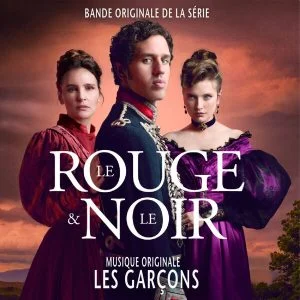
A Modern Adaptation of a Literary Titan: Glaz Records Releases the Original Soundtrack for "The Red and the Black"

In an era where classic literature is frequently reimagined for the screen, the arrival of a new adaptation carries both the weight of history and the promise of modern innovation. Today, Glaz Records has officially released the soundtrack for the highly anticipated French limited series The Red and the Black (Le rouge et le noir). Composed by the creative duo Les Garçons—known for their work on Sharon Stone: Survival Instinct and Un autre père—the score serves as the sonic heartbeat for this four-part period drama.
As the series premieres on France 2 and becomes available for streaming on france.tv, the release of this soundtrack offers audiences a chance to delve deeper into the complex, atmospheric world of Stendhal’s 19th-century masterpiece, reimagined through a contemporary lens.
The Main Facts: A Sonic Landscape for Stendhal’s Masterpiece
The soundtrack, now available on all major digital platforms, captures the essence of Julien Sorel’s journey—a narrative defined by ambition, social climbing, and the suffocating rigidity of the Bourbon Restoration. Les Garçons have crafted a score that mirrors the protagonist’s internal duality: the "red" of his military ambitions and the "black" of his clerical aspirations.
The collaboration between Glaz Records and the composing duo highlights a growing trend in television production: the integration of mood-setting, character-driven scores that function as independent artistic pieces. By blending period-appropriate instrumentation with modern electronic textures, Les Garçons have successfully bridged the gap between 1830s France and the 21st-century viewing experience. Fans of the show can now stream or download the full collection, which includes a meticulously curated tracklist that mirrors the rising tension of the series.
Chronology: From 1830 to the Present Day
To understand the weight of this new adaptation, one must look at the timeline of Stendhal’s seminal work and its transition to the screen.
The Literary Foundation (1830)
Marie-Henri Beyle, writing under the pseudonym Stendhal, published Le Rouge et le Noir in 1830. It remains one of the most influential novels of the 19th century, serving as a biting critique of French society. The story of Julien Sorel, a young man of humble origins who uses his intellect and charm to navigate the treacherous waters of the aristocracy, set the gold standard for the "bildungsroman."
Development of the Limited Series
The current four-part adaptation, created by Georges-Marc Benamoud, was conceptualized to breathe new life into the source material. Directed by Gaël Morel, the production team faced the challenge of translating Stendhal’s dense psychological prose into a visual medium that resonates with modern audiences. Filming involved an extensive ensemble cast, including Victor Belmondo, Virginie Ledoyen, and Camille Razat, who were tasked with embodying characters that have been debated by scholars for nearly two centuries.
The Scoring Process
The involvement of Les Garçons began during the post-production phase. Their goal was not merely to provide background noise but to underscore the "hypocrisy and pride" that drive the plot. The soundtrack’s release coincides with the series’ premiere on France 2, marking the culmination of months of collaborative effort between the creative team and the record label.
Supporting Data: The Production Ensemble and Narrative Arc
The Red and the Black is a production of significant scale, both in terms of its narrative scope and its ensemble cast. The series follows the tragic arc of Julien Sorel (played by Victor Belmondo), a brilliant young man whose meteoric rise is hampered by his own conflicting desires.
Key Cast Members:
- Victor Belmondo as Julien Sorel
- Virginie Ledoyen as Madame de Rênal
- Camille Razat as Mathilde de la Mole
- Patrick Timsit, Patrick Mille, Théo Cholbi, Romane Bohringer, Sophie Guillemin, Zoé Adjani, and Fred Testot in pivotal supporting roles.
The narrative structure, spread across four episodes, allows for a deep dive into the psychological warfare Julien engages in as he attempts to shed his peasant identity. The score by Les Garçons is strategically placed to highlight the moments of transition in the series—the "red" moments of passion and the "black" moments of cold calculation. By analyzing the soundtrack’s tracks, one can effectively chart the protagonist’s descent into the fatal consequences of his choices.
Official Responses and Creative Direction
The creative team behind the series has been vocal about the importance of the music in grounding the historical narrative. In a statement regarding the score, the producers emphasized that the music was intended to be "the invisible narrator" of the series.
Gaël Morel’s Vision
Director Gaël Morel noted in recent press junkets that the choice of Les Garçons was deliberate. "We wanted a score that didn’t feel like a museum piece," Morel stated. "Stendhal’s novel is inherently modern in its exploration of social mobility and the cost of success. The music needed to reflect that urgency, that feeling of a man running out of time."
The Composers’ Perspective
Les Garçons, in discussing their work for the soundtrack, noted the difficulty of balancing historical accuracy with the need for a modern, gripping sound. "The challenge was to avoid the ‘costume drama’ cliché," the duo shared. "We focused on the psychological state of Julien. His internal anxiety is the constant, and the music reflects that through repetitive, haunting motifs that slowly build into the tragic climax of the story."
Implications: The Evolution of Period Dramas
The release of The Red and the Black soundtrack and the series itself suggests a shift in how classic European literature is being presented to global audiences.
Modernizing the Canon
By casting young, popular actors like Victor Belmondo and Camille Razat, and pairing them with a contemporary, atmospheric score, the producers are actively courting a younger demographic that might otherwise be intimidated by 19th-century literature. This is a strategic move to ensure the longevity of Stendhal’s work in the digital age.
The Role of Streaming Platforms
The simultaneous release on France 2 and the streaming availability on france.tv illustrates how traditional broadcasters are adapting to the "on-demand" culture. Furthermore, the availability of the soundtrack via digital streaming platforms (like the Amazon link provided by Glaz Records) serves as a secondary engagement tool. Listeners who discover the music may be drawn to watch the series, while viewers of the series are likely to seek out the soundtrack to relive the emotional highs and lows of the story.
Cultural Impact
As the series gains traction, it is likely to spark renewed interest in Stendhal’s bibliography. The "red" and the "black"—the army and the church—are symbols that remain relevant in contemporary discourse regarding institutional power and individual integrity. By placing these themes in a high-production-value setting, the series invites a new generation to interrogate the same issues that bothered Sorel two hundred years ago.
Conclusion
The release of the soundtrack for The Red and the Black by Glaz Records is more than just a musical accompaniment; it is an invitation to explore a complex, tragic, and deeply human story. With the collaborative brilliance of Les Garçons, the series promises to be a standout entry in this year’s television landscape.
Whether you are a devotee of Stendhal’s original text or a newcomer to the tale of Julien Sorel, the score provides a gateway into the heart of the series. As the story of pride, love, and hypocrisy unfolds on screens across France and beyond, the music remains to linger long after the final credits roll, serving as a poignant reminder of the tragic consequences that follow when one attempts to rewrite their destiny.
For those interested in experiencing the work firsthand, the series is now streaming on france.tv, and the full soundtrack is available for streaming and download via the link provided by Glaz Records. It is a rare opportunity to witness a classic narrative being treated with both the respect of its history and the innovation of its future.