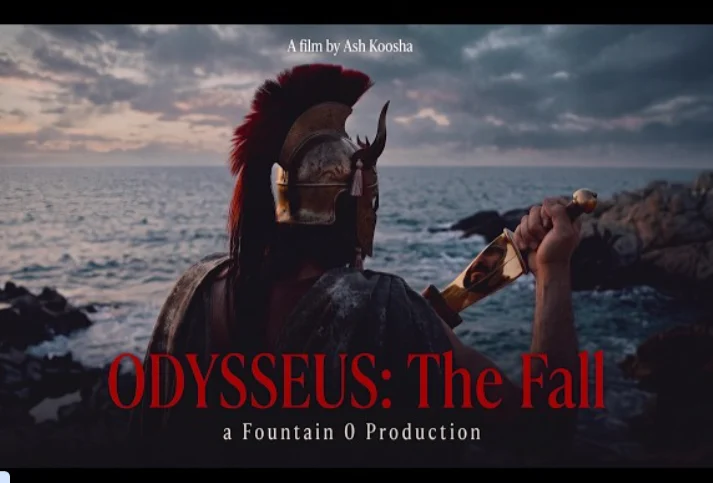

In the sweltering heat of the 2026 summer box office, a peculiar tension has emerged. On one side stands Christopher Nolan, the titan of analog spectacle, whose $250 million adaptation of The Odyssey serves as a fortress for traditional, large-scale cinematic craft. On the other side, operating from a digital workshop, stands Ash Koosha—an Iran-born, London-raised engineer and filmmaker who has ignited a firestorm of controversy by announcing his own 135-minute, AI-generated adaptation of the same Homeric epic.
Titled Odysseus: The Fall, Koosha’s project was produced for a fraction of the cost of a standard studio craft-services budget, utilizing no human actors and relying entirely on the generative capabilities of artificial intelligence. While the film’s release has been delayed by several weeks to allow the industry temperature to cool, the announcement has sparked a profound existential debate: Is this the dawn of a new, democratic era of cinema, or is it a parasitic encroachment on the sanctity of human artistry?
A Chronology of the Disruption
The controversy began when word leaked that Koosha, founder of the AI-centric production banner Fountain 0, was tackling the exact source material currently being championed by the most powerful director in Hollywood.
The timing could not have been more polarizing. The announcement arrived amidst a highly public, philosophical rift between Nolan and his lead actor, Matt Damon. During the press circuit for The Odyssey, Damon famously remarked, "I knew that this was the last chance I was going to have to do something like this," expressing a grim sentiment regarding the longevity of massive, physical film productions. Nolan, ever the optimist for the medium, retorted that such talk was "defeatist."
When Koosha unveiled his intention to adapt The Odyssey via AI, critics and cinephiles alike viewed it as a direct, provocative strike against the "old world" of cinema. To many, it appeared that Koosha was attempting to commodify the very narrative that Nolan was using to stave off the digital tide.
Fountain 0, a venture backed by CNBC founder Tom Rogers, has faced immediate backlash. Detractors argue that while Koosha’s previous AI-assisted work, Dreams of Violet—a poignant look at Iranian democracy protests—garnered sympathy due to the physical danger of filming on the ground in Tehran, The Odyssey lacks such moral urgency. Critics claim the film is merely a "knockoff" designed to ride the coattails of Nolan’s blockbuster.
The Philosophical Divide: "Tangential Filmmaking"
In an exclusive interview with The Hollywood Reporter, Koosha and his partners, Pooya Koosha and Tom Rogers, sought to frame their work not as a replacement for traditional cinema, but as a "tangential" evolution of it.
"My goal is not to make a movie that is the same as [Nolan’s]," Ash Koosha explains. "I’ve been an Odyssey fan since I was a kid. I’m using these tools to explore the story through my own lens—specifically, the immigrant experience of what it means to be far from home, which I think is often overlooked in traditional Western interpretations."
Koosha introduces the term "tangential filmmaking" to describe his process. He posits that in the past, if a scholar or artist had a theory about a classic text, they might write a Substack post or a paper that would reach a limited audience. With AI, that discourse can now be rendered in light, sound, and imagery. "I can paint my opinion with images," he says. "Now, a lot more people can experience that interpretation."
Tom Rogers, ever the strategist, frames the coexistence as a matter of industrial scale. "Christopher Nolan is the ultimate in physical filmmaking, and what we’re trying to do is be the ultimate in AI filmmaking," Rogers notes. "You can’t judge them on the same terms. They are at 125 years of cinematic evolution; we are in our infancy."
The "Bottom-Up" Revolution
To understand the implications of Odysseus: The Fall, one must look at the structural barriers that have historically defined Hollywood. For over a century, the barrier to entry has been capital. Unless a filmmaker could secure tens of millions of dollars, their vision was relegated to the fringes.
The Koosha team argues that AI is doing for film what the blogosphere did for journalism in the early 2000s. Just as the gatekeepers of traditional print media initially scoffed at the rise of the personal blog, the establishment is now reacting to the democratization of visual storytelling.
"The concentration of revenue became a barrier to entry," Ash Koosha notes. "All of that is going to go away. We are looking for the best use of these tools, and we hope other people come in and do this. This is about something very broad and democratic."
This vision suggests a future where high-budget, physical spectacles like Nolan’s exist alongside a vast, churning ocean of "scrappy," AI-generated content. In this model, the "blockbuster" remains a premium, high-event product, while AI provides a medium for creators who were previously locked out of the industry by the sheer cost of production.
The Future of the Human Actor
Perhaps the most visceral anxiety surrounding the Fountain 0 project is the absence of human performers. If the "tangential" model succeeds, will the human actor become an artifact?
Interestingly, Tom Rogers disagrees with the pessimistic outlook for performers. "I think this will make actors more valuable," he argues. "Whether it’s in an old-world movie or in live theater, people will want to see them—maybe even more than they do now. There will be a premium on human presence because it will become a distinction of luxury."
The team envisions a binary future: a "prestige" tier of filmmaking that relies on the traditional, human-centric craft that Nolan champions, and an "AI-native" tier that focuses on rapid, iterative, and discourse-driven storytelling.
Implications for the Industry
The release of Odysseus: The Fall is being held until late summer, a tactical decision meant to avoid immediate comparison fatigue. "We don’t want people to feel overloaded," says Pooya Koosha. "We aren’t trying to trick people. We want them to clearly compare the two as different animals."
The implications of this move are significant:
- Intellectual Property and Public Domain: By utilizing public-domain works like The Odyssey, AI filmmakers are signaling a move toward "remix culture" on a massive, feature-length scale. This challenges studios that rely on proprietary IP to protect their market share.
- The Death of the "Budget-Gate": If Koosha can prove that a compelling 135-minute film can be made for a few thousand dollars, it puts immense pressure on the mid-budget studio film. It forces the industry to justify why a studio-backed production costs $200 million if a comparable narrative experience can be synthesized in a home office.
- The Shift in Critical Language: Critics will now have to develop a new vocabulary to judge AI-generated work. If the "performance" is synthesized, is the director an auteur or an architect of prompts?
Ultimately, Odysseus: The Fall serves as a litmus test for the industry. Whether the audience accepts this "tangential" approach or rejects it as a hollow imitation remains to be seen. However, one thing is certain: the era of the exclusive, capital-intensive cinematic narrative is facing its most significant challenge since the invention of the television.
As the summer of 2026 continues to unfold, the industry will be watching not just the box office receipts of Nolan’s epic, but the cultural impact of Koosha’s experiment. The "End of Cinema" that Matt Damon fears may not be an end at all, but a radical, perhaps painful, metamorphosis into something entirely new.