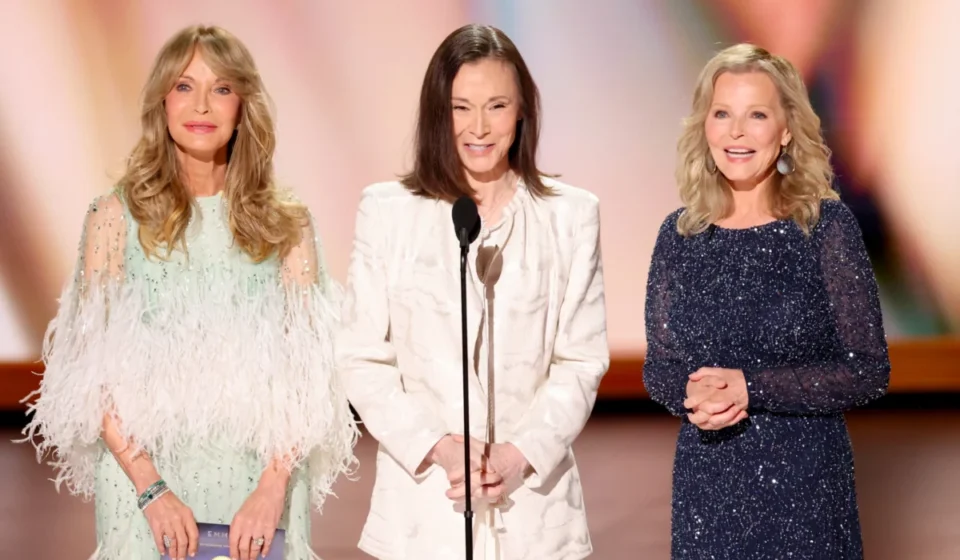

Fifty years after the Townsend Agency first opened its doors to television audiences, the "Charlie’s Angels" phenomenon remains a cultural cornerstone. While the Television Academy recently offered a long-overdue moment of recognition by hosting an onstage reunion of original stars Jaclyn Smith, Kate Jackson, and Cheryl Ladd at this year’s Emmy Awards, the gesture served as a poignant reminder of a complicated history. For decades, the show that redefined the action-adventure genre was relegated to the status of "pop culture fluff" by the industry gatekeepers of the 1970s. Today, however, the legacy of the Angels stands as a testament to the power of female friendship, narrative innovation, and a brand that managed to transcend the very "snobbism" that once sought to diminish it.
A Legacy Reclaimed: The Emmy Reunion
The atmosphere at the Emmys this past Monday was one of profound nostalgia and respect. As Jaclyn Smith, Kate Jackson, and Cheryl Ladd stepped onto the stage, they were greeted not as relics of a bygone era, but as pioneers of a format that paved the way for every female-led action series that followed.
"There was a lot of love in that room for us, and I really appreciated that," Cheryl Ladd reflected following the ceremony. "I could feel it." For the actresses, the moment was about more than just the anniversary; it was a validation of five seasons of hard work that the television establishment had historically overlooked.
The Chronology of an Icon
To understand the significance of this reunion, one must look back at the origins of the series. Created by Ivan Goff and Ben Roberts and produced by the legendary Aaron Spelling, Charlie’s Angels premiered on ABC in 1976. The concept was deceptively simple: three beautiful, highly skilled women—graduates of the police academy who had been relegated to menial desk jobs—are recruited by the mysterious, unseen millionaire Charles Townsend to work as private investigators.
The original trio—Farrah Fawcett as the charismatic Jill Munroe, Jaclyn Smith as the elegant Kelly Garrett, and Kate Jackson as the sharp-witted Sabrina Duncan—became an instant sensation. Their chemistry, coupled with the show’s unique blend of glamour, mystery, and danger, captured the American imagination.
Following the first season, Farrah Fawcett departed amidst a high-profile contract dispute, leading to the introduction of Cheryl Ladd as Kris Munroe, Jill’s younger sister. The show continued its meteoric rise, maintaining its status as a ratings juggernaut through 1981. Throughout the run, John Forsythe provided the voice of the enigmatic Charlie, a character who never appeared on-screen, serving as the connective tissue for the franchise’s various iterations.
Statistical Disconnect: The Industry vs. The Audience
Despite its massive popularity and status as a genuine pop-culture phenomenon, Charlie’s Angels was notoriously ignored by the Television Academy. Over its five-season run, the series received a paltry four Emmy nominations and zero wins. Kate Jackson earned two acting nominations, and David Doyle—who provided the steady, comedic anchor as Bosley—received one. The only other recognition came in the form of a 1977 sound editing nomination.
This statistical deficit stands in stark contrast to the show’s cultural footprint. While critics at the time dismissed the series as mere "eye candy," the public was captivated by the narrative arcs and the unprecedented portrayal of women in roles of physical and mental agency. Aaron Spelling himself famously defended the show against its detractors, acknowledging its "eye candy" appeal while insisting that the narrative structure, the mystery, and the inherent danger were what kept audiences returning week after week.
The "Snobbism" of the 1970s
"It would have been nice to have gotten Emmys, but there was a snobbism about it," Jaclyn Smith candidly admitted in a recent interview. "They didn’t like all the glamour. They put us down. We were Barbie dolls. They didn’t see the weight or the depth of the devotion of the girls to each other."
This perceived lack of depth was, according to Smith, a failure of the critics to recognize the show’s true innovation: the central role of female solidarity. In an era where television rarely centered on the internal dynamics of a female collective, Charlie’s Angels offered a template for "sisterhood" that resonated deeply with viewers.

Ladd echoed this sentiment, emphasizing the off-screen reality that mirrored the show’s themes. "We were women who were completely for each other. We weren’t like, ‘I’m better than you.’ There was no fighting. I thought that was just such a great way to bring women together and to give them strength."
Reflections on a Changing Landscape
Earlier this year, the trio appeared at a 50th-anniversary panel at PaleyFest in Los Angeles, an event that highlighted the bittersweet nature of the show’s longevity. "It was emotional in the sense that so many years had gone by," Smith remarked. "It reminds you of the passage of time, of course, and that we don’t have Farrah, David Doyle, and John Forsythe. Those were important people and people I love, certainly. But it’s still rewarding to think that when something has some magic, it’s lasting and it still brings joy to many generations."
This joy is currently a focal point for Smith, who is in the midst of a nationwide tour for her new memoir, I Once Knew a Guy Named Charlie. The book offers a retrospective look at the series, providing context for the challenges and triumphs of being at the center of the world’s biggest TV show.
From "Charlie’s Angels" to Modern Cinema
The franchise has seen several cinematic revivals, with varying degrees of success. Smith looks back on the 2000 and 2003 films starring Drew Barrymore, Cameron Diaz, and Lucy Liu with genuine appreciation. "Drew kept to that winning concept. She took it a step further. She evolved it," Smith says. "She did it beautifully. It was more spectacular. It was diving off buildings, escaping explosions and still tongue in cheek."
Conversely, Smith offers a critique of the 2019 film directed by Elizabeth Banks and starring Kristen Stewart, Naomi Scott, and Ella Balinska. While she praises Banks as a talented filmmaker, she believes the film’s failure to connect with audiences was rooted in a departure from the "original idea."
"She tried to really do a departure, and it didn’t work because what I find is if people love something, they don’t want it to change that much," Smith explains. "They want the original idea. But this had several Bosleys. The girls didn’t get along. Our whole essence was, we were a sisterhood, a fellowship. We had each other. It was loyalty before romance. We used our sex appeal to help us, and yet it still had a strong feminist backbone. I think it changed women’s roles on television."
The Lasting Implications
The story of Charlie’s Angels is ultimately a story of resilience. By surviving the critical derision of the 1970s to become a touchstone for multiple generations, the show has earned its place in the pantheon of television history.
The implications of the show’s success were profound: it proved that female-led ensembles could anchor prime-time programming, it challenged the traditional boundaries of the "action hero" archetype, and it established a blueprint for the "glamour-meets-grit" aesthetic that dominated the 80s and 90s.
As the industry continues to re-evaluate the shows that defined the late 20th century, the recognition of Charlie’s Angels at the Emmys represents more than just a nostalgic reunion. It is an acknowledgment that the "fluff" of yesterday often holds the seeds of the structural shifts of today. For Smith, Jackson, and Ladd, the vindication isn’t in the trophies they didn’t win, but in the enduring, multigenerational connection they fostered with a global audience—a feat that, half a century later, remains the ultimate Emmy-worthy achievement.