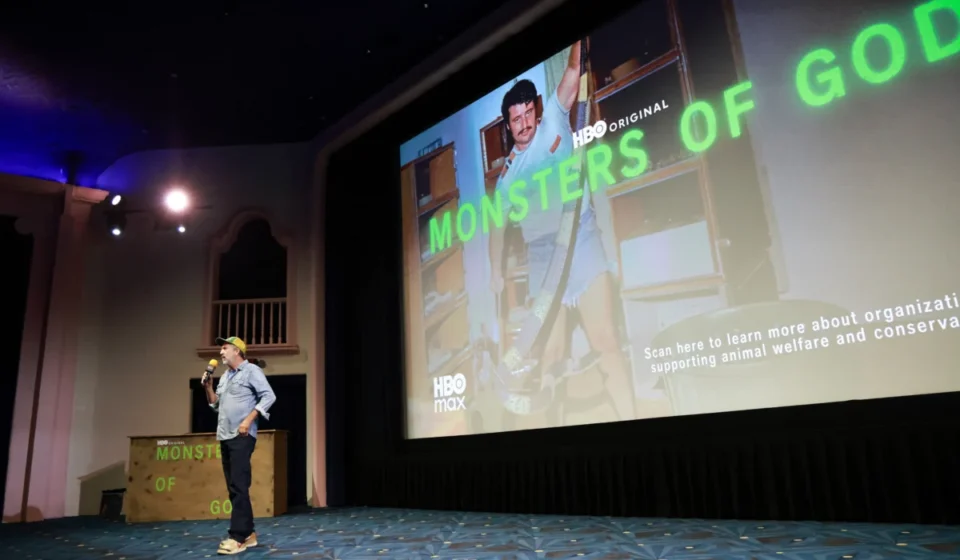
The Shadow of the Tiger: Eric Goode on the Complicated Legacy of ‘Monsters of God’

Editor’s Note: The following article contains spoilers for "Monsters of God" on HBO.
For filmmaker Eric Goode, the journey to bring his latest documentary series, Monsters of God, to the screen was never meant to be a simple production. A seasoned documentarian known for his deep-rooted connections to the exotic animal world, Goode expected his expertise in herpetology and his decades of conservation work through the Turtle Conservancy to be the "golden ticket" for gaining access to the notoriously guarded world of illegal reptile smuggling.
However, he encountered an unexpected, formidable hurdle: his own runaway success. The global phenomenon that was his Emmy-nominated debut, Tiger King, transformed from a career milestone into a significant professional liability. As Goode navigated the landscape of underground reptile dealing, he found that the subjects he sought to interview were no longer willing to open their doors to a man they viewed as the architect of their public humiliation.
The "Tiger King" Effect: A Double-Edged Sword
In a recent interview with IndieWire, Goode reflected on the irony of his current predicament. "After Tiger King came out, people just didn’t want to be portrayed as some crazy toothless hillbilly in Oklahoma," Goode explained. "They were very guarded… it was actually a deterrent having had Tiger King behind me. It made it harder to access people."
The skepticism was palpable among the veteran traders and smugglers Goode hoped to profile. Tom Crutchfield, a foundational figure in the American exotic reptile trade and a central subject in Monsters of God, openly admitted that had he viewed the Tiger King series before agreeing to participate in Goode’s project, he likely would have refused to go on camera.

Yet, the irony remains: Tiger King might never have achieved its explosive cultural impact had it not been for the foundational work Goode began years prior. Monsters of God is the culmination of a decade-long odyssey that began when Goode, a successful artist and hospitality entrepreneur, co-founded the Turtle Conservancy. At the time, he hired a pair of ambitious young New York filmmakers to produce public service announcements for his cause: Josh and Benny Safdie.
A Creative Evolution: From PSAs to Prestige Television
The relationship between Goode and the Safdie brothers—who would eventually become titans of independent cinema with films like Uncut Gems and Good Time—is a testament to the organic, often accidental nature of creative development.
"To be fair to Josh and Benny Safdie, they really were on a trajectory to be filmmakers," Goode noted. "I was on a trajectory to just do whatever my creative fantasies directed me to do. I had dabbled in filmmaking—I directed music videos in the early 1990s, and I made Super 8 movies in high school—but I wasn’t on this trajectory to be a filmmaker earlier in my life, necessarily. I was more of an artist."
Goode’s collaboration with the Safdies began in 2014, when the trio traveled through South Florida to film the characters who would later populate the world of Monsters of God. While the project was stalled by various professional commitments over the years, the DNA of that early footage remains. Today, Josh Safdie and Oscar-nominated screenwriter Ronald Bronstein serve as executive producers on the series, providing a bridge between Goode’s early experiments and his current, more polished documentary work.
Distinguishing the "Freakshow" from the History
One of the primary concerns for critics and audiences alike is whether Monsters of God falls into the same category as Tiger King or the subsequent Chimp Crazy—projects that lean heavily on the eccentricity of their subjects. Goode is quick to clarify that his intent was never to assemble a "freakshow."

"I could have found really crazy, insane reptile people that free-handle cobras and get bitten and almost die," he said. "But this story wasn’t about just finding the freakshow of the reptile people. It was more about finding this story that goes back over half a century and weaving this story into a documentary so people understand the history of the reptile world in the United States."
Unlike the explosive, personality-driven plot twists of Tiger King—where the narrative was propelled by murder-for-hire plots and kidnappings—Monsters of God operates as a historical excavation. It tracks the evolution of the trade, the rise of regulatory bodies, and the blurred lines between those tasked with enforcing the law and those profiting from its subversion.
The Final Reveal: The Case of Ken McLeod
The five-episode series concluded on September 3, and while it lacks the sensationalized violence of its predecessors, it culminates in a revelatory arc involving Ken McLeod, a former Lead Agent for Special Operations at the U.S. Fish and Wildlife Service.
McLeod’s story serves as the moral center—and the most damning indictment—of the industry. Initially appearing as a man who pivoted from the reptile trade into law enforcement, the documentary reveals that McLeod maintained his "fever" for the animals long after he was tasked with policing them.
"He happened to be on that other side of the fence," Goode explained. "During his tenure at U.S. Fish and Wildlife, everyone thought, ‘Oh, he’s so valuable… he’s such an angel.’ But meanwhile, he really wanted those reptiles. He was like an alcoholic running a liquor store."

The documentary exposes that, upon his retirement, McLeod kept a critically endangered ploughshare tortoise in his home for two decades—a species arguably extinct in the wild. For Goode, this is the ultimate act of hypocrisy. "It’s deeply selfish and unfair," he said. "It’s analogous to a drug enforcement agent having cocaine in his garage after he retires and selling it to the neighborhood."
Institutional Complicity and Unintended Consequences
Goode’s work extends beyond individual bad actors to analyze the institutions that provide a veneer of legitimacy to the trade. He recounts his failed attempts to secure an interview with Tom Schultz, the curator of herpetology at the San Diego Zoo. Despite the zoo’s reputation for conservation, Goode’s research suggests a complex, often murky history of cooperation between zoo curators and notorious illegal wildlife dealers like Anson Wong and Tommy Crutchfield.
"I spoke to him at length about his involvement with these illegal wildlife dealers," Goode said of his meetings with Schultz. "He knew Anson Wong intimately… was moving reptiles back and forth out of the San Diego Zoo. But again, the San Diego Zoo does a lot of really good work, and in the history of a zoo like that, not everyone is going to be perfect."
This, according to Goode, is the core thesis of Monsters of God: the process of conservation is inherently flawed. From the animal cops to the dealers, and even the activists like himself, everyone exists in a state of imperfection. The series serves as a cautionary tale about the extinction crisis, positing that some of the very laws enacted to protect endangered species often create loopholes that facilitate their destruction.
Implications for Future Conservation
The "big reveal" of the series—that the line between the guard and the prisoner is often razor-thin—leaves viewers with an uncomfortable question: who is actually protecting the natural world? By featuring individuals with criminal records, such as Mario Tabraue, alongside those who claimed to serve the law, Goode highlights that the trade of rare animals is a system defined by its own perverse set of values.

The series does not offer easy solutions. Instead, it invites the audience to consider the "unintended consequences" of global wildlife regulation. As the extinction crisis accelerates, Goode suggests that the industry must reckon with its past to have any hope of a functional future.
Looking Ahead: Beyond the Reptile House
With Monsters of God now streaming in full, the question remains: what is next for Eric Goode? While animals have served as a recurring theme in his work, the director is eager to pivot toward new territories.
"I’m working on a few different things, all different kinds of genres and worlds," Goode confirmed. He is currently editing a deeply personal documentary about his family, as well as a series documenting the vibrant, chaotic nightlife of downtown Manhattan in the 1970s and 80s—a world that contrasts sharply with the humid, clandestine reptile markets of the American South.
"I don’t want to just be redundant and do the same thing over and over again," he concluded. "I’m actually working on other things that don’t involve animals, but I do care about them, and it’s been a big part of my life from childhood."
For now, Monsters of God stands as a definitive, if haunting, document of a shadow economy that operates in plain sight. It is a portrait of obsession, legal failure, and the strange, often dark intersection of human desire and the natural world—a reminder that in the battle to save the planet’s most fragile creatures, the most dangerous monsters are often the ones we least expect.