The Pirate Ship at Sea: How Matt Johnson Navigated the Transition from Guerrilla Filmmaker to A24 Auteur

Anthony Bourdain once famously likened the environment of a professional restaurant kitchen to a pirate ship: a "dysfunctional, mercenary lot" of misfits fueled by adrenaline, outlaw spirit, and a frantic, shared camaraderie. It is a fitting metaphor not just for the life of a world-traveling chef, but for the career trajectory of filmmaker Matt Johnson.
Johnson, who has built his reputation on high-wire, run-and-gun projects that blur the lines between reality and fiction, has finally stepped into the mainstream spotlight with his latest feature, Tony. A biographical look at the formative years of Bourdain, the film represents a radical shift in methodology for a director who once prided himself on stealing shots in the streets of Toronto. As he navigates the transition from independent mischief-maker to the helm of major studio productions, Johnson finds himself reconciling his past as a film-school provocateur with his future as a visionary architect of large-scale storytelling.
The Evolution of a Storyteller: From The Dirties to Bourdain
For Matt Johnson, every film serves as a vessel for his own coming-of-age. "Every single movie I’ve made has basically been about a bunch of young men making a movie," Johnson admitted during his appearance on the Filmmaker Toolkit podcast this week.
His filmography acts as a map of his own artistic maturation. Whether it is the frantic engineers at Research In Motion in BlackBerry, the duo of Matt and Owen in his breakout The Dirties, the CIA operatives embedded at NASA in Operation Avalanche, or the relentless pursuit of a show at the Rivoli in Nirvanna the Band the Show the Movie, Johnson’s work is consistently preoccupied with the act of creation.

"I’m constantly just reliving the feeling of being in film school, trying to figure out how to create myself and become an adult," Johnson explained. Now 40, the director stands at a crossroads. Having delivered two of the most critically lauded films of the year, he finds himself in the rare position of being a director who is both highly sought after and deeply skeptical of the traditional filmmaking apparatus. "Until I have some new experiences," he noted, "I’m afraid that’s all you’re going to get from me."
The Guerrilla Method vs. The Period Piece
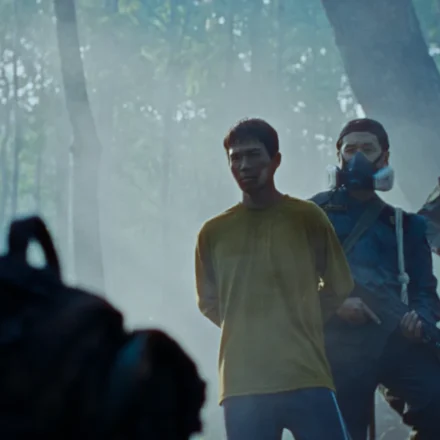
To understand the stakes of Tony, one must first understand the "Johnson Method." His previous work relied on a pseudo-documentary, run-and-gun style that prioritized spontaneity over script. His crews were small, his locations often unauthorized, and his storylines fluid. When filming Nirvanna the Band the Show, for instance, the production acted as a detective unit chasing down leads. If an interesting stranger appeared on the street, or a new narrative opportunity arose during an improvised scene, Johnson would pivot immediately, often abandoning the original plan to follow the "truth" of the moment.
"I can pursue ideas that come up on set right to the end," Johnson said of his earlier work. "We can create entirely new storylines from moments of improv… we can chase down the story with that production model as if we’re detectives on the trail of a serial killer."
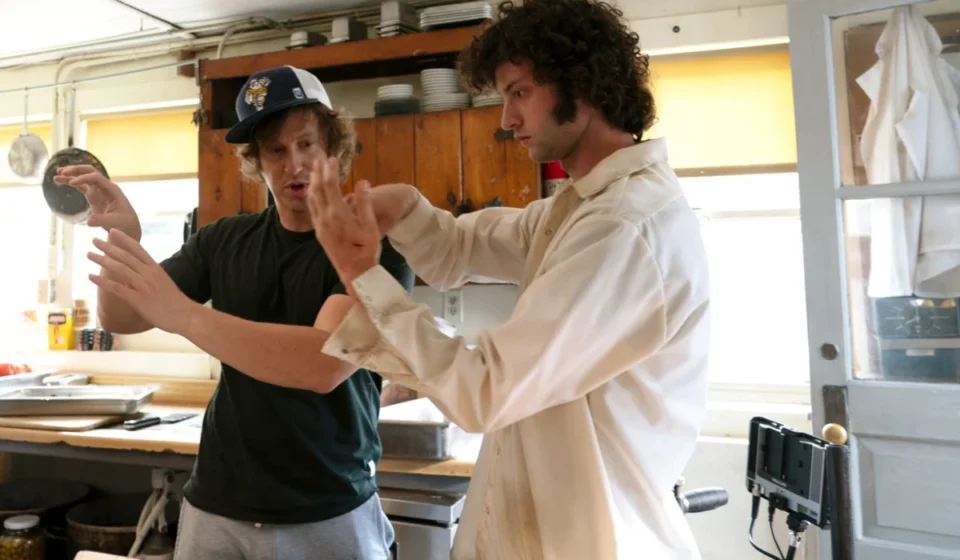
However, Tony required a departure from this chaos. As his first American feature, the film demanded a level of structural discipline impossible to achieve through guerrilla tactics. Rooted in the performance of breakout star Dominic Sessa—who portrays a 20-year-old Bourdain working in a Cape Cod kitchen—the film necessitated a more deliberate, storybook aesthetic. Working alongside cinematographer Michael Bauman, a veteran of the Paul Thomas Anderson school, Johnson sought to create a visual language where, as he describes it, "the pages just turn."

The Struggle of the Planned Frame
For a director whose identity is tied to the unexpected, the rigidity of a period piece was a profound challenge. "I was trying to challenge myself to just tell a story using only acting and writing," Johnson said. "It was a real shedding of what normally makes me comfortable."
During the production of Tony, Johnson confessed to feeling "trapped." For a filmmaker who views the script as a mere springboard, the requirement to hit specific marks and adhere to a pre-planned schedule felt like a betrayal of his own philosophy. "When [filmmakers] go write a scene, bring in the actors, shoot the scene, and they get it perfect, exactly the way that they had planned, that’s a failure," he argued. "My feeling is that the script and the plan is just your springboard for you to then discover something alive and out of control on the day."
This tension between the "pirate ship" mentality and the demands of a high-budget A24 production was mitigated by his partnership with Bauman. The cinematographer provided the technical scaffolding that allowed Johnson to focus on performance, even while the director remained deeply wary of losing the "accidents" that make his films feel vital.
Collaborative Spirits: The Influence of Josh Safdie
Johnson’s shift toward more formal filmmaking has been bolstered by a growing kinship with fellow visionary Josh Safdie. The two directors, both known for their kinetic, high-pressure storytelling styles, are currently collaborating on a comedy centered on the Transportation Security Administration (TSA).

The collaboration has provided Johnson with a new framework for leadership. Reflecting on advice from Safdie, Johnson noted, "He said to me, ‘My job is to transfer enthusiasm from myself to the other people making this movie.’ My God, if I don’t see it the exact same way."
Johnson views Safdie as the benchmark for modern independent filmmaking. He admires how Safdie has scaled his operation without sacrificing the "kinetic" nature of his work. "He started with nothing and very slowly built that thing and apparatus around him in New York," Johnson observed. "He is always working with the same people and slowly, slowly, slowly building the castle brick by brick."
Future Implications: The Magic of Scaling Up
As Johnson looks to the future, the scale of his projects is undoubtedly expanding. He is currently developing a potential trilogy based on Magic: The Gathering, a franchise that played a significant role in his own childhood. Reports suggest that Johnson may be inheriting the production apparatus utilized by Denis Villeneuve during the Dune trilogy, a massive step up from his days of sneaking into the CN Tower to film.
Yet, Johnson remains refreshingly grounded about his own limitations. "I’m not a technician," he insisted. "I actually don’t come to filmmaking from the point of view of someone who has images in his head that wants to create them. That’s not what draws me to movies."

The question facing Matt Johnson is whether he can maintain his "pirate" identity—that need for chaos and discovery—within the confines of a major studio trilogy. He is no longer the film student roaming Toronto with a camera in his backpack, but he is clearly terrified of becoming a cog in a machine that produces "perfectly planned" failures.
Conclusion: A New Chapter for the Outlaw Auteur
The release of Tony on August 21 marks the next step in this evolution. It is a film that proves Johnson can handle the weight of a biopic and the demands of period-accurate production, but it is also a testament to his ongoing struggle to keep the "alive and out of control" elements of his craft.
Whether he is dealing with the high-stakes world of Bourdain’s early kitchen life or preparing to adapt a massive gaming franchise, Johnson’s goal remains the same: to find the human error, the happy accident, and the authentic pulse in the middle of a pre-planned frame. For an audience accustomed to his unpredictable style, the transition to bigger stages is not an end to his outlaw spirit, but a new way of testing its limits.
A24 expands ‘Tony’ nationwide on Friday, August 21. For those interested in deeper insights into Johnson’s creative process, his full interview is available on the Filmmaker Toolkit podcast, streaming now on Apple, Spotify, and all major platforms.