The Twilight of the High-Concept Comedy: A Deep Dive into ‘Spa Weekend’ and the Fade of a Genre

The evolution of cinematic genres is rarely a sudden collapse; rather, it is a slow, often imperceptible receding of the tide. Just as the Western spent the 1960s drifting toward a horizon many didn’t realize was a final sunset—only to be resurrected decades later in deconstructed forms—the high-concept, "crass-but-lovable" comedy is currently entering its own twilight zone. The latest evidence of this transition arrives in the form of Spa Weekend, a film that attempts to capture the lightning-in-a-bottle energy of the late 2000s raunch-com era but instead serves as a poignant reminder of how tired the formula has become.
Written and directed by Jon Lucas and Scott Moore—the duo who rose to prominence with the screenplay for The Hangover and later directed the surprisingly sharp Bad Moms—Spa Weekend is a quintessential example of the "title-as-concept" movie. It wears its obviousness like a badge of honor, signaling to the audience: "I am loud, I am predictable, and that is why you are here." However, as the industry shifts and audience tastes lean toward more subversive or genre-bending humor, Spa Weekend feels less like a breath of fresh air and more like a beautifully packaged, yet stagnant, relic.
Main Facts: The Anatomy of a Wellness Satire
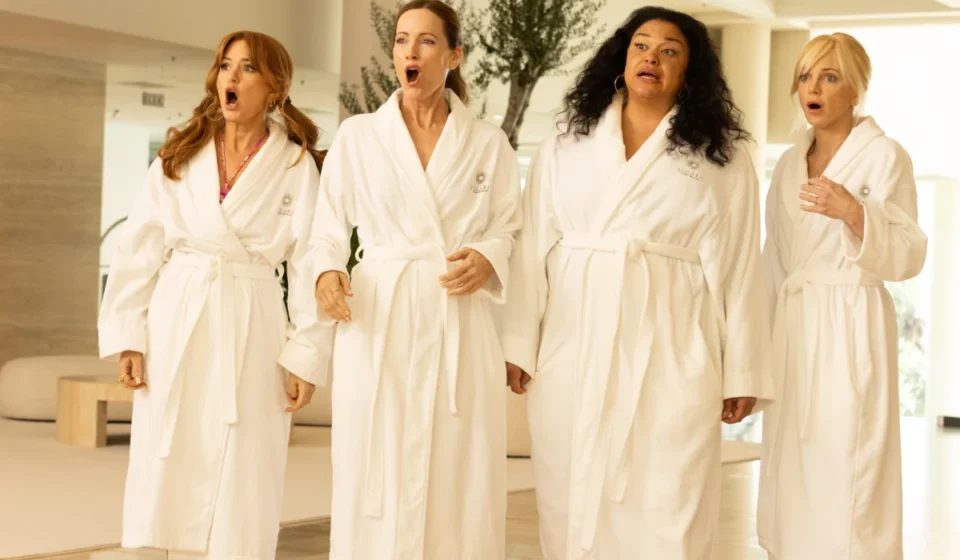
Spa Weekend centers on a familiar trope: four disparate female friends embarking on a luxury getaway to mend their fractured lives and reconnect. The film features a "minor-league" version of a star-studded ensemble, bringing together Leslie Mann, Anna Faris, Michelle Buteau, and Isla Fisher. On paper, the pedigree is impressive. Lucas and Moore have spent the better part of two decades perfecting the "group of friends behaving badly" sub-genre, and their move into the "wellness culture" space seemed like a natural evolution.
The film is set at the fictional Solaris Eden Beach, a "white-on-white" beachfront sanctuary where pampering is treated as a high-stakes performance art. The narrative attempts to skewer the New Age elitism of the modern wellness industry—think Goop-inspired "vagina steaming" and $400 hibiscus water—but it struggles to find a bite that matches its bark. Distributed by Black Bear Pictures, the film’s move away from major studio backing to an independent/streaming-focused model is perhaps the most telling fact about its place in the current Hollywood ecosystem.
Chronology: From Hibiscus Water to Mud Fights
The narrative arc of Spa Weekend follows a strictly traditional three-act structure, mirroring the "wild weekend" template established by its predecessors.
Act I: The Arrival and the Archetypes
The film opens by introducing its four leads, each a carefully constructed cardboard archetype. Jane (Leslie Mann) is the high-strung, over-scheduled attorney and divorced mother who is the catalyst for the trip. Her life is so regimented that a date must be scheduled three months in advance. She is joined by Sophie (Anna Faris), the "blonde mouse" who has spent a decade as a personal assistant to a tyrannical boss; Coco (Michelle Buteau), a divorced mother of two who serves as the group’s "fount of anger," though she meta-critiques her own role by rejecting the "angry Black woman" label; and finally, Mel (Isla Fisher), the wild card.
Upon arrival at Solaris Eden Beach, the group is met by Shanti (Erika Keynatz), a general manager who radiates a passive-aggressive "well-tended superiority." The first act focuses on the clash between the women’s messy realities and the sterile, elitist perfection of the spa.
Act II: The "Anarchic" Escalation
As the weekend progresses, the film attempts to inject "wild" comedy through a series of increasingly frantic set pieces. These include a raucous golf-cart chase through the pristine grounds, a mud-wrestling match between a divorced couple to "work off aggression," and a session of "goat yoga" that—predictably—devolves into chaos. It is during these sequences that the film’s central theme is revealed: the idea that every female friend group has one member everyone else secretly (or not so secretly) hates. In this case, it is Fisher’s Mel, a foul-mouthed British "trainwreck" who acts as the bull in the aromatherapy shop.
Act III: The Confrontation and Catharsis
The final act sees the inevitable breakdown of the spa’s "zen" facade. Jane encounters Kai (Adam Demos), a hyper-masculine Australian yoga instructor, leading to a moment of supposed clarity where Jane admits she sees through the "posh pretense" of the wellness industry. The film concludes with the requisite emotional breakthroughs, as the women accept their flaws and the "toxic" friend is reintegrated into the fold. However, the resolution feels less like an organic ending and more like a contractual obligation.
Supporting Data: The Lucas-Moore Track Record
To understand why Spa Weekend feels like a "pre-chewed" experience, one must look at the data and history of its creators. Jon Lucas and Scott Moore became the architects of the modern ensemble comedy with The Hangover (2009), which grossed over $467 million worldwide and redefined the R-rated comedy. They followed this success with Bad Moms (2016), a sleeper hit that earned $183 million on a modest $20 million budget.
However, the "bad behavior" genre has seen diminishing returns in recent years. Analysis of the domestic box office shows a sharp decline in the performance of mid-budget, high-concept comedies:
- The Theatrical Shift: In 2010, major studios released an average of 20-25 R-rated comedies per year. By 2023, that number had dropped to fewer than five.
- Streaming Migration: Films like Spa Weekend are increasingly being diverted to platforms like Hulu, Netflix, or independent distributors like Black Bear. This shift suggests that studios no longer view these "star-driven" comedies as reliable theatrical draws.
- The "Melissa McCarthy" Factor: The film casts Isla Fisher against type in a role clearly designed for the Melissa McCarthy archetype—the "bawdy, disheveled disruptor." While Fisher is a talented comedic actor, critics have noted that her performance feels "too grounded," lacking the "trashy insanity" required to make the character’s destruction feel earned rather than scripted.
Industry Perspectives and Critical Consensus
The reception of Spa Weekend highlights a growing rift between the creators of traditional comedies and the evolving expectations of the audience.
Critical Sentiment:
The consensus among film critics suggests that while the film is "amiable" and "likable," it suffers from a script that "needs a massage." Critics have pointed out that the satirical potential of wellness culture—a world ripe for the kind of evisceration seen in HBO’s The White Lotus—is largely wasted here. Instead of sharp social commentary, the film relies on "rote antics" and "tame" anarchy. The comparison to Barb and Star Go to Vista Del Mar is frequent; where Barb and Star embraced surrealism and genuine weirdness, Spa Weekend remains tethered to a formula that feels twenty years old.
Official Stance from the Creative Team:
While Lucas and Moore have defended their "crass and obvious" style as a form of escapism, industry insiders suggest that the "Hangover formula" may have reached its logical conclusion. The "pre-chewed" nature of the jokes—where the audience knows the punchline the moment the setup begins—is increasingly being rejected by a demographic that craves either more sophisticated satire or more authentic "cringe" humor.
Implications: The End of the "Bad Behavior" Era?
The release of Spa Weekend carries significant implications for the future of the comedy genre.
First, it signals the death of the mid-budget theatrical comedy. When major studios stop producing films like this, the "star system" for comedic actors begins to erode. Leslie Mann and Anna Faris, both veterans of the genre, find themselves in a film that feels "relegated" rather than "celebrated."
Second, it highlights the challenge of satirizing modern culture. In an era where "Goopy optics" and celebrity wellness gurus are already self-parodying, a film must go deeper than "goat yoga" jokes to remain relevant. Spa Weekend identifies the target but fails to pull the trigger, ending up as part of the very culture it seeks to mock.
Finally, the film serves as a litmus test for the "indie-streaming" model. By moving to Black Bear Pictures, Spa Weekend avoids the pressure of a massive opening weekend but also loses the cultural footprint that a major studio push provides. It becomes "content" rather than a "cinematic event."
In conclusion, Spa Weekend is a film that exists in a state of cinematic limbo. It is well-acted, professionally directed, and occasionally funny, but it is haunted by the ghost of comedies past. As the Western once did, the high-concept, crass comedy is riding into the sunset. We’ve seen what happens at the spa before, and while the "hibiscus water" might be refreshing for a moment, the aftertaste is one of undeniable familiarity. The genre isn’t dead, but it is certainly in need of a radical reinvention—one that a simple mud bath cannot provide.