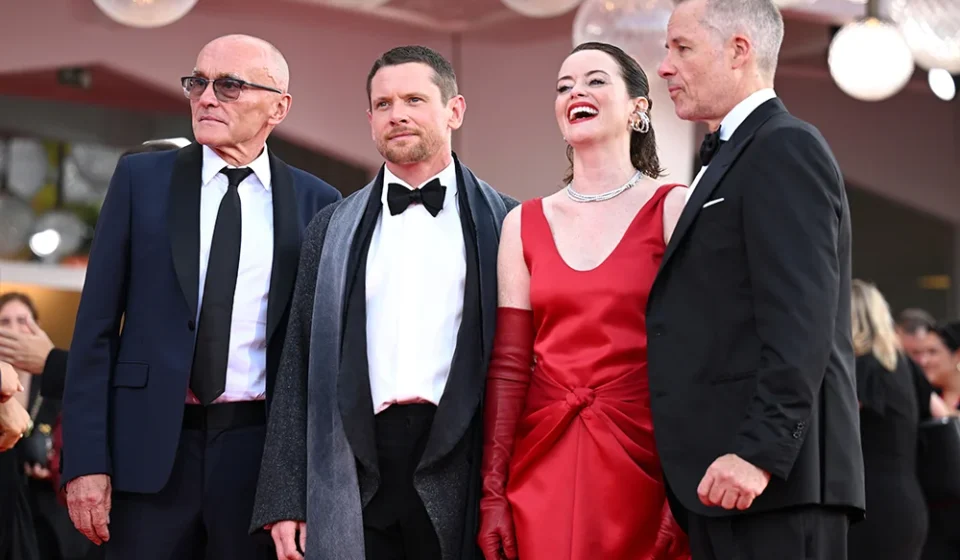

The 81st Venice Film Festival roared to life this week, casting a high-wattage spotlight on the Lido as cinema’s most prestigious event commenced with a potent mix of Hollywood glamour and biting political discourse. The festival’s opening night was anchored by the world premiere of Ink, director Danny Boyle’s explosive, fast-paced drama that chronicles the genesis of Rupert Murdoch’s global media empire.
As the curtains rose on the Palazzo del Cinema, the atmosphere was thick with both the humidity of the Italian summer and the palpable anticipation surrounding a film that dares to humanize one of the most polarizing figures in modern history. With a star-studded cast led by Guy Pearce and Jack O’Connell, Ink has officially set the tone for a festival grappling with the intersection of art, power, and industry-wide systemic inequality.
A Night of Glitz, Sweat, and Standing Ovations
The red carpet event was a spectacle of A-list proportions, drawing a crowd that had, in some cases, braved overnight camping to catch a glimpse of the stars. The heat on the Lido was stifling, creating a candid moment for lead actor Jack O’Connell, who, dressed in a sharp Dunhill coat, was forced to rely on paper towels to dab away perspiration before making his way into the Sala Grande Theatre.
Alongside O’Connell and co-stars Guy Pearce and Claire Foy, the premiere saw a significant turnout of industry titans, including George Clooney, who was honored earlier in the day with a prestigious lifetime achievement award. The presence of Jonathan Bailey and other luminaries underscored the festival’s return to full-scale, post-pandemic pageantry.
Following the final credits of Ink, the audience engaged in the customary Venetian ritual of a prolonged standing ovation. The applause lasted for nearly four-and-a-half minutes—a respectable duration by most standards, though notably curtailed by the cast’s own restlessness. As festival director Alberto Barbera attempted to orchestrate a more dramatic, lingering photo opportunity on the stairs, O’Connell and Foy—clearly eager to exit the sweltering theater—began collecting their belongings and heading toward the doors. The brief, slightly awkward interruption provided a moment of levity, with O’Connell sharing a joke with Boyle that drew laughs from the rest of the cast.
The Chronology of an Empire: Unpacking ‘Ink’
Set against the gritty, smoke-filled backdrop of 1969 London, Ink charts a pivotal chapter in the life of a young Rupert Murdoch. The narrative centers on Murdoch’s acquisition of The Sun, a struggling British broadsheet that he would eventually morph into the prototype for the modern, high-selling tabloid.
The film operates as a character study of the synergy between Murdoch—played with calculating charm by Guy Pearce—and his editor, Larry Lamb, brought to life by Jack O’Connell. Claire Foy rounds out the core cast as Jules Davies, a fictional journalist whose presence provides a moral and human anchor to the chaotic, hyper-competitive world of the London press.
The film’s trajectory through the festival circuit is already clearly mapped. Having been acquired by Netflix prior to its Venice debut, Ink is now a major contender for the Golden Lion. Following its Italian premiere, the film is scheduled for high-profile stops at the Telluride Film Festival and the Toronto International Film Festival (TIFF). Netflix has set a theatrical release for December 11, with the film slated to hit the streaming platform on January 8.
The Boyle Perspective: Avoiding the "Monster" Trope
During the post-premiere press conference, Danny Boyle addressed the elephant in the room: how to portray a man whose media conglomerate, the Fox Corporation, has been blamed for fueling political polarization across the globe. Boyle was adamant that his film was not intended to be a "hit piece."
"He represented, at the time, a breath of fresh air in what was a very rigid British society," Boyle remarked to the press. "He offered a kind of freedom with a different voice."
Boyle’s direction intentionally avoids "monsterizing" the mogul, a choice that has sparked early critical debate. By focusing on the 1969 origins of the empire, the film captures a moment of ambition and disruption rather than the settled, institutional power Murdoch would eventually exert. This nuanced approach suggests that Ink is more interested in the mechanics of media power than in rendering a moral judgment on the legacy of the 95-year-old Australian tycoon.
The Jury’s Charge: Art as a Political Instrument
While Ink dominated the headlines, the festival’s intellectual pulse was set by jury president Maggie Gyllenhaal. Addressing the assembly during Wednesday’s press conference, Gyllenhaal set a serious, reflective tone regarding the state of the world. With the backdrop of ongoing conflicts in Gaza and Ukraine, as well as the volatility of the American political landscape, Gyllenhaal insisted that filmmakers cannot—and should not—attempt to remain neutral.
"I think movies are fundamentally, unavoidably political," Gyllenhaal stated. She argued that the cinema’s role is to challenge audiences by forcing them to look at uncomfortable subjects. "I think we can challenge ourselves to hear stories about the most corrupt, most perverse people because it opens up the opportunity to find empathy for those people."
This philosophy directly mirrors the artistic gamble of Ink. If Gyllenhaal’s jury is looking for films that bridge the gap between repulsive figures and human complexity, Danny Boyle’s portrait of Murdoch fits the criteria perfectly.
Systemic Inequities: The Gender Gap at the Golden Lion
The festival’s discourse was not limited to international politics; it also turned inward toward the industry’s own exclusionary practices. Gyllenhaal addressed the glaring lack of female directors in the current Golden Lion competition, a point of contention that has dogged the Venice Film Festival for years.
In this year’s lineup, only a handful of films in the main competition are helmed by women: Woman Unknown, by Danish-Egyptian filmmaker May El-Toukhy, and Naza, a documentary co-directed by Rachel Szor and Yuval Abraham.
"There’s a systemic problem," Gyllenhaal noted, her tone reflecting the gravity of the oversight. "It’s harder for women to get films financed."
This admission highlights a lingering tension at the heart of the festival: while Venice continues to be a bastion of prestige and high-concept storytelling, it remains a site of struggle regarding who gets to tell those stories. The conversation surrounding the lack of female representation suggests that while the films on screen are evolving to tackle modern complexities, the infrastructure of the film industry itself remains frustratingly stagnant.
Implications for the Season Ahead
As the Venice Film Festival moves forward, Ink has established a formidable precedent. It is a film that marries the commercial muscle of a Netflix production with the auteur sensibilities of Danny Boyle, all while tackling a subject—media influence—that is arguably more relevant today than it was in 1969.
The critical reception will be closely watched, particularly as the film enters the North American circuit. For Netflix, Ink represents a key strategic play for the upcoming awards season. By positioning the film as both an historical drama and a character-driven study of power, the streamer is signaling its continued dominance in the prestige film space.
As the sun sets on the Lido, the festival leaves us with a compelling narrative arc: the rise of a media titan, the weight of historical memory, and a jury president demanding that cinema serves as a mirror to our most difficult realities. Whether Ink takes home the Golden Lion remains to be seen, but it has undoubtedly succeeded in making the world look, once again, at the man who changed how we consume the truth.