The Unquenchable Flame: Edoardo De Angelis Returns to the Lido with ‘The Fire Within You’

As the cinematic world turns its collective gaze toward the Venice Film Festival, the spotlight is firmly fixed on one of Italy’s most evocative filmmakers: Edoardo De Angelis. Ahead of the festival’s prestigious competition launch, RAI Cinema International Distribution has secured global rights to the director’s latest project, The Fire Within You (Il fuoco che ti porti dentro). This dark tragicomedy marks a distinct tonal shift for De Angelis, moving away from the grand historical scales of his recent work to explore the volatile, claustrophobic, and deeply personal anatomy of a toxic mother-son relationship.
A Career Defined by Neapolitan Soul
Edoardo De Angelis has spent the better part of the last decade establishing himself as a vital chronicler of the Neapolitan experience. His breakout moment arrived in 2016 with Indivisible, a visceral, visually arresting drama about conjoined twins that captivated festival audiences and solidified his reputation for blending local folklore with stark, human-centric storytelling.
De Angelis’s trajectory toward the upper echelons of European cinema was cemented in 2023, a landmark year that saw him open the Venice Film Festival with the anti-war epic Comandante. That same year, he further expanded his reach with the Netflix adaptation of Elena Ferrante’s The Lying Life of Adults. Having navigated both high-budget historical tapestries and intimate literary adaptations, The Fire Within You represents a return to the director’s roots—an intimate, character-driven chamber piece that challenges the traditional romanticization of the Italian matriarch.
The Narrative Foundation: From Page to Screen
The film is an adaptation of the prize-winning autobiographical novel by the esteemed Italian editor and author Antonio Franchini. The story follows Antonio, a man who successfully escaped the gravitational pull of his hometown of Naples, building a stable, conventional life in Milan. However, his past arrives at his doorstep in the form of his mother, Angela.
The synopsis sets the stage for a narrative that is as much a domestic thriller as it is a dark comedy: Angela is a woman defined by her extremes—irresistible yet deeply opinionated, conservative yet fiercely confrontational. Her arrival for Christmas Eve acts as the catalyst for an emotional siege. What begins as a festive gathering quickly devolves into a battlefield where decades of suppressed resentment, misunderstanding, and unresolved trauma rise to the surface.
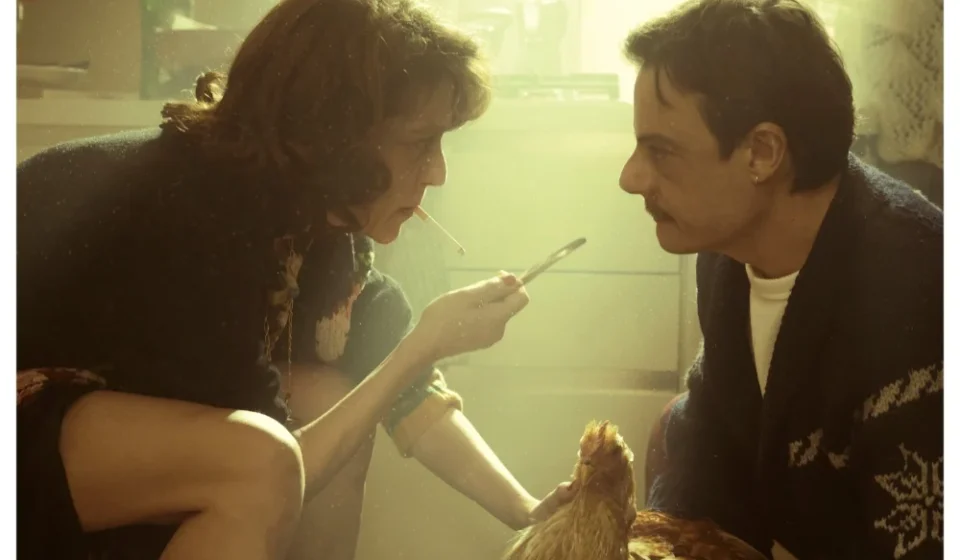
The film promises a surreal, high-stakes environment where the tension is not just between characters, but against inanimate objects and unspoken expectations. From a stubborn capon that refuses to be cooked to the ghost of a daughter who may never arrive, the film serves as a crucible. As De Angelis describes it, the relationship is a "fire that burns with an unquenchable intensity—one that no distance and no separation can ever extinguish."
Official Insights: A Conversation with Edoardo De Angelis
In an exclusive discussion with Variety, De Angelis delved into the origins and thematic ambitions of The Fire Within You. When asked how the project originated, the director noted that the connection was serendipitous. While working with Franchini on the publication of the novelization of Comandante, the author shared the seeds of his personal story.
"I was immediately fascinated because I found so many similarities with my grandmother and with many women I’ve met in my life," De Angelis reflected. "Women who are strong, charismatic, incendiary. For me, to make a film, all you need is a strong character, like Angela. Obviously, then you have to build everything else. The plot can be changed, the story can be rewritten, but the character remains the anchor."
Deconstructing the Matriarchal Archetype
Perhaps the most compelling aspect of De Angelis’s commentary is his deconstruction of the "Neapolitan Mother" archetype. In popular culture, the Italian mother is often reduced to the "loving nurturer"—the woman who cooks with love and keeps the family unit together. De Angelis rejects this stereotype entirely.
"In this case, her cooking is terrible," the director notes. "She hates her children and her grandchildren. In fact, she almost poisons them. And yet, this type of figure exists in the society that I grew up in: a matriarchal, male-dominated society. It is a human, maternal land of many contradictions."
This toxic brand of matriarchy, according to De Angelis, is not limited to Naples; it is a universal, albeit devastating, archetype. The film explores the paradox of this relationship: the mother is a heat source, but one that destroys those who linger too long. "If you distance yourself from it, you’re nothing. Away from her heat, you freeze to death. If you come too close, you burn."
The Performance: Vanessa Scalera’s "Madman" Approach
The success of such an intense, character-heavy film rests entirely on the shoulders of the lead actress, Vanessa Scalera. De Angelis describes their collaboration as one of the most rewarding of his career, marked by a moment of creative surrender that transformed the production.
"I told her, ‘Vanessa, you’re doing everything really well. But I want something else. I want you to let go; I want you to take me places you don’t even know exist,’" De Angelis recalled.
The director compared the process of working with Scalera to driving a high-speed vehicle on a winding road. The performance became so raw, so uninhibited, that the pair stopped trying to "steer" the character and instead allowed the momentum of the emotional conflict to dictate the pace. De Angelis hinted that Scalera likely mined her own biography to tap into the character’s specific tics and mannerisms, creating a performance that is both eerily grounded and dangerously unpredictable.
Production and Market Implications
Produced by Picomedia—an Asacha Media Group company under the Fremantle umbrella—in collaboration with RAI Cinema, the film is positioned as a prestige project for the Italian market and beyond.
The acquisition by RAI Cinema International Distribution ensures that the film will receive a robust rollout. For the international market, The Fire Within You represents a high-concept exploration of family trauma, a genre that has seen significant crossover success in recent years (as seen in the global appetite for works like The Bear or the films of Yorgos Lanthimos).
By bringing this film to the Venice competition, De Angelis is not just presenting a story about a dysfunctional family; he is testing the boundaries of how much "heat" an audience can withstand. The film serves as a reminder that the most intimate conflicts—the ones played out over a kitchen table—are often the most cataclysmic.
Conclusion: The Horizon
As the festival curtains rise, all eyes will be on how the international jury and the critics respond to this volatile portrait of motherhood. If The Fire Within You succeeds, it will not be merely because of its technical execution, but because of its brutal honesty. De Angelis has tapped into something fundamental about the human condition: the agonizing, inextricable bond that exists between the creator and the created.
Whether the film ultimately claims the Golden Lion remains to be seen, but it has already succeeded in its primary objective: it has sparked a conversation about the darker, often ignored aspects of familial love. For De Angelis, the fire is already burning, and the world is invited to watch.