
The horror genre has long been the lifeblood of independent cinema, providing a playground for visionaries to subvert expectations with limited budgets and boundless imagination. Yet, rarely does a film arrive with the sheer, hallucinogenic audacity of Buddy. The story of a bright orange unicorn turned cinematic nightmare has officially emerged as the most significant indie-horror success story of the year, shattering box office projections and proving that in the post-pandemic landscape, the "weird" is exactly what audiences are hungry for.
A Staggering Opening: By the Numbers
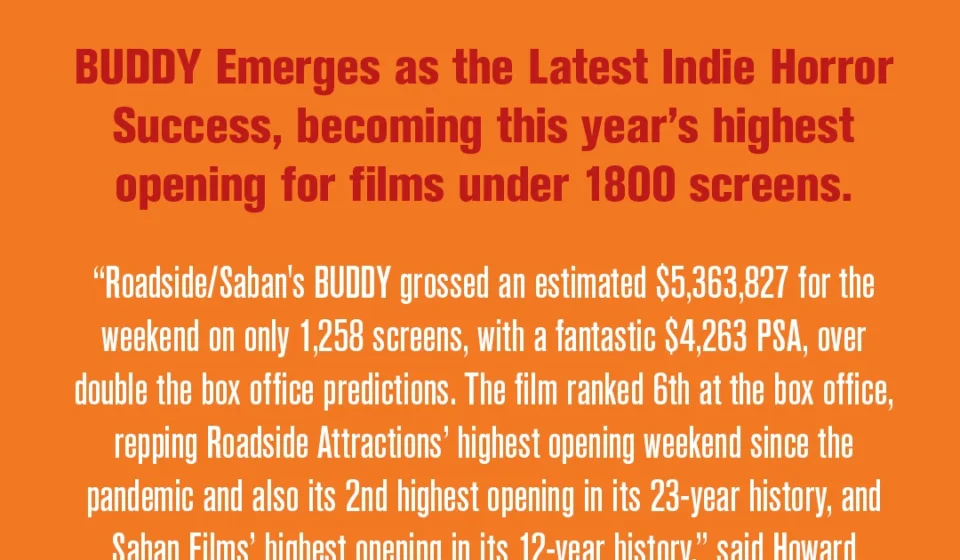
The Roadside Attractions and Saban Films collaboration, Buddy, has defied conventional wisdom, grossing an estimated $5,363,827 during its opening weekend. While that figure may seem modest compared to the bloated budgets of summer blockbusters, the context tells a different story. The film achieved this monumental haul on only 1,258 screens—a feat that makes it the highest-opening film of the year for any project showing in under 1,800 theaters.
More impressively, the film effectively doubled original box office projections. For Roadside Attractions, Buddy marks their most successful opening weekend since the onset of the global pandemic and stands as the second-highest opening in the studio’s 23-year history. Saban Films, meanwhile, is celebrating a landmark achievement of its own: Buddy is the highest-grossing opening in their 12-year existence.
This performance places Buddy in a new pantheon of indie-horror darlings, joining the ranks of viral sensations like Terrifier, the visceral Clown in a Cornfield, and the high-profile, auteur-driven Dracula by Luc Besson.
Chronology: From Sundance Sensation to Cultural Zeitgeist
The ascent of Buddy was not accidental; it was a carefully cultivated trajectory that began in the chilly, prestigious corridors of the Sundance Film Festival.
- The Festival Circuit: Upon its premiere, Buddy immediately generated "water cooler" buzz. Industry insiders and critics were struck by director Casper Kelly’s commitment to practical effects and his refusal to adhere to traditional horror tropes.
- The Marketing Blitz: Unlike traditional horror films that rely on legacy sequels or jump-scare-heavy trailers, Buddy leveraged a grassroots digital strategy. By the time of its wide release, the film had garnered over 450,000 followers across social media channels, amassing a staggering 150 million views.
- The Release Window: The film’s theatrical rollout was calculated to maximize the "communal experience." By targeting a release during a period where audiences were feeling the fatigue of franchise repetition, Buddy offered a fresh, "gonzo" alternative that demanded to be seen in a crowded theater.
Supporting Data: The Gen Z Factor
The success of Buddy is not merely a result of good luck; it is a direct reflection of a shifting demographic. According to exit polls, 83 percent of the audience for Buddy is under the age of 35, highlighting a potent trend: Gen Z is actively seeking out original, high-concept, and social horror experiences.

Furthermore, the film’s reach is impressively diverse. It over-indexed with Hispanic audiences, who accounted for 37 percent of the opening weekend turnout. This data suggests that the film’s visual-first, high-concept narrative transcends traditional language barriers and cultural marketing silos.
When compared to recent horror outings, the digital footprint of Buddy is nothing short of anomalous. Its 150 million views on social media significantly outpace the promotional reach of major studio releases, including Obsession, Insidious: Out of the Further, End of Oak Street, and even the highly touted Evil Dead Rise. This proves that in the current market, authenticity and "meme-ability" are more valuable currencies than traditional celebrity star power.
Official Responses: The Vision of the Creative Team
The executives behind the film’s distribution—Howard Cohen and Eric d’Arbeloff of Roadside Attractions, alongside Jonathan Saba and Shanan Becker of Saban Films—issued a joint statement capturing the industry’s collective surprise and admiration for the project.
"We loved Buddy the moment we saw the film at Sundance," the executives stated. "We were blown away by the wildly imaginative worlds director Casper Kelly created with practical effects. Audiences are clearly responding to its authenticity and its ‘gonzo’—WTF—horror-comedy-thriller combination."
The "WTF" factor, as described by the studio heads, is precisely what critics have latched onto. With an 88 percent "Certified Fresh" rating on Rotten Tomatoes, the film has bridged the gap between critical darling and audience favorite. Reviewers have praised Kelly’s decision to avoid CGI-heavy spectacle, opting instead for tactile, physical, and often unsettling practical effects that ground the absurd premise of a demonic orange unicorn in a palpable, terrifying reality.
The Implications: A New Era for Indie Horror
The success of Buddy serves as a clarion call to the film industry. For years, the narrative has been that the theatrical experience is dying, or at the very least, that audiences will only leave their homes for massive IP-driven tentpoles like those from Marvel or DC. Buddy proves this premise false.

1. The Death of the "Safe" Bet
The primary implication of Buddy’s success is the validation of high-risk, original content. Studios have spent years banking on established intellectual property to mitigate risk. Buddy proves that a completely original, bizarre, and unclassifiable story can generate more profit per screen than a legacy sequel.
2. The Power of "Communal Escapism"
Post-pandemic, the cinema has evolved from a passive viewing space into a communal destination. Younger audiences are increasingly using horror films as a social event—a place to scream, laugh, and react in unison. Buddy’s blend of horror and comedy provides the perfect "social environment" that cannot be replicated on a home streaming service.
3. Practical Effects as a Selling Point
The resurgence of practical effects, pioneered by filmmakers like Casper Kelly, is a reaction against the "digital fatigue" of the last decade. Audiences are increasingly savvy regarding CGI; the "weight" of practical effects in Buddy has become a primary selling point in its marketing, suggesting that future indie horror projects will likely move away from green-screen reliance to capitalize on this tactile trend.
Conclusion: The Unicorn’s Legacy
As Buddy continues its theatrical run, its legacy is already cemented as a pivotal moment in the 2020s horror landscape. It is a reminder that the genre thrives best when it pushes boundaries, defies categorization, and embraces the weird.
Whether the industry will learn the right lesson—that audiences crave the authentic and the avant-garde—remains to be seen. But for now, Buddy stands as a bright orange beacon in a sea of gray, proof that even a unicorn can become a box-office monster if you give it the right screen and the right amount of chaos. The success of this film is not just a win for Roadside Attractions or Saban Films; it is a win for every aspiring filmmaker who has a wild, terrifying, and "WTF" idea waiting to be unleashed upon the world.