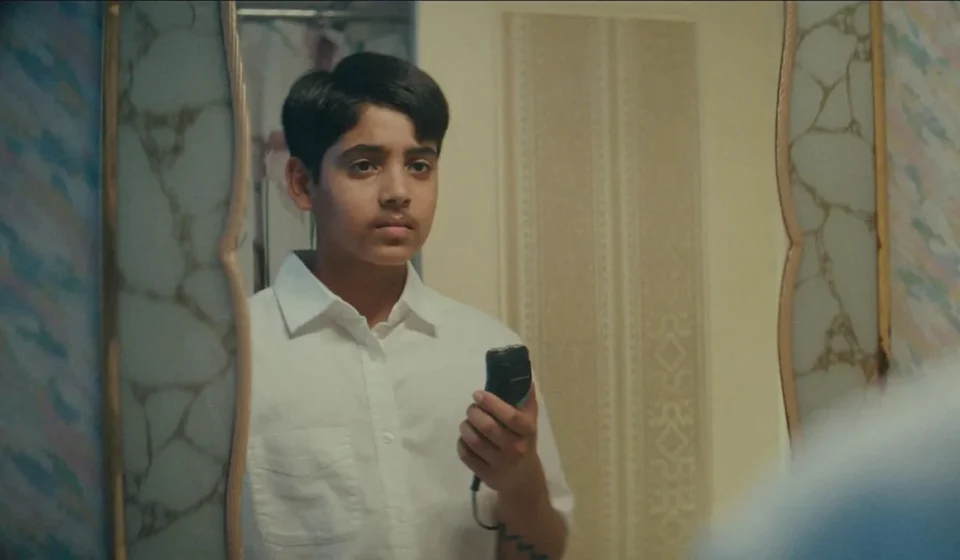
The Uncomfortable Verisimilitude of Adolescence: A Deep Dive into Imran J. Khan’s ‘Mustache’

The American coming-of-age comedy is a genre often defined by its glossy nostalgia and sanitized rebellions. However, every few years, a film emerges that strips away the cinematic veneer to reveal the raw, itchy, and often mortifying reality of puberty. Imran J. Khan’s feature directorial debut, Mustache, is such a film. A bilingual, mid-90s period piece set in the Silicon Valley suburbs, Mustache captures the specific anxieties of the Pakistani American experience with a level of "uncomfortable verisimilitude" rarely seen in mainstream media.
Winner of the Narrative Feature Competition Audience Award at SXSW, the film serves as both a cultural time capsule and a universal exploration of the "outsider" identity. Through the eyes of its 13-year-old protagonist, Ilyas, Khan explores the intersections of faith, family, and the desperate desire to shave off one’s own insecurities.
Main Facts: The Genesis of a New Coming-of-Age Classic
Mustache is the first feature film from writer-director Imran J. Khan, who draws heavily from his own upbringing in the Bay Area during the 1990s. The film centers on Ilyas (played by newcomer Atharv Verma), a scrawny, whip-smart teenager whose life is upended when he is forced to transfer from a private Islamic school to a public high school in San Jose.
Key Production Details
- Director/Writer: Imran J. Khan
- Lead Cast: Atharv Verma (Ilyas), Rizwan Manji (Hameed), Ayana Manji (Yasmeen), Melody Cao (Liz Park), and Alicia Silverstone (Miss Martin).
- Setting: San Jose, California, circa 1995–1996.
- Primary Themes: Immigrant identity, religious observance vs. social integration, the "cringe" of adolescence, and the evolution of digital communication (AIM).
The film is notable for its bilingual dialogue, seamlessly blending English with Urdu to reflect the authentic linguistic environment of a South Asian American household. At its core, the movie is a character study of a boy who feels "alien" in every environment he occupies—too "ethnic" for the public school kids, yet too "corrupted" by American pop culture for his traditionalist father.
Chronology: From Islamic School to the Public School Odyssey
The narrative arc of Mustache follows a tight, emotionally escalating timeline that mirrors the frantic internal state of its protagonist.
The Initial Displacement
The story begins with a conflict that is both trivial and existential: Ilyas’s upper lip. As he hits puberty, a prominent mustache begins to sprout. In his conservative household, particularly under the watchful eye of his father, Hameed, the question of whether a young man is "allowed" to shave becomes a point of religious and cultural contention.
This personal crisis is exacerbated when Hameed, struggling to launch a new business and provide for his family of five, decides to pull Ilyas out of the familiar, protective environment of his Islamic school. The transition to a generic American public high school is immediate and jarring. Ilyas is thrust into a world where his scrawny frame and conspicuous facial hair make him an instant target for bullying.
The Scheme and the Digital Lifeline
Disconnected from his peers, Ilyas’s only solace is his connection to Yasmeen (Ayana Manji), his crush from his former school. Their relationship exists primarily through the glowing screens of mid-90s computers, utilizing America Online’s Instant Messenger (AIM).
Desperate to return to his Quranic studies—not necessarily out of religious fervor, but out of a desire for social safety—Ilyas concocts a series of harebrained schemes to convince his parents that public school is "corrupting" him. These ploys range from the hilarious to the pathetic, such as sheepishly eating McDonald’s in the family kitchen as a sign of his "Westernization."
The Deception Escalates
The plot takes a turn into "Dear Evan Hansen" territory when Yasmeen helps Ilyas draft fake emails from a "girlfriend" at his new school. The goal is for his parents to find these emails and be so scandalized that they immediately transfer him back to the Islamic institution. However, the plan backfires when Ilyas begins to develop real feelings for the subject of his lies: his witty and attractive classmate, Liz Park. Following her into the school’s drama class—led by the empathetic Miss Martin (Alicia Silverstone)—Ilyas finds himself building a real life that contradicts his elaborate scheme to escape.
Supporting Data: Aesthetics, Performance, and the ‘Cringe’ Factor
The success of Mustache relies heavily on its technical execution and the casting of its lead. Unlike many teen movies that cast 25-year-olds to play freshmen, Khan opted for age-appropriate actors, which heightens the film’s sense of realism.
The Performance of Atharv Verma
Atharv Verma’s portrayal of Ilyas is the film’s emotional anchor. He plays the character as a boy in a constant state of "anxiety spirals." Ilyas is a "sci-fi writer" at heart, obsessed with Back to the Future, and he contextualizes the world through complex diagrams and flowery, verbose voiceovers. Verma manages to convey a character who is intellectually advanced but socially paralyzed, making his "apocalyptic" reactions to minor social faux pas feel genuine to the audience.
Visual Language and Symbolism
Director Imran J. Khan utilizes specific visual motifs to represent Ilyas’s hyper-awareness:
- Extreme Close-ups: The film frequently cuts to macro shots of hair follicles and skin, representing Ilyas’s obsession with his mustache and how the world perceives his physical flaws.
- The "Spotlight" Effect: When Ilyas feels judged, the cinematography shifts to high-energy, jittery bursts that intentionally agitate the viewer, mirroring a panic attack.
- Computer Light: The scenes of Ilyas and Yasmeen "talking" via IM are staged as face-to-face conversations bathed in the cool, blue glow of a computer monitor, emphasizing the intimacy of early digital connections.
Official Responses and Production Background
The film has been hailed by critics as a vital addition to the South Asian American cinematic canon. During its festival run, particularly at SXSW, audiences and critics noted that the film avoids the "model minority" trope, instead presenting a family that is messy, financially stressed, and culturally complex.
Directorial Intent
In various interviews and Q&A sessions, Imran J. Khan has emphasized that Mustache was born from a desire to see a version of the 90s that included people like him. "It’s a story about a kid who is trying to find a middle ground between two worlds that both feel like they don’t quite fit," Khan has noted. He intentionally focused on the "mustache" as a symbol of the awkwardness of puberty that transcends culture but is filtered through a specific religious lens.
The Significance of the Cast
The casting of Rizwan Manji (known for Schitt’s Creek) adds a layer of seasoned gravitas to the film. Interestingly, the role of Yasmeen is played by Manji’s real-life daughter, Ayana Manji, which adds an organic chemistry to their scenes. The inclusion of Alicia Silverstone serves as a meta-nod to the 90s teen genre she helped define with Clueless, though here she plays the supportive adult mentor rather than the "it-girl."
Implications: Subverting the Genre and the Power of Specificity
Mustache carries significant implications for the future of independent filmmaking and representation. It suggests that the "universality" of a story is not found by making it generic, but by leaning into the most specific, lived-in details of a particular culture.
Subverting Coming-of-Age Tropes
Most coming-of-age films follow a trajectory of "self-discovery" that leads to confidence. Mustache is more cynical—and perhaps more honest. It suggests that finding oneself is not a linear path but a series of "hilarious tightrope walks." The film’s "aesthetic North Star" is Ilyas’s awkwardness. By refusing to let the character become "cool" by the end of the movie, Khan stays true to the reality of being 13.
The Immigrant Narrative 2.0
The film also pushes the immigrant narrative beyond the standard "clash of cultures" trope. It explores the internal diversity of the South Asian community—the distinction between the "cool" kids, the "ostracized" peers, and those trying to navigate the religious expectations of their parents. It highlights the "social suicide" that comes with being "completely seen" before one is ready.
Conclusion
Ultimately, Mustache is more than a comedy about a boy with facial hair. It is a mirror reflecting the most naked and vulnerable versions of ourselves. By grounding social chaos in genuine anxiety and piercing second-hand embarrassment, Imran J. Khan has created a film that feels both like a hazy memory and a painful, immediate reality. It stands as a testament to the fact that while the technologies of the 90s—like AIM and floppy disks—may be obsolete, the feeling of being a "scrawny kid with a quiet disposition" trying to survive high school is eternal.