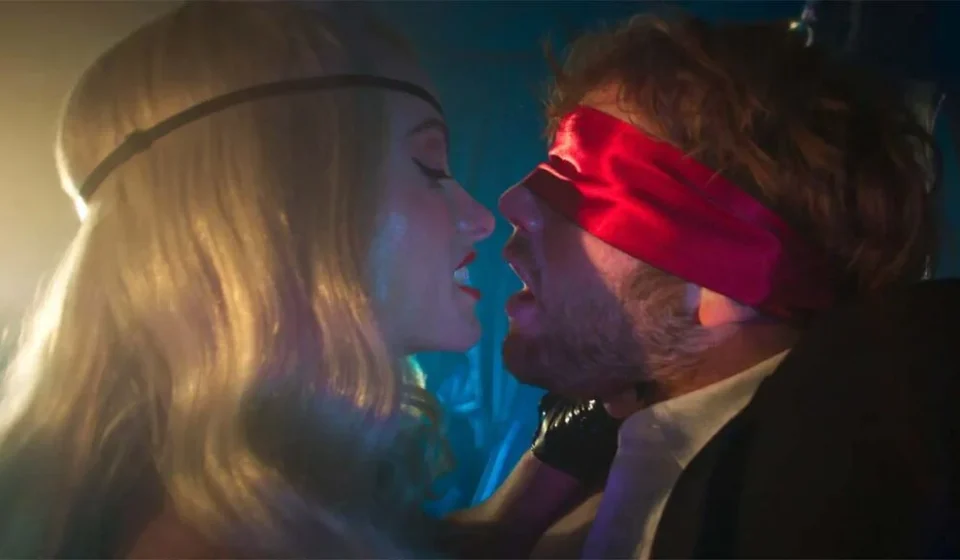

Editor’s Note: This review was originally published during the 2026 Sundance Film Festival. Magnolia Pictures releases "I Want Your Sex" in theaters starting July 31.
In a cultural landscape dominated by the rise of "trad-life" influencers—a demographic that often pairs performative celibacy with regressive, extremist ideologies—the return of Gregg Araki feels less like a cinematic event and more like a necessary intervention. It is 2026, and the 66-year-old auteur, best known for his defining contributions to 1990s queer cinema, has emerged from a 12-year hiatus to remind a timid generation that there is profound, transformative power in being unapologetically horny.
His latest feature, I Want Your Sex, is a half-naked prayer for Gen Z to shed the digital armor that keeps them feeling safe, isolated, and profoundly unfulfilled. It is an invitation to engage in the messy, consensual, and occasionally dangerous business of human desire.
The Premise: A Portrait of Modern Dysfunction
The film introduces us to Elliot (Cooper Hoffman), a 23-year-old adrift in the vapid, hyper-capitalist art world of Los Angeles. We first meet him in a state of physical disarray—bleeding from the face—while his employer, the celebrated artist Erika Tracy (Olivia Wilde), floats face-down in a swimming pool. It is an opening image that sets the tone for the film’s erratic, genre-bending trajectory: a blend of high-concept satire, erotic drama, and a half-hearted murder mystery that refuses to take itself too seriously.
Erika Tracy, a "pretentious whore from hell" as she gleefully describes herself, is the engine of the film. Her art is intentionally mediocre, a hollow reflection of the industry’s obsession with brand over substance. Her primary interest, however, is not her work, but the psychological and sexual domination of her assistants. Elliot, a self-effacing people-pleaser, is the perfect mark. He is desperate for guidance and stunted by a relationship with a frigid, med-student girlfriend (Charli xcx) who refuses to engage in any physical intimacy.

Chronology of a Power Exchange
The film charts a nine-and-a-half-week arc of "sex-slavery" that serves as a gender-swapped, satirical riff on the 2002 film Secretary. Erika wields her power with a casual cruelty that mirrors the corporate dynamics of the past century. She is a figure of "alien cheekbones" and latex power suits, a woman who claims to have slept with underground legends and who views her subordinates as playthings to be molded or discarded.
As the weeks progress, the dynamic shifts. Araki is not interested in traditional eroticism; the trysts are often comic, clinical, and framed by S&M tropes that strip away the glamour of the encounter. The question at the heart of the narrative is whether Elliot is truly being exploited or if he is using this toxicity as a vehicle to understand his own desires. Does he actually enjoy the power dynamic, or is he simply performing the role he thinks he is required to play?
The narrative reaches its most potent peak when Elliot involves his best friend, Apple (Chase Sui Wonders), in an attempt to bridge his own insecurities. Wonders delivers the film’s most nuanced performance, playing a tomboy struggling with her own identity and desires. When Erika offers Apple a "golden opportunity" to explore her sexuality, the scene becomes a raw, fraught, and deeply affecting centerpiece that underscores the film’s broader thesis: that vulnerability is the only true antidote to the paralysis of modern life.
Supporting Data: The Cast and the Craft
While the film thrives on its central performances, it struggles under the weight of its supporting cast. Olivia Wilde is clearly having the time of her life, channeling a BDSM-infused Norma Desmond that carries much of the film’s runtime. Cooper Hoffman, meanwhile, channels a scruffy, modern-day Tom Hanks, providing the guileless center required to keep the audience grounded amidst the surrounding absurdity.
However, the film falters when it relies on a parade of "name talent" to fill out its roster. Mason Gooding, despite his undeniable screen presence, is relegated to the tired trope of the "sassy gay best friend," while Daveed Diggs, Johnny Knoxville, and Margaret Cho feel stuffed into roles that lack the depth of the leads. In these moments, the film feels like it is trying to cram a massive, high-budget sensibility into a project that thrives on the transgressive, DIY spirit of Araki’s earlier work.

Visually, the film is somewhat stilted. For a director who once made "cheapness" a stylistic feature—turning low budgets into an aesthetic of punk-rock urgency—I Want Your Sex feels surprisingly conventional. It is the first of his films where the budgetary constraints feel like a bug rather than a feature, lacking the frenetic, neon-drenched energy that made films like Kaboom feel like a fever dream.
Official Responses and Industry Context
The film’s reception has been as polarized as its premise. Magnolia Pictures, which is positioning the film for a wide release, is banking on the "Araki name" and the buzz generated at Sundance to draw in an audience that has been starved for transgressive, adult-oriented content. Industry critics have noted that while the film’s satire of the art world is somewhat "camp-lite," it functions effectively as a critique of a generation that has been conditioned to fear the consequences of being truly seen.
The film serves as a meta-commentary on the current state of Hollywood: the way it swallows up raw, rebellious talent and attempts to sanitize it for a broader audience. That the film doesn’t entirely succeed in its attempt to bridge the gap between "outsider art" and "commercial product" is perhaps the most honest thing about it.
The Implications: Why It Matters
Despite its narrative bloat and occasional "teachable moment" heavy-handedness, I Want Your Sex remains an essential watch. It captures a specific, painful truth: that in an era where every action is filtered through digital performance, the act of baring one’s soul—and one’s body—is the most radical act left.
The film does not end in a traditional place of healing or resolution. There is no moralizing conclusion where the characters "learn their lesson" and return to a state of normalcy. Instead, it concludes with the messy, unresolved reality of human connection. It suggests that while the pursuit of desire can be toxic, confusing, and occasionally humiliating, it is far better than the alternative: going through life without ever knowing what you want, or how it feels to finally get it.

Araki’s return may not be the seamless, definitive masterpiece his fans were hoping for, but it is a necessary reminder that cinema can still be a space for the uncomfortable, the perverse, and the profoundly human. It is a messy, occasionally labored, but ultimately vital piece of work that dares to suggest that maybe, just maybe, we should all be a little more "chickenshit" about admitting that we want to be touched.
Grade: B-
“I Want Your Sex” premiered at the 2026 Sundance Film Festival. Magnolia Pictures releases the film on July 31.