The Provocation of Paul Schrader: Unpacking the Polarizing "The Basics of Philosophy"

Paul Schrader has spent the better part of five decades interrogating the human condition through the lens of the "man in a room"—a lonely, often self-flagellating figure grappling with existential dread, religious trauma, and the crushing weight of moral failure. From the neon-soaked streets of Taxi Driver to the austere, quiet suffering of First Reformed, Schrader’s cinema has always thrived in the gray spaces of the soul. However, with his 26th directorial effort, The Basics of Philosophy, the veteran filmmaker has waded into waters so murky and fraught with potential for outrage that the film threatens to collapse under the weight of its own ambition.
Premiering at the 2026 Venice Film Festival, The Basics of Philosophy is not merely a drama; it is a volatile, self-conscious provocation. By juxtaposing the themes of pedophilia and the realities of gay life in a rural, mid-western setting, Schrader has crafted a film that feels designed to ignite a "diabolical shitstorm" of cultural debate.
The Narrative Core: A Professor’s Descent
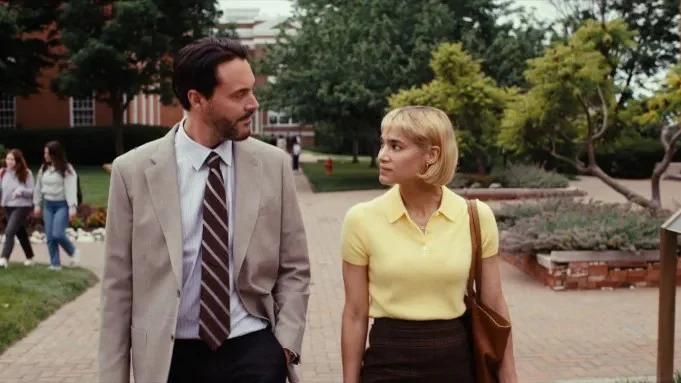
The film centers on John Jorissen (Jack Huston), an academic at the fictional Ridgemont College in Missouri. A specialist in the works of Spinoza, Jorissen is a man of intellectual rigidity, defined by his professional persona. His life is one of performative domesticity; he maintains a "situationship" with a colleague, Professor Rebecca Richards (Sofia Boutella). Their bond is a study in estrangement—a sexless, tentative arrangement that seems to serve as a prism for Jorissen’s repressed anxieties rather than a genuine romantic connection.
The narrative momentum shifts violently during the funeral of Jorissen’s father, Melvyn (Bill Pullman). Amidst the religious pageantry and the stifling atmosphere of a mourning community, Jorissen spots a face from his past: Miguel (Daniel Zovatto). The revelation is seismic: Miguel is a grown version of a 14-year-old boy whom Jorissen once tutored when he was a music instructor.
Through a series of black-and-white, misty-lensed flashbacks, the audience is invited to piece together the history between these two men. Were these events a transgression, a misunderstanding, or a dark, formative trauma? Schrader deliberately leaves the truth fractured, challenging the viewer to reconcile the man Jorissen has become with the specter of his past.
Chronology of a Controversial Production
To understand The Basics of Philosophy, one must look at the context in which it was produced. This is Schrader’s first project since a former assistant leveled allegations of sexual misconduct against the filmmaker in 2025—a claim Schrader has consistently and vehemently denied.
While the film was likely in development prior to these public accusations, the finished product feels inextricably linked to the director’s own biography. It is a work obsessed with the concept of the mea culpa, or at the very least, a cynical acknowledgment of the "religious guilt" that has served as a central pillar of Schrader’s career. The film functions as an uncomfortable mirror: is this a genuine attempt at atonement, or a defiant troll aimed at a culture that is increasingly scrutinizing the private lives of its auteurs?

Supporting Data: Cinematography and Performance
Technically, The Basics of Philosophy stands among the most visually arresting entries in Schrader’s recent filmography. Collaborating with cinematographer Sean Price Williams, Schrader moves away from the monochromatic austerity of First Reformed into a realm of oversaturated, vibrant, and at times garish lighting. The visual language evokes the high-melodrama of classic cinema, yet it is applied to a subject matter that is decidedly sordid.
Jack Huston’s performance is a high-wire act of ambivalence. As a member of one of Hollywood’s most storied dynasties, Huston brings a weary, aristocratic detachment to the role of Jorissen. He portrays the character with a terrifying, hollowed-out blankness—a man who spends his days writing academic treatises on Spinoza while his internet history hides the search for Nembutal. His interactions with Miguel are fraught with a perverse, palpable tension, perfectly capturing the tremor of a man who knows his mask is slipping.
The Failure of Representation: A Muddled Underbelly
Despite the film’s technical prowess, it stumbles significantly in its portrayal of the queer experience. Schrader’s attempt to depict the "gay underworld" of Missouri feels not only dated but fundamentally disconnected from reality.
When Jorissen tracks Miguel to a local dive bar—specifically, a "line-dancing gay dive bar"—the film descends into caricature. The character of Claude (Shiloh Fernandez), a hustler who also happens to own a gun shop and hold a degree in psychology, feels ripped from the pages of a 1970s exploitation film. When Claude declares he is going to "shake his booty," the dialogue feels so wildly improbable that it undermines the film’s intended seriousness.
Comparatively, the film lacks the nuance of recent, smaller-scale works like Elliot Tuttle’s Blue Film, which explored similar thematic terrain—the dangerous intersection of desire and predation—with a more confident, authentic gaze. Because Schrader’s perspective remains so fundamentally "outside" of the world he is depicting, his attempt to generate "moral hot water" fails to scald as effectively as it might have had it been anchored in a more authentic understanding of the subculture it portrays.
Official Responses and Public Reception
The film has already polarized critics. At the Venice Film Festival, the discourse was divided between those who saw it as a "restlessly fascinating" return to form for the 80-year-old director and those who found its treatment of sensitive subjects to be exploitative and ill-conceived.
There has been no formal response from the subjects of the real-world allegations, but the industry is watching closely to see how distributors handle the film. As of now, The Basics of Philosophy is seeking a U.S. distributor—a process that will undoubtedly be complicated by the toxic blend of the film’s controversial subject matter and the director’s personal baggage.

Implications: The Death of the Auteur?
The central implication of The Basics of Philosophy is the question of whether a filmmaker’s work can ever be truly separated from their life when the work itself is so insistently autobiographical. Schrader has created a film that is fundamentally about the impossibility of running from one’s own depravity.
The film suggests that for the "man in a room," the only path to virtue is to be destroyed before the world finds out who you really are. It is a bleak, nihilistic conclusion, one that feels particularly pointed given the current cultural climate.
Is this the "best film since The Card Counter," as some have suggested, or is it a relic of a bygone era of "provocateur cinema" that no longer resonates with a modern audience? The answer likely depends on the viewer’s tolerance for the "ick factor." Schrader is clearly aware that he is baiting his audience. He knows that his film will be labeled as "Ragebait" by some, while others will view it as a profound, if flawed, confession.
Ultimately, The Basics of Philosophy is a movie that demands a reaction. It is a work that refuses to be ignored, even as it makes a compelling case for why it should be deeply scrutinized. Whether it serves as a final, masterful statement on the burden of guilt or a tawdry, misguided stumble remains a matter for the history books. For now, the film stands as a challenging, messy, and deeply unsettling coda to an already legendary career.
Grade: C+
The Basics of Philosophy premiered at the 2026 Venice Film Festival. It is currently seeking U.S. distribution.