The Mirage of the Wasteland: Why Ridley Scott’s ‘The Dog Stars’ Feels Like a Departure into Vacuity

Ridley Scott has spent nearly half a century defining the visual vocabulary of cinema. From the claustrophobic, industrial dread of Alien (1979) to the historical grandeur of Gladiator (2000) and the visceral, mud-caked realism of The Last Duel (2021), the British filmmaker has consistently proven himself a master of world-building. Yet, with his 30th feature film, the post-apocalyptic thriller The Dog Stars, Scott has delivered a work that stands as a confounding anomaly in his illustrious career. While not an unmitigated disaster, it is arguably the first Ridley Scott project in decades that feels profoundly, almost aggressively, unnecessary.
Adapted from Peter Heller’s novel by screenwriter Mark L. Smith, the film presents a vision of a world post-viral-collapse that feels caught between high-minded introspective drama and hollow, genre-compliant action. Despite a pedigree of talent behind and in front of the camera, the film struggles to justify its own existence, serving as a somber, often inert reflection on a world that has already been exhausted by pop culture’s recent obsession with the end of days.
The Geography of Despair: A Chronology of the Collapse
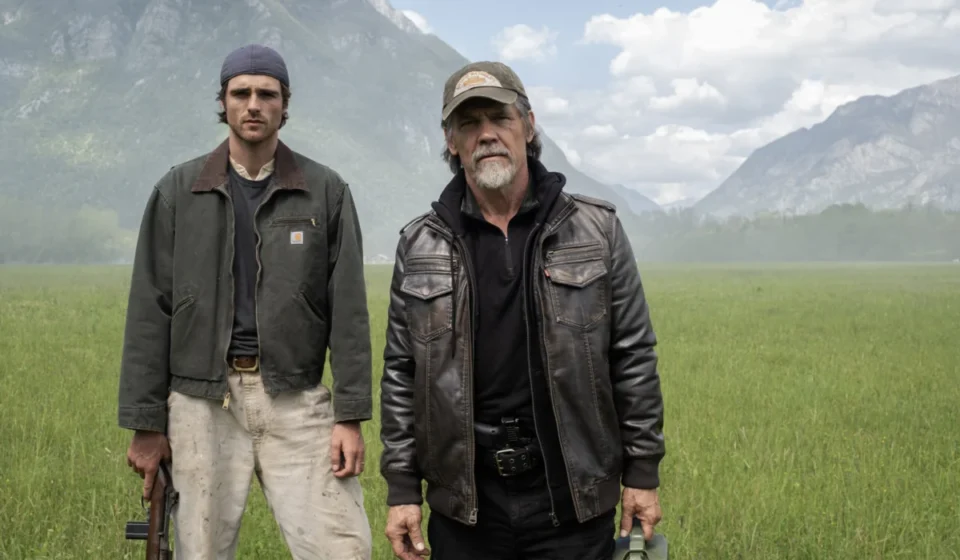
The narrative of The Dog Stars unfolds in the shadow of a global pandemic that has effectively wiped out the structures of modern civilization. We are introduced to Hig, played with a weary, soulful detachment by Jacob Elordi. Hig is a pilot, a relic of a time when the sky was a place of transit rather than a source of looming threat. He resides in a desolate, abandoned airplane hangar alongside Bangley (Josh Brolin), a man whose personality has been entirely subsumed by paranoia and the tactical requirements of survivalism.
The chronology of their misery is established through fragmented memories: the tactile, domestic warmth of kissing a pregnant wife and playing with a dog, juxtaposed against the current reality of scavenging for rations in a derelict McDonald’s. It is a classic, if somewhat shopworn, trope of the genre. Hig, grieving the loss of his wife, Melissa, maintains a tenuous tether to his humanity through his Australian cattle dog, Jasper, and a yellow Cessna he painstakingly repairs. His goal, initially, is one of quiet nihilism: to fly into the peaks of the Telluride mountains and end a life that has lost its structural integrity.

As the film progresses, the duo finds themselves besieged not by the expected "brain-infected fungus monsters" found in contemporary counterparts like The Last of Us, but by the more mundane, if no less lethal, threats of human desperation. They navigate a landscape dominated by marauding splinter groups, most notably the "Reapers"—a group of face-painted, ululating, post-verbal mercenaries whose presence serves to inject sporadic, jarring bursts of violence into an otherwise languid narrative.
Supporting Data: The Craft of the Mundane
The production design, led by the lush, overgrown reclamation of Erie, Colorado, offers a striking visual palette. The city, now choked by towering grasses and creeping flora, provides a backdrop that screams of lost grandeur. Composer Harry Gregson-Williams contributes a score rich in South American-inflected folk textures, attempting to ground the film in a mournful, earthy reality.
However, the technical proficiency of the film is undermined by a pervasive lack of narrative tension. A central set piece—a night-vision-filtered siege on Bangley’s property—demonstrates the classic Scott eye for choreography, yet it rings hollow. In a director’s filmography defined by high-stakes tension, these scenes feel curiously randomized. They occur, they contain gore, and they conclude with little impact on the emotional arc of the characters.
The film’s cinematography, helmed by Mank Oscar-winner Erik Messerschmidt, is equally perplexing. While technically sound, it lacks the "lively spirit" one might expect from such a collaboration. The gray, muted tones of the wasteland reflect the characters’ inner lives, yet they ultimately serve to distance the viewer from the stakes, turning the film into a visual exercise in malaise rather than a compelling drama.

The Romance of the Apocalypse: Casting and Chemistry
The film’s second act shifts focus as Hig follows a mysterious radio transmission to Grand Junction. There, he encounters a new duo: "Pops" (Guy Pearce), a former Navy SEAL, and his daughter Cima (Margaret Qualley). The dynamic between this pair and the protagonists provides the film with its most significant, albeit flawed, emotional beats.
Cima, despite having spent years in the harsh reality of a collapsed world, maintains an aesthetic of clean-cut, modern grooming that threatens to shatter the film’s suspension of disbelief. The chemistry between Elordi and Qualley, intended to be the film’s romantic core, remains fundamentally blunted. Their connection feels like a narrative imposition—a requirement of the genre rather than an organic outgrowth of the story. The script by Mark L. Smith, whose upcoming work on the WWII football drama The Mosquito Bowl remains a point of speculation, seems to hinge the survival of humanity on this pairing, a conceit that lands with a dull thud.
The inclusion of Allison Janney as Darlene, a stewardess running an Art Deco, retro-futurist airport in Grand Junction, offers a fleeting, albeit bizarre, injection of life into the final act. It is here that the film briefly flirts with a more surreal, Kubrickian horror, suggesting that the film’s most interesting potential was buried under layers of unnecessary sobriety.
Implications: The Legacy of the Master
What are we to make of The Dog Stars in the context of Scott’s late-career output? Following the bombastic, action-heavy Gladiator II, this film feels like a retreat into a smaller, more suffocating space. It is a film that reflects on the "plaintive, platitudinous" nature of memory while struggling to engage with its own present.

The absence of government, the shadow of paramilitary organizations, and the survivalist ethos all mirror the current anxieties of a polarized society, yet the film fails to synthesize these elements into a coherent critique. Instead, it offers a "heterosexuals will save us" trope that feels remarkably dated and uninspired for a director of Scott’s stature.
The performance of Jacob Elordi is undeniably competent. He carries the weight of the film’s sadness with a stoic, brooding intensity that proves his range as a leading man. Yet, even his captivating silhouette cannot rescue a screenplay that seems determined to keep its characters, and its audience, at a distance.
Conclusion
Ultimately, The Dog Stars is a film that yearns for the very clichés it purports to subvert. It attempts to be a somber meditation on grief, loneliness, and the fragility of the human spirit, but it is hampered by a lack of narrative momentum and a failure to establish a genuine emotional connection between its characters.
For the legions of fans who have followed Ridley Scott from the neon-soaked streets of Blade Runner to the dust-blown arenas of Gladiator, The Dog Stars will likely be viewed as a curiosity—a technically proficient, well-acted, but ultimately hollow entry in a legendary filmography. It is a film that reminds us that even the most visionary directors are subject to the entropy of their own creative process.

Grade: C
20th Century Fox releases "The Dog Stars" in theaters nationwide on Friday, August 28.