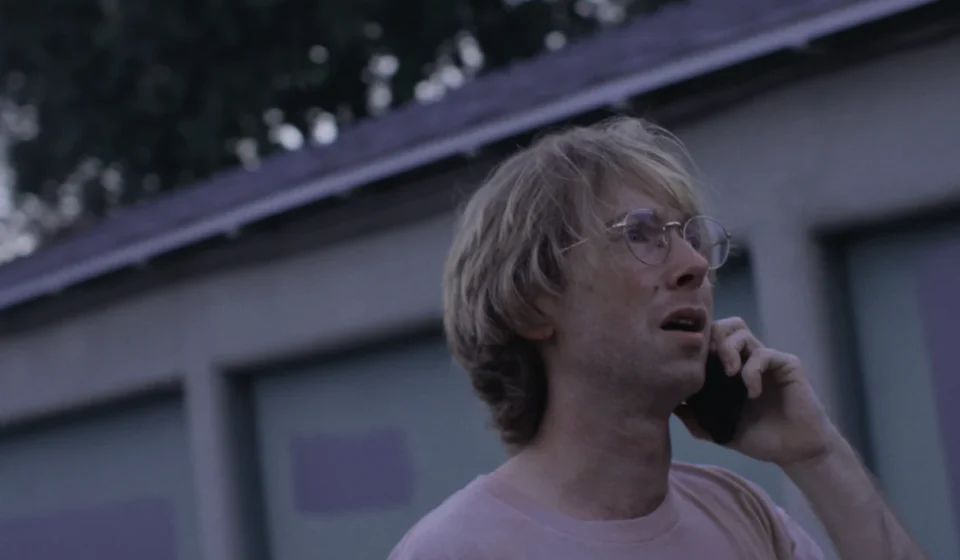
The Digital Void: Harrison Atkins’ Sour Minnows and the Erosion of Human Certainty

In the landscape of 2026 independent cinema, few films have managed to capture the ambient, gnawing dread of the current moment quite like Harrison Atkins’ Sour Minnows. Premiering at the Fantasia International Film Festival to a polarized yet captivated audience, the film serves as a surreal, meta-textual exploration of identity, memory, and the slow-motion collapse of human connection in an age increasingly mediated by artificial intelligence and digital noise.
The film begins with a television broadcast: “HOLLYWOOD HEARTACHE: DEATH OF AN ENIGMA.” The subject is Jojo “Vacation” Monica, an eccentric performer found dead under circumstances that defy conventional explanation. For the film’s protagonists, Ricky (David Brown) and Tepper (Chase Williamson)—two Los Angeles roommates characterized by a blend of slacker apathy and cinephilic pretension—the news of Monica’s death is little more than a prompt to engage with a piece of content they have ignored until now.
A Chronology of Disintegration
The narrative arc of Sour Minnows is not linear; it is fractal. It operates on the logic of a corrupted hard drive, skipping through sequences that mirror the fragmented attention spans of its protagonists.
The film opens with a sequence that sets the tone for the entire experience: a news anchor (Ryan Perez) sits in a field behind a dilapidated structure, calmly announcing the onset of the apocalypse as a horde of brain-dead humanoids—the "tunnel denizens"—slurp small fish from the pavement. It is a scene of grotesque, low-fidelity horror.
When Ricky and Tepper witness this same event, the film reveals the first of many ruptures in consciousness. Tepper remembers the incident vividly, claiming, “We dropped the groceries, dude,” while Ricky remains trapped in a state of bewilderment. This dissonance—the “permanent state of déjà vu,” as described by the character Aura (Suzanna Son)—is the film’s primary engine. Atkins uses this to destabilize the viewer’s trust in the narrative. We are forced to ask: Are we watching a linear story, or are we trapped in a loop of digital decay?
As the film progresses, the boundaries between the reality of the characters and the “content” they consume begin to dissolve. Ricky, who spends his days training AI modules, finds his own internal monologue mirroring the synthetic, hollowed-out language of the bots he teaches. He leaves himself cryptic notes, such as “MEN’S ROOM,” in a desperate attempt to anchor his own sanity, yet he remains unable to differentiate between his lived experiences and the data points he generates for his job.

The Anatomy of the Indie Slacker Archetype
At the heart of the film’s critique are Ricky and Tepper. They are, by design, difficult to empathize with. Tepper represents a specific strain of artistic entitlement—the amateur auteur who treats every person he meets as a potential extra in his own incoherent short films. Ricky, while less aggressive, is defined by a deep-seated malaise that mirrors the broader rot within the creative industry.
Atkins does not paint these men as tragic heroes, but rather as symptoms of a system that has commodified human expression. Their obsession with "content" at the expense of genuine human connection serves as a stinging indictment of the modern indie film scene. Yet, in a move of profound empathy, Atkins suggests that even this shallow, self-obsessed urge to create is a human instinct that is currently under siege. In a world where the creative landscape has been reduced to an "obvious racket," the act of making anything—even a crappy short film—becomes a desperate, valid attempt to assert one’s existence.
Supporting Data: The Ghost in the Machine
The film’s technical execution mirrors its thematic concerns. Atkins blends "bold arthouse bravado" with the "quaint charm of home video," utilizing a lo-fi aesthetic that feels both authentic and inherently suspicious. The seams are visible; the editing is intentionally jarring; the digital artifacts serve as a reminder that we are watching a construct.
The inclusion of the “yellow being” that allegedly “piloted” the late Jojo Monica adds a layer of supernatural horror that feels both out of place and entirely necessary. It serves as a metaphor for the way modern digital entities inhabit our lives, steering our attention and shaping our memories. By the time Monica’s death is reported on the news, his interview clips—once seen as the ramblings of a dying man—take on a terrifying, prophetic weight. He was telling the truth, but in a society addicted to the screen, the truth is often the first thing to be discarded as noise.
Official Context: A Tribute to Jeff Baena
The most significant piece of context provided by the film arrives in the final frames: a dedication to the late filmmaker Jeff Baena. Baena, a creative collaborator and friend of Atkins, died by suicide in early 2025.
For many viewers, this dedication acts as a “decoder ring” for the film’s emotional intensity. It transforms Sour Minnows from a cold, intellectual exercise into a raw, grieving document. The film does not attempt to explain the loss of such a complex, talented figure; instead, it acknowledges the "psychic distance" between the objective facts of a person’s life—the data points—and the reality of knowing them.

AI can provide a summary of a life, but it cannot capture the "wonderful weirdness" of human connection. Sour Minnows exists in that gap, mourning the loss of the intangible essence that makes an individual irreplaceable.
Implications for the Future of Cinema
The implications of Sour Minnows for the industry are twofold. First, it serves as a warning about the homogenization of culture. As AI begins to permeate the creative process, original, messy, and "imperfect" works like Atkins’ film become both harder to produce and more vital to our cultural health. The roughness of the film—its occasional opacity and its collision of too many concepts—is not a failure; it is evidence of human labor.
Second, the film challenges the audience’s role in the consumption of media. When Ricky is forced to watch himself from afar, it is a moment of profound tragedy. He is not the arbiter of his own truth; he is an observer of his own degradation. By forcing the audience to watch Ricky watching himself, Atkins mirrors the way we consume the lives of others on social media.
Ultimately, Sour Minnows is a film that refuses to be categorized. It is a horror film, a satire, a tragedy, and a meditation on the digital condition. While it may not have the mass-market accessibility of a more polished feature, its intellectual ambition is undeniable.
Atkins does not offer a solution to the malaise he depicts. He does not provide a roadmap out of the "gaping cave" that his characters are falling into. Instead, he offers a form of "bittersweet comfort." He suggests that in a world where everyone feels like they are losing their grip on reality, there is a shared, vulnerable humanity that remains—if only we can stop scrolling long enough to recognize it.
In his own words through his characters, Atkins asks the audience: “Did you actually watch it?” It is a question that lingers long after the credits roll, challenging us to engage with the world—and with each other—with a level of attention and compassion that the digital age actively tries to steal from us.

Sour Minnows is a flawed, frustrating, and deeply moving work that cements Harrison Atkins as one of the most vital, if intentionally difficult, voices in contemporary American cinema. It is a reminder that even when the screen is dark, the human need to tell a story remains the only true tether to the world we inhabit.
Grade: B+
“Sour Minnows” had its world premiere at the Fantasia International Film Festival on July 24. It is currently seeking distribution.