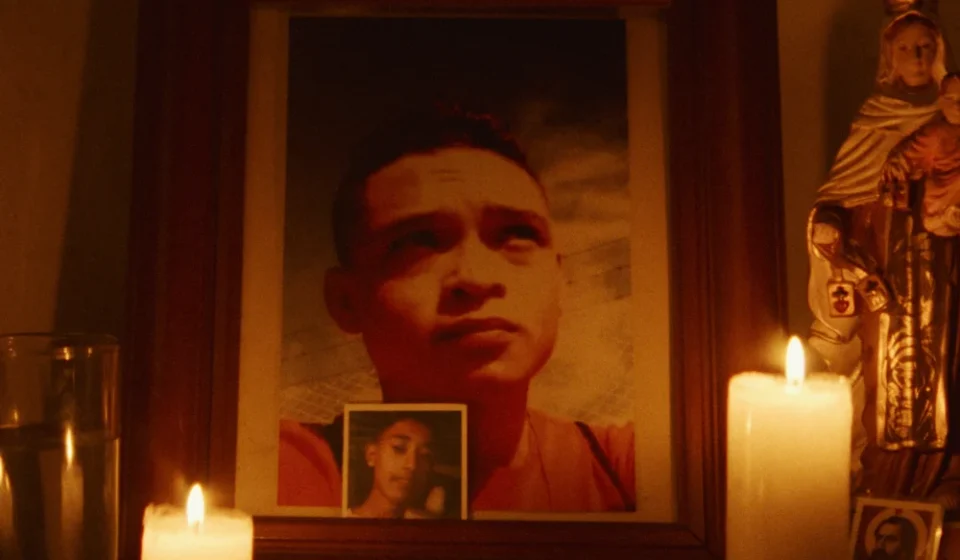
The Architecture of Absence: Unpacking the Trauma of Colombia’s Disappeared in ‘Five Years, Four Months’

The term "forcibly disappeared" is a chilling euphemism that has become woven into the fabric of Colombian history. Since the mid-1960s, a brutal internal conflict involving the state, paramilitary groups, and various guerrilla factions has left a void in the hearts of tens of thousands of families. While the international community often views these statistics through a lens of political history, the cinematic triumph Five Years, Four Months (Cinco años, cuatro meses) shifts the focus from the macro-political to the micro-emotional.
Directed by Juan Miguel Gelacio and Esteban Hoyos García, the film serves as a haunting meditation on the nature of grief that refuses to conclude. It is a portrait of a mother, Martha Baquero, whose life has been suspended in a "dizzying gulf" of uncertainty. Premiering in the Crystal Globe competition at the Karlovy Vary International Film Festival, the film has been lauded for its visceral, affective power and its refusal to look away from the agonizing slow-motion reality of a life defined by loss.
Main Facts: A Fictional Lens on a National Scourge
At the heart of Five Years, Four Months is Martha Baquero, portrayed with devastating restraint by Jenny Nava. While Martha is a fictional creation, her story is an amalgam of real-life testimonies from Colombian women who have spent decades searching for their children. The film follows Martha’s arduous journey to find the remains of her son, Fabian, who vanished into the maw of the country’s long-standing conflict.
The directors, Gelacio and García, eschew the traditional tropes of the "political thriller" or "human rights documentary." Instead, they embrace a style of understated realism that borders on the hypnotic. The film’s narrative is built on the "in-between" moments: the long bus journeys, the filling out of repetitive government forms, and the literal digging into the earth of potential mass graves.
The Aesthetic of Alienation
The filmmakers utilize a sensory-heavy approach to illustrate Martha’s alienation. Through meticulous sound design—amplifying the rustle of the wind, the low hum of traffic, and the calls of distant animals—the film places the viewer inside Martha’s hyper-aware yet numb psyche. This is a cinematic representation of trauma; she is a woman who is physically present in the world but emotionally tethered to a past that refuses to stay buried.
Chronology: The Labyrinth of the Search
The narrative structure of Five Years, Four Months mirrors the actual experience of the families of the disappeared: a long, exhausting slog through bureaucracy and false hope, punctuated by moments of surreal desperation.
The Bureaucratic Slog
The film begins by documenting the "drawn-out processes" that define Martha’s daily existence. We see her navigating nationwide exhumation projects, her life measured in bus tickets and the signatures on endless paperwork. These sequences are intentionally "uneventful," emphasizing the "calm and steady rhythm" of a life that has stalled. For Martha, the present is merely a waiting room for a future that may never arrive.
The Search for Community
In an effort to manage her grief, Martha joins a dance therapy class for other mothers of the missing. These scenes provide a rare glimpse into a support network of women who take care of one another. Here, Martha attempts to reconnect with her body, which has become a vessel for sorrow. However, the film poignantly notes that for the rest of the world, "life goes on." Martha is forced to put a "note of gaiety" into her voice during ordinary interactions, a mask that hides a psyche screaming with agony.
The Descent into the Unknown
The chronology takes a sharp turn when Martha meets Sandra (played by Carmiña Martínez). Sandra, who has been searching for her own son for 24 years, introduces a supernatural element to the search. She speaks of a place where one can find the missing by "speaking with a dead man." This leads Martha into a seedy, potentially dangerous world of crime and spiritualism. What begins as a realist drama transitions into something more diffuse and atmospheric, as the tension shifts from the ambient to the concrete.
Supporting Data: The Historical Reality of the Disappeared
To understand the weight of Five Years, Four Months, one must look at the staggering data that informs its narrative. The Colombian conflict is one of the longest-running internal wars in modern history, and the practice of forced disappearance was used as a weapon of terror by all sides.
- The Scale of Loss: According to the Colombian Unit for the Search for Persons Deemed as Missing (UBPD), more than 120,000 people are estimated to have been forcibly disappeared between 1948 and 2016. For context, this number is significantly higher than the disappearances during the "Dirty Wars" in Argentina and Chile combined.
- The Search for Justice: Following the 2016 Peace Agreement between the Colombian government and the FARC (Revolutionary Armed Forces of Colombia), the Special Jurisdiction for Peace (JEP) was established. Part of its mandate is to uncover the truth about these disappearances, but for many families, the progress is agonizingly slow.
- The Role of the Mothers: Much like the Madres de la Plaza de Mayo in Argentina, groups like the Madres de la Candelaria in Colombia have been the primary drivers of memory and justice. Their persistent presence in public squares and government offices is the real-world inspiration for Martha’s character.
The film’s inclusion of Martha’s eerie dreams—naked, anonymous bodies in dark forests—reflects the collective subconscious of a nation where the earth itself is a graveyard. These "haunting images" are not just cinematic flourishes; they are a visual representation of the "False Positives" scandal, where civilians were murdered by the military and dressed as guerrillas to inflate body counts.
Official Responses and Critical Reception
The film’s premiere at Karlovy Vary marked a significant moment for Colombian cinema on the international stage. Critics have praised the "impressive control" exhibited by Gelacio and García, noting that their second feature confirms them as masters of "cinema’s visceral, affective powers."
Critical Acclaim for Jenny Nava
The performance of Jenny Nava has been a focal point of critical discussion. By playing Martha with an "opaqueness that invites curiosity," Nava avoids the melodrama often associated with portrayals of grief. Her face, often "more blank than it is severe," forces the audience to project their own understanding of loss onto her, making the experience deeply personal for each viewer.
The Directors’ Vision
In interviews and press statements, Gelacio and García have emphasized that their goal was not to provide answers but to honor the "in-between feeling" of those left behind. They have stated that the film is an attempt to bridge the gap between the "grieving, still looking for answers, and those lucky others for whom the present isn’t a constant reminder of what has been lost."
The film’s reception has also highlighted the "hypnotic spell" it casts. By maintaining a slow, steady pace, the directors force the audience to endure the passage of time alongside Martha, making the "five years and four months" of the title feel palpable.
Implications: The Social and Psychological Toll
The implications of Five Years, Four Months extend far beyond the cinema screen. The film serves as a psychological autopsy of a society in a state of perpetual trauma.
The Transmutation of Pain
The film suggests that pain never truly stops; it only "transforms." For Martha, the community of grieving mothers is not enough. Her refusal to accept the silence of the state leads her to seek solace in "benevolent ghosts." This implies a profound failure of the social and legal structures of the country; when the law cannot provide closure, the grieving are forced to seek it in the spiritual or the surreal.
A Tool for National Memory
As Colombia continues its fragile peace process, films like this play a crucial role in "memory work." They ensure that the "forcibly disappeared" do not become mere statistics. By focusing on the "youthful enthusiasm" of the missing son, Fabian, and the "endless love" of his mother, the film humanizes the victims and their families.
The Final Step
The film’s culmination—a "devastatingly beautiful scene" where Martha speaks about her son for the first time—serves as a metaphor for the country’s need for truth-telling. The lush nature of Colombia is shown not just as a backdrop, but as a witness to the violence and the love that remains.
Ultimately, Five Years, Four Months helps a global audience understand the lengths to which a human will go to find a shred of truth. Whether that truth comes from a government file or a "dead man," the film argues that the act of searching is itself a form of resistance against the silence of history. Gelacio and García’s work is a moving testament to those who refuse to let the "dizzying gulf" of absence swallow the memory of their loved ones.