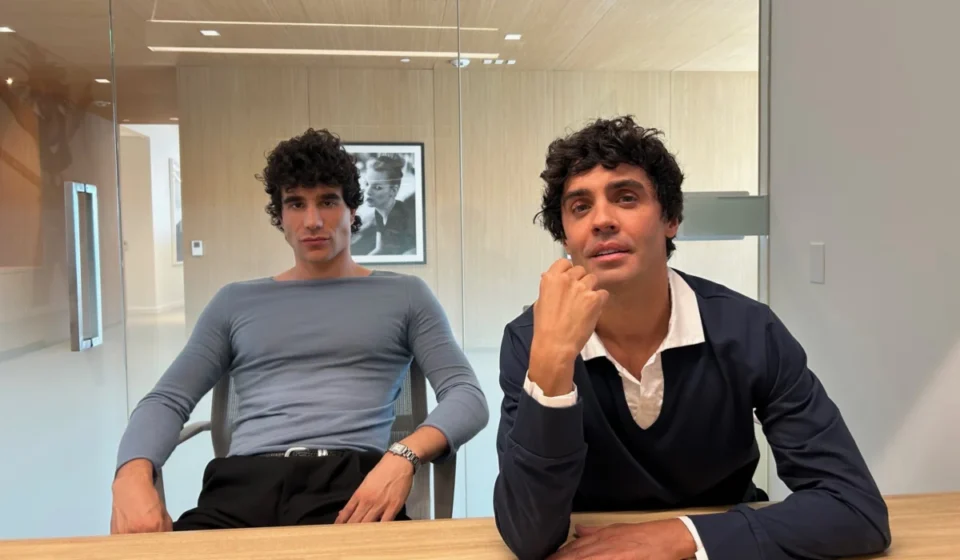
The Alchemy of Loss: How Los Javis Turned Personal Breakup into Spain’s Most Ambitious Cinematic Epic

Long before La Bola Negra set the Croisette ablaze at this year’s Cannes Film Festival, the creative duo known as "Los Javis"—Javier Calvo and Javier Ambrossi—had already solidified their status as the architects of a new Spanish cultural renaissance. Having conquered the small screen with the sharp-witted industry satire Paquita Salas (2016–2019), the poignant trans-identity biopic Veneno (2020), and the haunting, genre-defying family thriller La Mesías (2023), the pair had established a reputation for blending deep, often painful, human emotion with high-concept storytelling.
Now, with the backing of a $14 million budget from Netflix, the duo has delivered their most ambitious feature film to date. La Bola Negra not only shared the prestigious Cannes Director’s Prize with veteran filmmaker Pawel Pawlikowski’s Fatherland but has also emerged as a top contender for Spain’s official entry for Best International Feature at the Academy Awards, with a final selection announcement expected on September 16.
The Genesis of an Epic: From Flight-Read to Feature Film
The road to La Bola Negra was born out of serendipity and a touch of the metaphysical. Three years ago, following the collapse of a separate production, Calvo found himself on a flight, diving into the script of the Spanish Civil War-era play La Piedra Oscura.
"It called to me somehow," Calvo recounted during a recent sit-down at IndieWire’s Los Angeles headquarters. "I started to cry during the first monologue. When the character Sebastián describes the bombing of his town, his relationship with his mother, and his life in the local band, I was overwhelmed. I realized this wasn’t just a play; it was a sign."

When Ambrossi read the text, the two saw an opportunity to bridge the past with the present. Their research led them to a startling revelation: Federico García Lorca’s own play, La Bola Negra, existed only in a four-page fragment, its completion cut short by the poet’s assassination in 1936.
"Suddenly, another door opened," Calvo said. "We realized we could reimagine La Bola Negra. What if Lorca had finished that work? We saw a way to weave the historical trauma of the Civil War with a contemporary narrative."
A Structure of Three Acts
The resulting screenplay, spanning 156 pages, is a tripartite examination of love, loss, and the resilience of the human spirit. The film intertwines the historical tragedy of the Lorca era with the narrative of La Piedra Oscura, all while anchored by a fictional contemporary protagonist, Alberto (played by Carlos González).
Alberto serves as the audience’s proxy, a disaffected academic struggling to reconcile the silence of history with the vibrant, hard-won rights of the present-day LGBTQ+ community. "It was necessary to touch ground," Ambrossi explained. "We had to remind people that the Spanish Civil War isn’t ancient history. Our grandfathers lived it. When we talk about Lorca’s death 90 years ago, we are talking about yesterday."

To realize this vision, the duo sought a lead actor capable of embodying the "reluctant revolutionary" Sebastián. They found him in the popular musician Guitarricadelafuente. "We needed a young soldier, someone who was gay, someone who possessed a musical soul and didn’t have to fake the craft," said Calvo. "He had war eyes—eyes that held all the soul of that generation."
Navigating the Crucible: A Mid-Production Split
Perhaps the most striking aspect of the film’s creation is the quiet intensity behind the camera. Midway through the grueling, non-CGI production, Calvo and Ambrossi—partners in both life and work for 13 years—made the decision to separate romantically.
Rather than signaling the end of their creative partnership, the transition marked a profound evolution. "Every movie we make is cathartic," Calvo said. "When we started writing about desire and impossible love, we were forced to face the truth of our own situation. We asked ourselves, ‘Am I honoring the past with my present?’ We realized we weren’t. You miss life when you deny yourself. We decided to be family rather than a couple."
Ambrossi emphasized that the split was not a product of conflict, but of radical honesty. "It’s about evolving. Don’t lie to yourself. We were mature enough to realize that while the romantic chapter had closed, something more beautiful—our partnership as creators—was entering a new, clearer phase."

Supporting Cast and Creative Ambitions
The film’s gravity is further bolstered by a surprising international flair. Through a series of chance connections, the duo secured appearances from two titans of cinema: Penélope Cruz and Glenn Close.
After an early press conference, Cruz’s agent reached out to inquire about a potential role. "We created a small, musical arc for her," said Ambrossi. "We studied the singers of the era to ensure her dialogue captured the cadence of the time." Meanwhile, after receiving an admiring email from Glenn Close regarding La Mesías, the directors reached out to her with a role as a Lorca expert. Her willingness to learn Spanish for a brief, pivotal role added a layer of prestige that the directors admit was never part of a "commercial" calculation.
"This was never designed to be a standard, populist movie," Calvo noted. "There is a political statement behind creating a big, bold, gay, epic period drama in Spain. People often relegate LGBTQ stories to niche, indie corners. We wanted to make this as big as humanly possible."
The Weight of History and Modern Implications
As La Bola Negra prepares for its theatrical release in Spain on September 25 and an extended 47-day theatrical run in the United States starting October 16, the political landscape of Spain looms large in the directors’ minds.

"The Right wing is growing everywhere," Ambrossi observed. "There is a shadow of regression, of moving backward. Our purpose with this film is visibility. We are unearthing stories that were forced into silence. We want to show that even in the face of such darkness, magic—and art—can survive."
The production was, by all accounts, a Herculean effort. Without the crutch of CGI for the intense bombing sequences, the crew had to rely on practical effects and a deep, shared trust. "Every day was a battle," Calvo said. "But we had a crew that believed in the mission. They allowed us to explore, to make mistakes, and to try again."
Looking Toward the Future
With their partnership now redefined, Los Javis are already looking to the horizon. They are currently co-writing their next project, a script that will be bilingual, reflecting their growing international reach.
"Suddenly, it’s clearer, easier," Ambrossi reflected on their new dynamic. "We are in a good moment, open to life."

As the awards season approaches, the industry is watching closely to see if the film that began with a standing ovation in Cannes will culminate in the ultimate validation. For Calvo and Ambrossi, however, the success of La Bola Negra is already measured in the act of telling the truth.
"We were going to do something special," Calvo concluded. "We were going to leave our hearts here." Whether or not they walk away with golden statues, the duo has already succeeded in their primary goal: ensuring that the stories of the past are no longer whispered, but broadcast to the world in a roar of cinematic defiance.