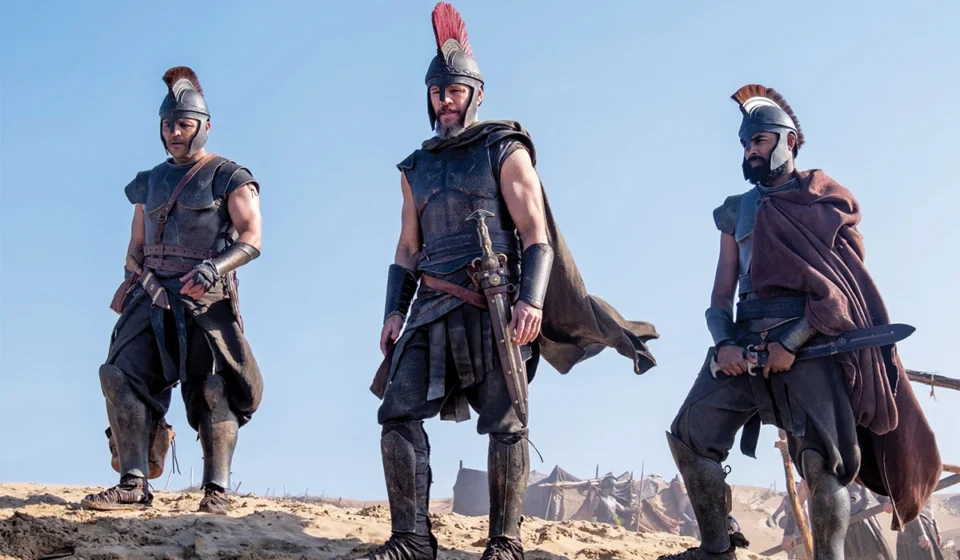
A Mythic Triumph: How Christopher Nolan’s ‘The Odyssey’ Rewrote the Box Office Record Books

In an era where the theatrical experience is frequently scrutinized and the R-rated blockbuster is often viewed as a commercial gamble, Christopher Nolan has once again defied gravity. His latest cinematic tour de force, The Odyssey, has officially ascended to the pinnacle of commercial success, shattering the record for the highest-grossing R-rated film in history. With a staggering global haul of $1.352 billion, the film has officially eclipsed the previous benchmark set by 2024’s Deadpool & Wolverine, which concluded its remarkable run with $1.338 billion.
This achievement is not merely a statistical milestone; it represents a cultural phenomenon that underscores the enduring power of high-concept, auteur-driven storytelling. In a market often dominated by established superhero franchises and sequels, The Odyssey—a three-hour, R-rated adaptation of Homer’s ancient epic—has proven that audiences remain hungry for ambitious, large-scale original narratives.
The Chronology of a Modern Epic
The journey of The Odyssey from concept to box office juggernaut is a masterclass in strategic release and sustained audience engagement. When the film premiered on July 17, it immediately signaled its intent by generating a formidable $123 million during its domestic opening weekend.
Unlike many contemporary blockbusters, which often experience a sharp "front-loaded" decline after their opening frames, The Odyssey demonstrated extraordinary "legs." Word-of-mouth regarding the film’s visceral cinematography, Matt Damon’s transformative performance, and Nolan’s uncompromising direction kept theaters packed throughout the summer.
By the end of its first month, the film had solidified its status as a global sensation. The distribution of its $1.352 billion total—split between $516 million domestically and $835 million in international markets—reveals a broad, universal appeal that transcends cultural and linguistic boundaries. Even with its nearly three-hour runtime, which traditionally limits the number of daily screenings a theater can host, the film maintained high occupancy rates across major markets, forcing multiplexes to extend its residency well beyond the standard theatrical window.
Supporting Data: The Anatomy of a Record-Breaker
To understand the sheer scale of The Odyssey’s success, one must look at the metrics that define it. The film is currently the fifth release of the year to surpass the coveted $1 billion threshold, placing it in the rarified company of the industry’s most successful heavyweights.
Perhaps the most significant engine of this revenue has been the premium large-format (PLF) sector. Imax, in particular, has seen unprecedented returns from the film, accounting for a massive $354 million of the total global gross. This figure officially makes The Odyssey the highest-grossing Imax release of all time, comfortably surpassing the previous record-holder, James Cameron’s Avatar (2009), which earned $271 million in the format (not adjusted for inflation).
The film’s performance is also a personal milestone for Christopher Nolan. It now stands as the highest-grossing film of his storied career, comfortably outperforming The Dark Knight Rises (2012), which previously held the crown with $1.08 billion. When adjusting for the inherent risks of an R-rated "sword-and-sandal" epic, the achievement becomes even more profound. The film has joined the likes of Joker as one of the few R-rated films to reach the billion-dollar milestone, proving that adult-oriented, complex narratives can achieve the same market penetration as family-friendly tentpoles.
An Ensemble of Mythic Proportions
Central to the film’s massive appeal is its ensemble cast, a roster of talent rarely seen in a single production. Matt Damon anchors the film as Odysseus, delivering a performance that critics have described as both physically grueling and deeply vulnerable. His portrayal of the king of Ithaca’s arduous, decade-long voyage home from the Trojan War provides the emotional bedrock that keeps audiences grounded amidst the spectacle of Nolan’s staging.
However, the supporting ensemble—a who’s who of modern cinema—is equally integral to the film’s success. The cast includes:
- Tom Holland as Telemachus
- Anne Hathaway as Penelope
- Robert Pattinson as Poseidon
- Lupita Nyong’o as Athena
- Zendaya as Circe
- Charlize Theron as Calypso
- Elliot Page, Jon Bernthal, and John Leguizamo in pivotal supporting roles.
The chemistry between these performers, combined with the scale of the production design, created an "event" atmosphere that drove repeat viewings—a critical component in pushing the film past the $1.3 billion mark.
Official Responses and Industry Camaraderie
The film industry is often characterized by intense competition, but the passing of the torch from Deadpool & Wolverine to The Odyssey was met with a surprising display of grace and sportsmanship. Ryan Reynolds, the creative force behind the Deadpool franchise, took to the social media platform X (formerly Twitter) to publicly congratulate Nolan and his team.
"Congratulations to the entire cast and crew of The Odyssey for becoming the highest-grossing R-rated movie of all time," Reynolds wrote. His post, which featured a lighthearted comment about the film’s "one helluva car" (a playful nod to the film’s scale), was widely shared, highlighting the mutual respect that exists among the industry’s top-tier creators.
This public acknowledgment from one titan of the box office to another serves as a reminder that when a film succeeds at this level, it is viewed as a victory for the entire theatrical ecosystem.
Implications for the Future of Cinema
The implications of The Odyssey’s success are likely to reverberate through Hollywood for years to come. Studio executives are already analyzing the data to determine what lessons can be applied to future greenlights.
1. The Viability of the "Prestige" Blockbuster
For years, the industry trend has favored established intellectual property (IP) and interconnected cinematic universes. While The Odyssey is based on Homer, it is a timeless literary work rather than a corporate-owned franchise. Its success suggests that audiences are increasingly seeking "prestige" blockbusters—films that offer the scale and spectacle of a superhero movie but are underpinned by the creative signatures of auteur directors and grounded, adult-oriented storytelling.
2. The Power of Premium Large Formats
The record-breaking Imax performance is a wake-up call for exhibitors. The investment in premium screens is no longer just a luxury; it is a necessity. The $354 million earned via Imax confirms that audiences are willing to pay a premium for a superior viewing experience, particularly for films that utilize large-format cameras and immersive sound design.
3. Challenging the Runtime Paradigm
There has long been a narrative in Hollywood that movies exceeding two and a half hours face a "ceiling" in terms of profitability due to the limited number of daily screenings. The Odyssey has effectively debunked this myth. By providing a high-quality experience that warrants the three-hour commitment, the film has proven that "event" status can overcome logistical constraints.
4. The R-Rating Re-evaluation
Finally, the film’s success forces a re-evaluation of the R-rating. Historically, studios have feared that the R-rating limits the potential audience for high-budget films. The Odyssey has proven that mature themes, intense action, and complex character studies are not deterrents, provided the quality of the filmmaking matches the ambition of the project.
Conclusion: A New Benchmark
As The Odyssey continues its final weeks in theaters, its legacy is already being written. It stands not only as the highest-grossing R-rated film in history but as a testament to the fact that cinema, at its best, is a communal experience that can bridge the gap between the ancient past and the modern present.
Christopher Nolan has once again demonstrated that he is a singular force in the industry—a director capable of commanding massive budgets, managing gargantuan casts, and delivering films that resonate with the global public on a profound level. As we look toward the future of the medium, The Odyssey will undoubtedly serve as the primary case study for what is possible when vision, talent, and scale align in perfect harmony. It is, quite simply, a voyage that will be remembered for decades to come.