Harmony Across the Divide: A Comprehensive Analysis of Emmanuel Courcol’s ‘The Marching Band’

The intersection of high art and working-class struggle has long been a fertile ground for European cinema, often yielding narratives that balance poignant social critique with the redemptive power of human connection. The latest entry into this tradition, Emmanuel Courcol’s The Marching Band (originally titled En Fanfare), has finally made its way to American shores. After a triumphant domestic run in France throughout 2024, the film arrives in the United States via Greenwich Entertainment, bringing with it a reputation for being both a formulaic crowd-pleaser and a masterfully constructed character study.
Directed by Emmanuel Courcol, who previously found success with the prison-drama-turned-comedy The Big Hit (2020), The Marching Band navigates the rocky terrain of class disparity, terminal illness, and the universal language of music. While it occasionally surrenders to the well-worn tropes of the "feel-good" genre, it is elevated by the precision of its editing and the profound chemistry of its two lead actors, Benjamin Lavernhe and Pierre Lottin.
Main Facts: A Narrative Overture of Unusual Speed
The Marching Band is notable for a narrative velocity that is rarely seen in contemporary drama. In its opening sequence—roughly the first twelve minutes—the film establishes a complex web of conflict that would take most features an entire hour to unpack.

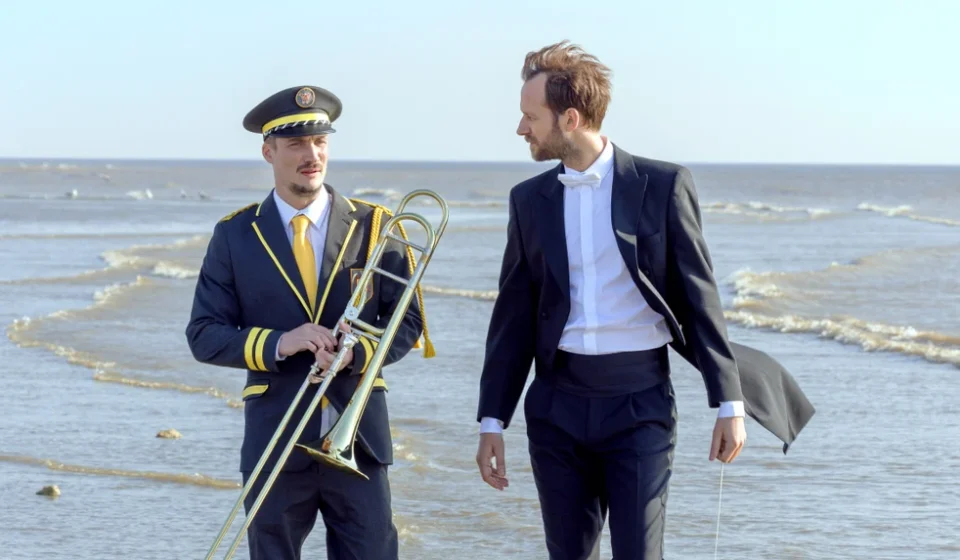
The story centers on Thibaut (Benjamin Lavernhe), a world-renowned classical music conductor based in the cultural epicenter of Paris. His life of worldly elegance is shattered by a diagnosis of leukemia. The urgency of his condition necessitates a bone marrow transplant, but a startling revelation complicates his survival: his sister is not a genetic match because Thibaut was adopted. This discovery leads him to his biological brother, Jimmy (Pierre Lottin), a man whose life exists on the opposite end of the socioeconomic spectrum.
Jimmy remains in the disadvantaged, industrial North of France, working as a cook in a communal canteen. Unlike Thibaut’s world of grand concert halls and freshly pressed overshirts, Jimmy’s world is one of double denim, unemployment, and the modest joys of the local brass band. When Thibaut approaches Jimmy for a life-saving transplant, the request serves as the catalyst for a reunion that is as much about cultural collision as it is about biological necessity.
Chronology: From Cannes to the American Theatrical Window
The journey of The Marching Band to the American market has been a slow but steady crescendo. The film initially made waves during its premiere at the Cannes Film Festival, where it was greeted as a sophisticated psychological drama with "broad appeal" potential.

- Cannes Premiere (2022/2023): The film began its life on the festival circuit, earning praise for Courcol’s ability to blend the "buddy movie" archetype with the "socially conscious crowd-pleaser" style popularized by British films like The Full Monty.
- French Domestic Release (Early 2024): Upon its wide release in France, the film became a significant box-office hit. Its success was attributed to its resonance with a public weary of cynical narratives, offering instead a story of regional pride and familial reconciliation.
- US Acquisition and Distribution (Late 2024): Greenwich Entertainment, a distributor known for bringing high-quality international cinema to American audiences (such as the Oscar-winning Free Solo and the acclaimed The Rescue), secured the Stateside rights.
- Theatrical Debut: The film opened in select U.S. theaters this week, marking a pivotal moment for Courcol as he attempts to translate his specific brand of French humanism for a domestic audience accustomed to more traditional Hollywood structures.
Supporting Data: Technical Precision and the Anatomy of Performance
The effectiveness of The Marching Band rests on its formal construction. Critics have noted that while the plot may be predictable, the execution is nearly flawless.
The Power of the Edit
Editor Guerric Catala is credited with the film’s "brutally economical" pace. By shunning the lingering sentimentality that often plagues medical dramas, Catala keeps the focus on the rhythm of the characters’ lives. The film "strides" forward, mirroring the tempo of the marching band at its center. This prevents the leukemia subplot—which functions more as a "MacGuffin" to bring the brothers together than a deep dive into oncology—from weighing down the narrative.
Costume and Social Signifiers
Christel Birot’s costume design plays a vital role in world-building. The visual contrast between Thibaut’s "Parisian bobo" (bourgeois-bohemian) aesthetic and Jimmy’s functional, working-class attire provides a silent but constant commentary on the different chances the two men were afforded in life. These choices highlight the "gentle social critique" that runs beneath the surface of the film.

The Meta-Casting of Lavernhe and Lottin
The casting is perhaps the film’s most inspired element, utilizing the real-world reputations of its leads to mirror the story’s internal dynamics:
- Benjamin Lavernhe: A member of the prestigious Comédie-Française, Lavernhe brings a disciplined, classical theater background to the role of Thibaut. His performance captures a man who is likable but "insufficiently ashamed" of his privilege.
- Pierre Lottin: Known largely for his work in the popular comedy franchise Les Tuche—which centers on a stereotypical working-class family—Lottin brings an innate authenticity to Jimmy. He articulates a specific blend of shame, pride, and resentment through "passive-aggressive joshing" and subtle eye contact.
Official Responses and Critical Reception
The critical consensus suggests that The Marching Band is a film that "mostly pulls off" a difficult balancing act. It is simultaneously a mismatched buddy comedy, a social drama, and a musical celebration.
Variety’s review highlights a standout scene that encapsulates the film’s charm: Thibaut discovers Jimmy has "perfect pitch." Rather than a grand, cinematic revelation, the scene is played in a "minor key." Thibaut asks Jimmy to identify the chords of a barking dog or a honking car; Jimmy answers with a shy, murmuring precision. This brevity prevents the moment from becoming "gloopy or crass," a testament to Courcol’s restrained writing.

However, the film has not escaped criticism for its reliance on formula in the final act. As the story progresses toward its "barn-burning finale," it mirrors the 1996 British classic Brassed Off. Critics point to a "surfeit of montages" and an "artificial falling-out" between the brothers as moments where the film becomes a touch too pleased with its own ability to manipulate audience emotions. Despite these "pre-ordained moments," the consensus remains that the formula works because it is built on a foundation of genuine smarts and technical skill.
Implications: The Enduring Appeal of the "Federating Power of Music"
The success of The Marching Band carries several implications for the current state of international cinema and the "feel-good" genre.
The "North of France" Narrative
The film continues a rich tradition of French cinema that looks toward the North (Hauts-de-France) as a site of both economic hardship and cultural resilience. By focusing on a musical collective as a "lifeline" for a community struggling with poverty and unemployment, Courcol tapped into a zeitgeist of regional identity that clearly resonated with French voters and audiences.

Music as a Bridge
The film’s soundtrack serves as a microcosm of its thematic ambitions. It veers between the sophisticated jazz of Lee Morgan’s "I Remember Clifford" and the populist appeal of Dalida or the overture from Verdi’s Aida. The recurring use of Ravel’s "Bolero"—a piece that repeats the same phrase with evolving tonal differences—serves as a metaphor for the brothers’ relationship: they are the same melody played in vastly different environments.
The Global Market for Social Crowd-Pleasers
For American audiences, The Marching Band offers a reminder that social realism does not always have to be bleak. The "socially conscious crowd-pleaser" is a genre that allows for the discussion of serious issues—classism, healthcare, and unemployment—within a framework that ultimately affirms human dignity. Its arrival in the U.S. suggests that there is still a robust market for foreign films that prioritize emotional catharsis and precise storytelling over avant-garde experimentation.
In conclusion, while The Marching Band may eventually "succumb to formula," it does so with such grace and technical proficiency that it remains a standout work of 2024. It is a film that understands the beat of the human heart is often found in the most unlikely of harmonies.