Cinematic Gastronomy: Qiu Jiongjiong’s “Fuxi: Four Tales of Feasting” and the Renaissance of Handcrafted Artifice

The international film circuit has long looked to Chinese independent cinema for gritty realism or sweeping historical epics. However, with the emergence of Qiu Jiongjiong, a painter-turned-filmmaker, a new vocabulary has entered the lexicon: the "theatrical soundstage" aesthetic. Following the breakout success of his 2021 fiction debut A New Old Play—which secured the Special Jury Prize at Locarno—Qiu has returned with an even more ambitious, visually decadent follow-up. Fuxi: Four Tales of Feasting is not merely a film; it is a four-course anthology that navigates the intersection of Sichuanese culinary tradition, folkloric myth, and the cyclical nature of human existence.
Main Facts: A Multi-Hyphenate’s Vision of Sichuan
Qiu Jiongjiong occupies a unique space in contemporary cinema, acting as director, writer, editor, and, crucially, his own production designer. This total control over the frame allows Fuxi to function as a living painting. The film’s title, Fuxi, is clarified early via an opening title card as "a tasty delicacy, or the act of eating it." It serves as a spiritual and sensory sequel to A New Old Play, which utilized stylized studio environments to tell the history of 20th-century China through the eyes of a Sichuan opera performer.
In Fuxi, the scope expands from a single life to a millennium-spanning exploration of community and ritual. The film is structured as an anthology of four "rhyming" chapters, each centered on a specific era and a specific mode of consumption. The cast is anchored by the presence of Lee Kang-sheng, the iconic muse of Taiwanese master Tsai Ming-liang. Lee’s presence brings a "slow cinema" pedigree to Qiu’s high-concept theatricality, creating a tension between the stillness of the acting and the vibrancy of the handcrafted sets.
The film’s philosophy is summarized by its recurring fascination with the earthy, unpretentious realities of life. As the final sequences suggest, the overarching message is one of stoic acceptance: "We eat, we shit, and that’s it, as of old." Yet, within that crude cycle, Qiu finds immense beauty, utilizing rippling bedsheets for waves, foam mountains for landscapes, and hand-painted backdrops that reject the polished anonymity of modern digital effects.
Chronology of the Feast: Four Epochs of Flavor
The film’s narrative structure is chronological in a cosmic sense, moving from the dawn of humanity to the threshold of the modern era, all while maintaining a consistent "liminal" space between myth and reality.
I. The Ancestors’ Fuxi: The Primal Ritual
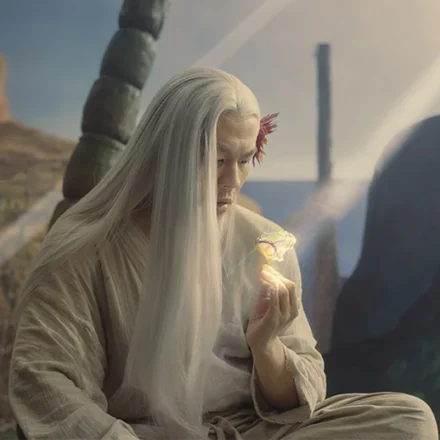
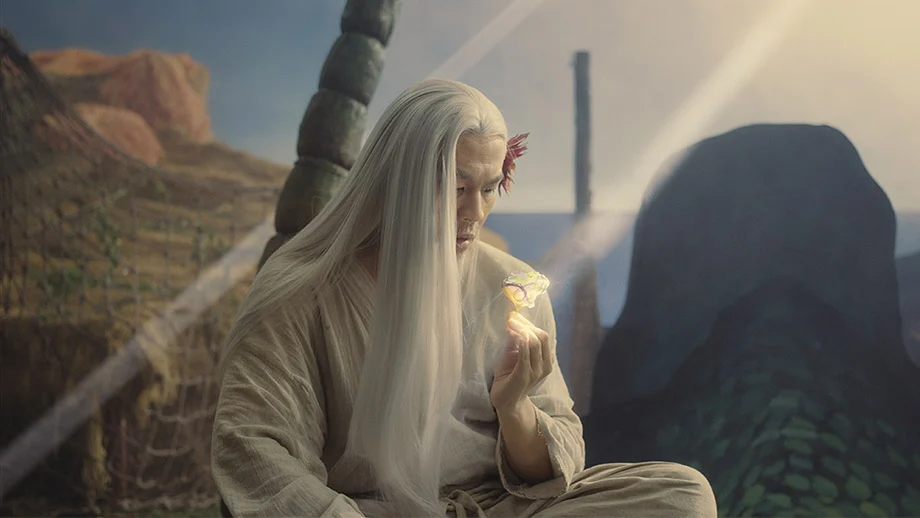
The first segment transports the audience to a prehistoric tribe. While the characters are recognizably human, they possess tails—a physical manifestation of their connection to the animal kingdom. The story centers on a dying matriarch (played by Lee Kang-sheng in a rope-fiber silver wig) who performs a final act of communal nourishment. She severs her own tail with a prop hatchet to prepare a soup for her descendants. This "burial rite" establishes the film’s core theme: food as a vessel for memory and the literal continuation of the bloodline.
II. The King’s Fuxi: The Transition to Agriculture
Jumping forward a millennium, the tails have vanished, and the tribe has evolved into a hierarchical society. This segment introduces the legend of Duyu, the "Cuckoo King" of Sichuan lore. In Qiu’s rendition, the King has abdicated his throne to live as a bird, returning once a year to taste the tributes of his subjects. Here, the production design shines, with villagers toiling behind tiered hillsides made of flat boards painted with abstract green swirls. The introduction of animal husbandry is represented by actors in masks and unitards playing dogs—creatures that were wild in the first segment but have now been domesticated.
III. The Litterateur’s Fuxi: The Poet in Exile
The third and most substantial segment features Lee Hong-chi as the Song dynasty dissident poet Su Dongpo. Set against a backdrop representing 1997—rendered via cutouts of skyscrapers backlit through lighting gels—the story follows four spirits gathering for a festive banquet. Each course served triggers a memory from Su Dongpo’s life. The visual contrast here is striking: the artifice of the skyscraper cutouts clashes with the visceral, earthy "food porn" of browning pork belly and steaming fish. The use of "offcuts" like lamb’s spine serves as a poignant metaphor for the pains of exile and the resilience of the artist.
IV. Sworn Brothers’ Fuxi: The Dawn of Modernity
The final chapter takes place at the turn of the 20th century during the twilight of the Qing dynasty. A young kitchen servant (Zhou Jiarui) flees his masters and joins a motley crew of outlaws and ghosts. They teach him the art of making congee, emphasizing the virtues of patience and camaraderie. This segment acts as a bridge to A New Old Play, touching on the "promises and disappointments of modernity" while maintaining the folkloric tone that defines Fuxi.
Supporting Data: The Craft of the Soundstage
The technical execution of Fuxi is a deliberate rebuttal to the prevailing trends in global cinema. While high-budget productions increasingly rely on generative AI and digital "Volumes" (like the Mandalorian’s StageCraft), Qiu Jiongjiong leans into the "tactile flourish."
- Production Design: Every element in the film is handcrafted. The "ocean" is made of dyed blue bedsheets; "clouds" are generated by smoke machines and hand-painted glass. This "toy-like" quality is not a result of budget constraints but a stylistic choice intended to emphasize the "fiction" in filmmaking.
- The Frame Story: The film utilizes a frame narrative featuring Sol (Wen Ke) and Luna (Xiao Luxi). Dressed in sun and moon headpieces, they observe the feasting mortals from a foam mountain seesaw. These interstitial sequences are often tinted in sepia or steel-blue, mimicking the aesthetic of silent-era cinema.
- Culinary Detail: Unlike many films where food is a prop, Fuxi treats Sichuanese cuisine with documentary-level reverence. The film includes detailed instructions for cooking specific dishes, making the "Four Tales" as much a cookbook as a cinematic anthology.
Official Responses and Critical Reception
The reception of Fuxi among international critics and festival programmers has been marked by a fascination with its form, though some have noted its shift in tone compared to Qiu’s previous work.
The "Political" vs. The "Folkloric"
Critics who lauded A New Old Play for its political ambition—often comparing it to Jia Zhangke’s Platform—have found Fuxi to be "less substantial" in its historical commentary. While A New Old Play was an explicit pageant of 20th-century Chinese upheaval, Fuxi operates in a "folkloric mode." The response suggests that while the film is a "joy to behold," its focus on the cyclical nature of life (eating and shitting) rather than the linear progression of politics may alienate those seeking a "hard-hitting" social critique.
The "Lee Kang-sheng" Factor
The casting of Lee Kang-sheng has been hailed as a masterstroke. Known for his "sly charisma" and "morose" presence in Tsai Ming-liang’s films, Lee’s performance in drag (as the granny and the female elder) provides a subversive layer to the film. Critics have noted that his presence bridges the gap between the avant-garde traditions of Taiwan and the burgeoning independent scene in mainland China.
The Anti-Digital Movement
Industry observers have pointed to Fuxi as a "luxury good" in an era of digital shortcuts. The film’s "intricately wrought tactile flourishes" have been cited as a reason for its high standing in the festival circuit, serving as a reminder of the power of "resourceful" filmmaking that prioritizes the artist’s hand over the computer’s algorithm.
Implications: The Future of Independent Vision
The release of Fuxi: Four Tales of Feasting carries significant implications for the future of independent Chinese cinema and the broader landscape of "artifice" in film.
1. The Survival of the "Painterly" Director:
Qiu Jiongjiong’s success demonstrates that there is a sustainable audience for highly stylized, personal filmmaking that eschews realism. By acting as his own production designer, Qiu has created a brand of "handcrafted cinema" that is uniquely his, suggesting that the future of the auteur may lie in total aesthetic control.
2. Food as Cultural Diplomacy:
By centering the film on Sichuanese cuisine, Qiu taps into a universal language. The detailed cooking sequences and the emphasis on the "ritual of the meal" allow the film to transcend linguistic barriers, offering international audiences a sensory gateway into Chinese history and myth.
3. The Rejection of Digital Homogenization:
In a world where digital effects can make any location look like any other, Qiu’s "soundstage" philosophy offers a path forward for filmmakers who want their work to feel "tangible." The "freedom" Qiu seeks—to cross borders between life and death, fiction and reality—is facilitated by the very artificiality of his sets. Because nothing is "real," anything is possible.
4. A New Philosophy of History:
Fuxi suggests a shift in how historical narratives are told. Rather than focusing on "Great Men" or "Great Events," the film argues that the true history of a people is found in what they eat, how they share it, and how they remember those who fed them. It is a "stoic" view of history that prioritizes the stomach over the sword, suggesting that while dynasties fall and modernization disappoints, the "act of eating" remains a constant, sacred thread.
In conclusion, Fuxi: Four Tales of Feasting is a testament to the power of the human imagination when applied to the most basic of human needs. It is a film that demands to be tasted as much as it is watched, marking Qiu Jiongjiong as one of the most vital and visually inventive voices in modern cinema. As the sun and moon seesaw over his foam mountains, the message is clear: the feast goes on.