Behind the Mask of Post-War Anarchy: A Review of May el-Toukhy’s Woman Unknown

In the landscape of contemporary European cinema, few filmmakers possess the ability to excavate the darkest corners of the human psyche with the clinical precision of Danish-Egyptian director May el-Toukhy. Seven years after the international success of Queen of Hearts—a film that dissected the taboo of forbidden desire with razor-sharp intensity—el-Toukhy returns with Woman Unknown. Premiering to a rapturous, if unsettled, audience at the 2026 Venice Film Festival, the film stands as a harrowing, atmospheric, and deeply political period thriller that demands a reckoning with the ghosts of the past.
Set in the immediate, chaotic aftermath of the Nazi occupation of Denmark in 1945, Woman Unknown is a masterclass in tension, internal monologue, and the corrosive nature of survival. Through the lens of a protagonist forced to perform her own existence, el-Toukhy explores the thin, blood-stained line between victimhood and monstrosity.
The Chronology of Fear: Denmark, 1945
The narrative is anchored in the precarious, fragile period of liberation. While history books often focus on the jubilant celebrations of Allied victory, el-Toukhy zooms in on the anarchy that followed. The "liberated" streets of Denmark are not merely places of joy; they are zones of vigilante justice. The film introduces us to the feltmadrasser—or "field mattresses"—a derogatory term used by the Danish Resistance to identify women who had romantic or sexual relationships with German occupiers.
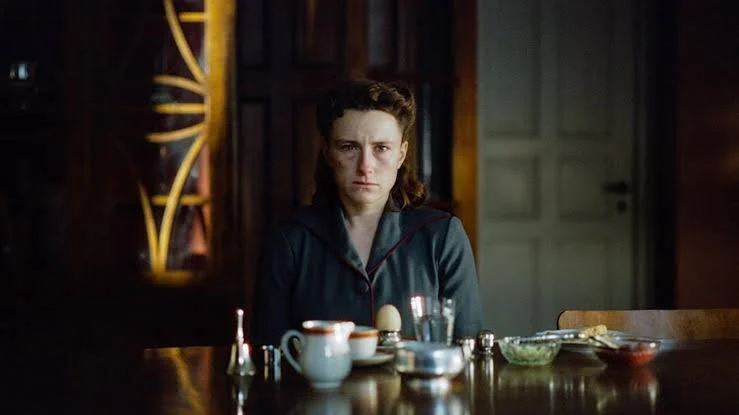
The protagonist, Marie (played with haunting, skeletal restraint by Mathilde Arcel), is a woman whose identity is as fluid as her surroundings are rigid. A maid and nanny to the wealthy garment factory owner Christian (Carsten Bjørnlund), Marie exists in a state of perpetual, hyper-vigilant motion. She is betrothed to Christian, a man whose social standing rests upon the maintenance of an impeccable, traditional façade.
As the film progresses, the viewer is invited to track Marie’s descent into a life of desperate artifice. The domestic sphere, designed with cold, mid-century elegance by Sabine Hviid, serves as a suffocating stage where Marie must navigate the whims of her fiancé and his preadolescent daughter, Leonora. Leonora, a character who embodies the "un-repressed" truth in a world of stifling manners, keeps a contraband photograph of her late mother—a silent, defiant act of memory that contrasts sharply with the performative oblivion Marie must maintain to stay alive.

The Anatomy of a Performance
At the heart of the film is Mathilde Arcel’s physically transformative performance. Arcel is the focal point of nearly every frame, yet she remains an enigma. She speaks only when necessary, and even then, her words are weighed, measured, and discarded like currency. Her true communication occurs in her eyes—restless, scanning, and perpetually assessing threats like a small animal in a den of predators.
The film’s cinematography, helmed by Jasper Spanning, employs a voyeuristic approach. Marie is frequently framed through doorways, windows, and grates, creating a persistent sensation of surveillance. The viewer is left to wonder: is she truly being watched, or is this the externalization of her own internal paranoia? This distinction matters little, as the threat is both everywhere and nowhere. The film’s score, a rhythmic, drum-heavy composition by Mikkel Hess, acts as a heartbeat that signals not that danger is approaching, but that it is already entrenched.
The Pornography of Humiliation: A Historical Reckoning
The film’s most visceral sequences involve the brutalization of women at the hands of the Danish Resistance. In one harrowing, extended scene, el-Toukhy forces the audience to confront the reality of post-war retribution. A woman is dragged through the streets, her hair shorn, her back painted with a swastika, and her body exposed to the jeers of a mob.
These sequences are not mere period-piece set dressing; they are the film’s moral center. El-Toukhy has noted that the title Woman Unknown is derived from the captions found on historical photographs of these victims—women whose names were stripped from them, replaced by the collective, hateful label of the "collaborator." By lingering on the violence, el-Toukhy levels a j’accuse at the "freedom fighters" who weaponized trauma to inflict their own brand of sexualized, barbaric degradation. It is a bleak, Haneke-esque assessment of human nature: the realization that the line between the oppressor and the liberator is often drawn in the same red paint.
Character Dynamics and the "Haneke" Influence
The film does encounter minor friction when it introduces the antagonist, Karl (Thorbjørn Hedegaard). A figure from Marie’s past, Karl serves as a catalyst for the film’s second-act tension. However, his portrayal—often verging on a "gargoyle" caricature—feels slightly at odds with the grounded, hushed tone of the rest of the film. His overt, reckless attempts to leverage Marie’s secrets feel like a forced narrative device that threatens to destabilize the film’s carefully calibrated social portraiture.

Conversely, the relationship between Marie and Christian is a masterstroke of subtlety. Christian is not a mustache-twirling villain; he is a man of status, governed by appearances. His job, which involves the manufacturing of female outerwear, is a thematic mirror to the film’s focus on how women are "clothed" in social expectations. Their marriage, built on cold, transactional intimacy, reveals the true horror of their world: a place where one’s value is contingent on how perfectly they wear the mask of the "ideal wife."
Implications for Modern Audiences
Woman Unknown is, at its core, a film about the erasure of the female identity. It suggests that fear, when sustained over a lifetime, acts as an effacing force, turning women into ghosts within their own homes.
The film’s implications reach far beyond the borders of 1945 Denmark. By highlighting how quickly a society can turn toward performative, violent morality in the name of "justice," el-Toukhy provides a chilling warning for the modern era. The "witch-hunts" depicted on screen are not relegated to the history books; they are reflections of our own tendency to strip individuals of their complexity in favor of simplified, marketable narratives of guilt and virtue.
As the film moves toward its haunting conclusion, the audience is left with a profound sense of unease. Even after Marie commits acts that might be deemed unforgivable, we are left with a lingering, uncomfortable empathy. We understand why she does what she does, not because she is "good," but because she is human—and in the world el-Toukhy has constructed, humanity is a dangerous liability.
Conclusion: A Masterpiece of Bleakness
Woman Unknown is an angry, despairing, and necessary piece of cinema. While it falters slightly in its secondary characterization, the strength of its direction, the visual language of its cinematography, and the sheer power of Arcel’s performance elevate it to a significant position in the year’s filmography.

As the film seeks U.S. distribution, it arrives at a time when questions of historical memory and gendered violence are at the forefront of the cultural conversation. It is a challenging, uncompromising work that refuses to offer the audience the comfort of a resolution, opting instead to leave us standing in the cold, questioning the masks we wear to survive.
Grade: B+
Woman Unknown premiered at the 2026 Venice Film Festival and is currently awaiting a wider U.S. release date.