Gridiron and Gunfire: Analyzing Peter Berg’s Brutal Pacific War Epic ‘The Mosquito Bowl’

The intersection of American sport and military sacrifice has long been a fertile ground for Hollywood storytelling, but rarely has it been harvested with the sheer, cacophonous intensity of Peter Berg’s latest Netflix-backed feature, The Mosquito Bowl. Known for his "action merchant" sensibilities and a filmography that oscillates between gritty realism (Lone Survivor) and high-octane spectacle (Battleship), Berg’s adaptation of Buzz Bissinger’s 2022 historical novel seeks to bridge the gap between the stadium and the foxhole.
While the film ostensibly tackles the same historical terrain as Terrence Malick’s philosophical masterpiece The Thin Red Line, the two are diametrically opposed in execution. Where Malick found poetic melancholy in the jungles of Guadalcanal, Berg finds a brawny, blood-spattered "Semper Fi" salute. The Mosquito Bowl is a film that revels in the carnage of the Pacific Theater, using the visceral reality of 1940s combat to underscore the mettle of its Marine heroes—men who were drafted from the heights of college football stardom into the depths of a global inferno.
Main Facts: The Convergence of Sport and Slaughter
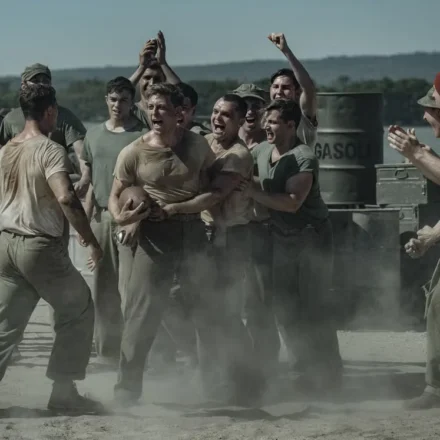
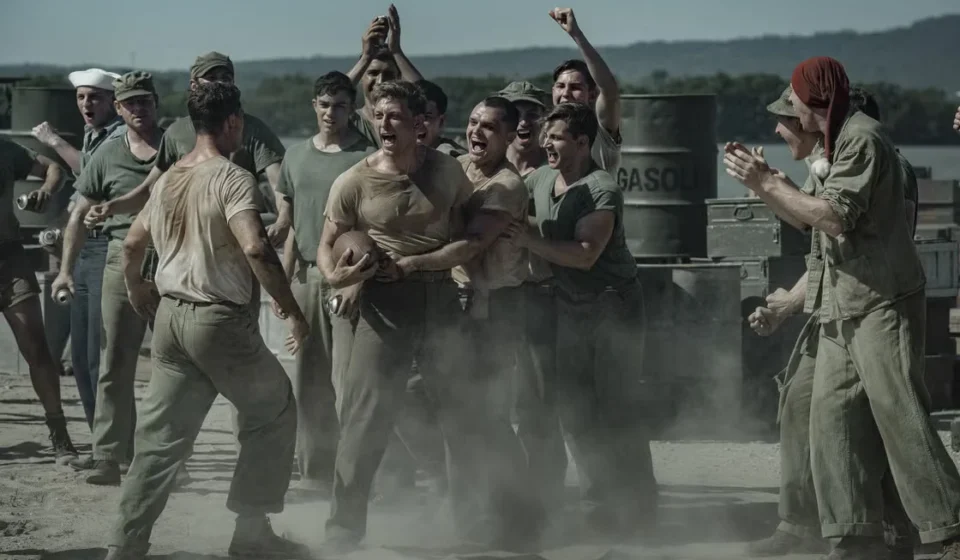
The Mosquito Bowl centers on a singular, surreal event in military history: a football game played on Christmas Eve 1944 on the island of Guadalcanal. The participants were not merely soldiers looking for a distraction, but some of the finest athletes of the "Greatest Generation." Drawn from the 4th and 29th regiments of the 6th Marine Division, the rosters included 65 former college stars, many of whom had been All-Americans or captains at prestigious programs like Brown, Purdue, and Wisconsin.
The film, directed by Peter Berg and written by Mark L. Smith (of The Revenant fame), attempts to elevate this game to the same mythic status as the 1914 Christmas Truce of World War I. However, the narrative framework extends far beyond the sidelines. It follows four primary characters—John McLaughry (Nicholas Galitzine), Tony Butkovich (Ray Nicholson), Dave Schreiner (Tom Francis), and Bob Baumann (Bill Skarsgård)—as they transition from the gridiron to the grueling reality of Pacific combat.
Backed by Netflix’s significant production resources, the film utilizes an aggressive visual style and a crushing soundscape to depict the horrors of war. Despite its focus on the "Mosquito Bowl" game, the film is primarily concerned with the "mettle" of the American Marine, often blurring the lines between the strategy of a football play and the tactics of an amphibious assault.
Chronology: From the Big Ten to the Beachheads
The narrative structure of The Mosquito Bowl follows a traditional but fragmented timeline, designed to maximize the emotional contrast between the characters’ past glories and their harrowing present.
1. The Pre-War Zenith (1941)
The film opens by establishing the athletic prowess of its protagonists. We see John McLaughry (Galitzine) as a standout at Brown University, his future with the New York Giants seemingly assured. This era is bathed in the nostalgic glow of pre-war Americana, showcasing the "jocular" Purdue star Tony Butkovich (Nicholson) and the soulful Wisconsin Badgers duo, Dave Schreiner (Francis) and Bob Baumann (Skarsgård). The surge of patriotic duty following the attack on Pearl Harbor serves as the catalyst that "puts their futures on ice," leading the group to enlist in the Marine Corps.
2. The Crucible of Parris Island
The middle act follows the familiar, grueling trials of basic training. Berg leans into the tropes of the military drama, depicting the dehumanizing but unifying experience of Parris Island. Here, the film begins to merge the identities of the athlete and the soldier, framing the Marine Corps as "the greatest offensive line in the history of football."
3. The Pacific Theater and the Mosquito Bowl (1944)
By late 1944, the 6th Marine Division is stationed on Guadalcanal. The titular game occurs on Christmas Eve, serving as a brief, "macho combat without consequences" interlude. However, as the film progresses, the game is overshadowed by the looming specter of the invasion of Okinawa. The "Mosquito Bowl" is depicted less as a turning point and more as a poignant, if somewhat fleeting, reminder of the lives these men left behind.
4. The Aftermath and Reflection
The film utilizes a framing device set years after the war, featuring an older, stoic McLaughry visiting a college football field. This provides a "misty-eyed" reflection on the cost of victory, though critics argue the film’s "blunt sensory force" often drowns out these quieter moments of contemplation.
Supporting Data: Technical Proficiency and Cast Performance
The production of The Mosquito Bowl is a technical tour de force, even if its narrative elements are viewed as "flimsy" by some reviewers.
Visual and Auditory Landscape
Director of Photography Jacques Jouffret employs an aggressively desaturated palette, reminiscent of the "bleached" look popularized by Saving Private Ryan. The use of nauseous POV shots and antsy, abrasive editing is intended to mimic the chaos of the battlefield. This is paired with a grinding, guitar-heavy score by the post-rock band Explosions in the Sky, a frequent collaborator of Peter Berg. The result is a "video game" level of intensity that prioritizes sensory impact over character development.
The Cast
The film relies on a quartet of rising and established stars to carry its "alpha male" archetypes:
- Nicholas Galitzine: Provides the leading perspective as McLaughry, though the script limits him to a "stoic, misty gaze."
- Ray Nicholson: Appropriates the "rakish perma-grin" of his father, Jack Nicholson, to portray the charismatic Butkovich.
- Tom Francis: The Tony nominee brings a soulful withdrawal to the role of Dave Schreiner.
- Bill Skarsgård: Delivers a capable performance as Baumann, though the script struggles to differentiate his personality from his peers.
Historical Context
While the film takes liberties with dates to create a "shared soldierly narrative," it is rooted in the very real loss of life among the Mosquito Bowl participants. In reality, 15 of the 65 men who played in that game were killed in action on Okinawa, a statistic that underscores the "war-is-hell" sentiment Berg aims to convey.
Official Responses and Critical Reception
While Netflix has marketed the film as a prestigious historical epic, initial critical responses have been polarized, focusing on Berg’s "unrestrained" directorial style.
The "Berg-Bissinger" Synergy: Industry analysts have noted that the collaboration between Peter Berg and Buzz Bissinger (cousins in real life) was a "fait accompli." Following the massive success of the Friday Night Lights film and television series, the duo has become synonymous with stories that explore the intersection of American masculinity, sports, and community. However, some critics suggest that The Mosquito Bowl lacks the "human dimension" that made Friday Night Lights a cultural touchstone.
Critiques of Jingoism: Several reviews have pointed out a "jingoistic undertow" in the film. The depiction of Japanese soldiers—often shown in decontextualized shots of ritual suicide or summary execution—has been criticized for lacking nuance. Critics argue that while the film attempts to portray the "morally corrupting effects of warfare," it fails to challenge the racist invective of the era, instead "reveling in onscreen carnage."
Netflix’s Strategy: From a corporate perspective, The Mosquito Bowl fits into Netflix’s broader strategy of producing high-budget, "dad-core" action dramas that appeal to a broad domestic audience. By combining a "Greatest Generation" narrative with modern cinematic violence, the streaming giant aims to capture the same demographic that frequented films like American Sniper or Greyhound.
Implications: The Legacy of the Athlete-Soldier
The Mosquito Bowl raises significant questions about how modern cinema remembers the Second World War. By framing the Marine Corps through the lens of football, the film reinforces a specific brand of American exceptionalism—one where athletic prowess is the ultimate preparation for the "offensive line" of combat.
The De-humanization of Conflict
The film’s greatest implication may be its contribution to the "gamification" of war cinema. By cranking up the technical proficiency to "video game levels," Berg risks creating a viewing experience that is "heartless." When the human characters are "colorless and interchangeable," the violence becomes the primary attraction. This suggests a shift in the genre away from the "poetic anti-war melancholy" of the 1990s toward a more blunt, sensory-driven depiction of military service.
The "Greatest Generation" Mythos
The film serves as an "ennobling mixture of portraiture and brutal evocation," continuing the long-standing Hollywood tradition of canonizing the soldiers of WWII. However, by "lightly fudging" historical dates and leaning into archetypes, it prioritizes a cohesive "heroic" narrative over the messy, individual realities of the men involved.
Conclusion
Ultimately, The Mosquito Bowl is a film of contradictions. It is a technically brilliant but emotionally hollow salute to a group of extraordinary men. It celebrates the "Christmas truce" spirit of a football game while simultaneously "reveling in carnage." For Peter Berg, the film is a definitive statement on his brand of "brawny" filmmaking; for the audience, it is a loud, ruinous, and undeniably intense window into a unique footnote of history—one where the stakes were far higher than any championship trophy.