The Unstoppable Ascendance: Why ‘The Gilded Age’ Season 4 Remains TV’s Most Essential Opulence

When Julian Fellowes’ The Gilded Age returned to HBO, the air in the fictionalized 19th-century New York felt decidedly thinner—and significantly more charged. As Season 4 unfolds, we find ourselves once again in the orbit of Bertha Russell, the relentless social architect played with razor-sharp precision by Carrie Coon. If the previous season left us in a state of precarious ambiguity, the new installment offers a definitive answer: Bertha is not merely surviving; she is conquering.
The season opens with a sequence that perfectly encapsulates the show’s central friction. In a moment of high-stakes tension, a stiff, cravat-wearing British doctor attempts to dismiss Bertha with a haughty, “You do not understand the situation. Please leave me.” Bertha’s response—a subtle, icy flicker of her eyes—speaks volumes. It is a look that navigates the spectrum between “I will endure this insult for the sake of the objective” and “If you cross me again, I will dismantle your entire world.” She retreats, not out of weakness, but because her wisdom dictates that one must choose their battles. She trusts the expert for the moment, but make no mistake: Bertha Russell is done being sidelined.
The State of the Union: Setting the Stage for Season 4
The narrative arc of The Gilded Age has always been a tug-of-war between the rigid traditions of Old New York and the unbridled, aggressive ambition of the “new money” elite. As Season 4 commences, that divide has only widened. The season picks up months after the dramatic conclusion of the third outing. Bertha finds herself across the Atlantic, tending to her daughter Gladys (Taissa Farmiga), who is currently expecting. This geographic distance from the Russell stronghold in New York serves as a catalyst for the season’s emotional and political shifts.
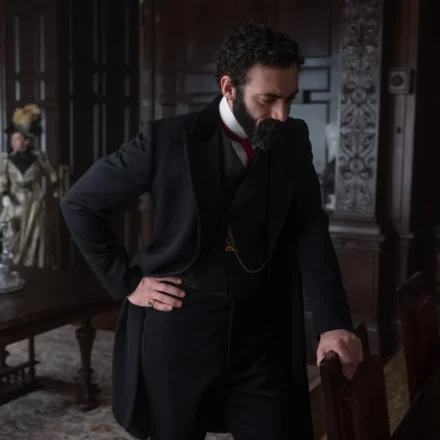
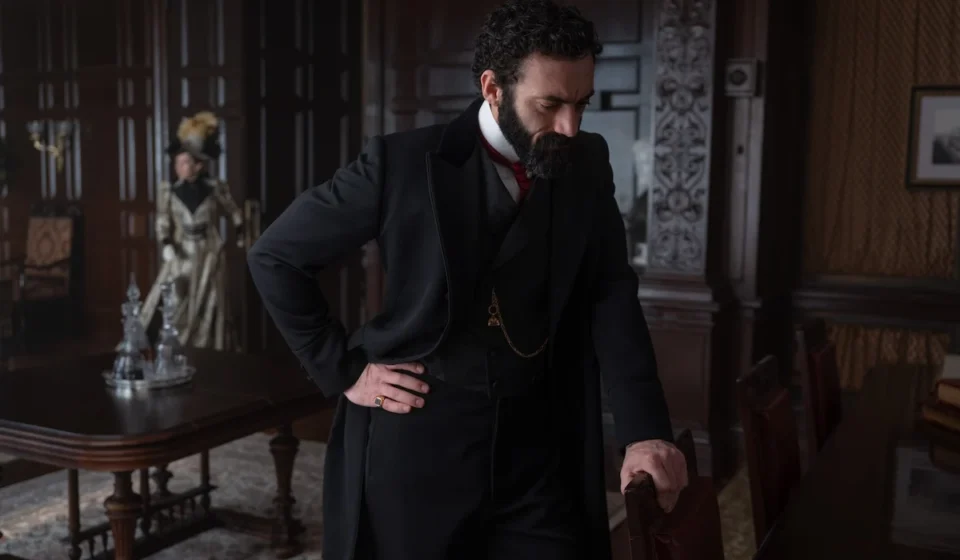
Meanwhile, George Russell (Morgan Spector)—the man who has spent three seasons as the invincible “Train Daddy”—finds himself navigating his most turbulent year yet. For viewers who have grown accustomed to George’s boardroom dominance, his struggle to keep his business in the black is a jarring, albeit necessary, evolution. It is a fitting, if not entirely intentional, humility for a titan of industry who has long operated as if the world were his to command. This season-long arc allows Spector to lean into a more vulnerable, brooding performance, proving that even the most powerful men in the Gilded Age are subject to the whims of the market and the consequences of their own hubris.

Chronology and Character Development: A Sprawling Cast in Motion
Season 4 is a sprawling tapestry that attempts to weave together the disparate lives of its ensemble cast. While the Russells occupy the high-altitude dramas of the elite, other characters are charting their own paths of upward mobility:
- Peggy Scott (Denée Benton): Having solidified her status as a literary force, Peggy navigates the complexities of professional success while her fiancé, Dr. William (Jordan Donica), rises through the ranks of the medical establishment. Their storyline offers a grounded, earnest look at Black excellence during an era that sought to actively suppress it.
- Jack (Ben Ahlers): The innovative spirit of the household, Jack, continues to find success with his inventions. However, his transition into a new home—and a new social status—brings the friction of etiquette classes and the harsh realities of the capitalist marketplace, proving that ingenuity alone is rarely enough to survive.
- The Van Rhijn Household: Agnes (Christine Baranski) and Ada (Cynthia Nixon) remain the emotional anchors of the series. This season, they provide the necessary spice: Ada finds herself entangled in a forbidden romance, while Agnes prepares to host the most significant event in the show’s history: a dinner for the President of the United States.
The Presidential Dinner: A Microcosm of Social Warfare
If the season has a centerpiece, it is the impending visit of the President. The logistics of this dinner—who is invited, the seating chart, the menu, the attire—become the primary source of tension for the upper crust of Manhattan. It is a masterclass in Fellowes’ ability to treat social slights with the same gravity as international diplomacy.
The presence of POTUS at Agnes’s mansion acts as a pressure cooker, pitting guests against one another in a “steel-cage death match” of polite, cutting remarks and strategic posturing. This is where The Gilded Age truly shines. The show understands that for this demographic, maintaining one’s standing is far more critical than the rise and fall of railroad stocks. The drama is not in the money lost, but in the face saved.
Supporting Data and Thematic Implications
Despite the show’s penchant for glamour, Season 4 continues to grapple with the realities of the era. The series remains a “frothy” experience, yet it is punctuated by acknowledgments of misogyny, bigotry, and systemic oppression. These themes inform the characters’ motivations, though the show is careful not to let them descend into “extra-dour drama.”

However, the sprawl of the cast is beginning to show some strain. While the upstairs dramas remain riveting, the “downstairs” character development feels slightly neglected. Supporting players like Oscar and Enid are relegated to the sidelines, while other characters are burdened with arcs that feel disconnected from the central momentum. Furthermore, the romantic dalliances of Larry Russell (Harry Richardson) and Marian (Louisa Jacobson) continue to move at a glacial, and occasionally tedious, pace. They are attractive, well-meaning, and entirely predictable, serving as a contrast to the high-voltage machinations of their parents.
Official Perspectives: A Shift in Power Dynamics
The writing team, led by Julian Fellowes and executive producer Sonja Warfield, seems to have made a conscious choice to shift the perspective of the show. In previous seasons, there was a narrative trend of blaming Bertha for the family’s turmoil—suggesting that her pursuit of power was a betrayal of her domestic duties. Season 4 effectively dismantles this.
It is now clear that Bertha was never the villain of her own story; she was merely the most competent person in the room. The show now rewards her for her tenacity. By focusing on her as the primary driver of the Russell family’s success, the series bucks historical precedent and aligns itself with a more modern, feminist reading of the era. Bertha is not just playing the game; she is redefining the rules.
Conclusion: Why We Still Need The Gilded Age
Some critics have argued that The Gilded Age refuses to let its characters face true, permanent loss. Unlike its HBO stablemates, such as Succession or Game of Thrones, this series lacks a desire to punish its leads. But is that a weakness? In a television landscape dominated by gritty, cynical, and often exhausting narratives, The Gilded Age provides a necessary, soapy, and impeccably designed refuge.

The show remains a staple of Sunday-night viewing because it promises, and delivers, a world of sunshine, rainbows, and the occasional, satisfying takedown of a cravat-wearing doctor. It acknowledges the darkness of history while choosing to focus on the triumph of the individual. As we watch Bertha Russell navigate the treacherous waters of 19th-century society, we are not just watching a period drama—we are watching a woman build a legacy in real-time. She understands the situation perfectly, she knows exactly what she wants, and she isn’t going anywhere. For the audience, that is more than enough.
Grade: B
‘The Gilded Age’ Season 4 premieres Sunday, November 1 at 9 p.m. ET on HBO. New episodes will be released weekly through the finale on December 20.