
In the landscape of contemporary South Korean cinema, few directors possess the visionary audacity of Yeon Sang-ho. From the claustrophobic, high-octane terror of Train to Busan to the genre-bending explorations of Psychokinesis, Yeon has consistently established himself as a master of weaving intimate, character-driven dramas into the fabric of high-concept science fiction. However, his latest feature, Paradise Lost, which recently premiered at the 2026 Toronto International Film Festival, marks a startling departure from this pedigree. What promised to be a haunting meditation on grief, technology, and the nature of memory instead emerges as a sprawling, conceptually cluttered thriller that struggles to reconcile its competing narrative threads.
The Premise: A Digital Sanctuary for the Lost
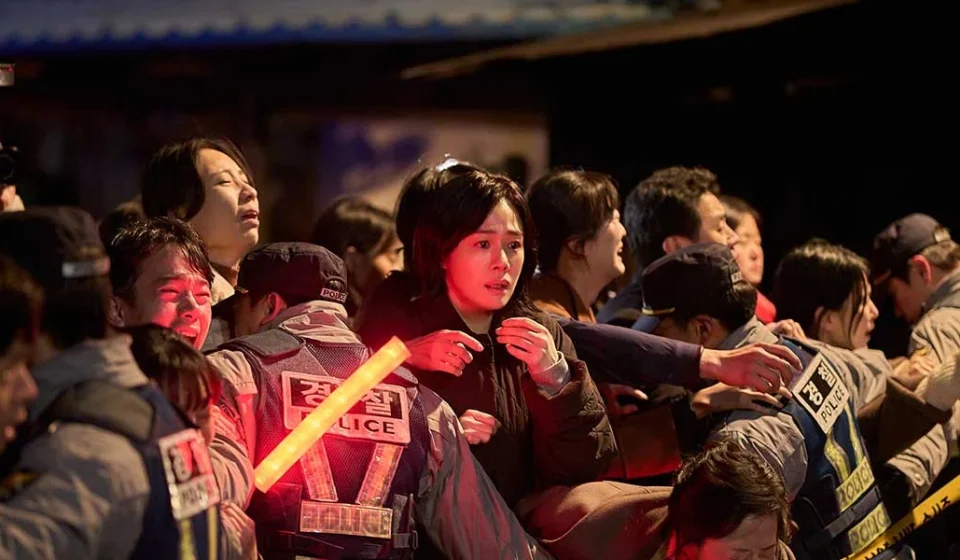
The core of Paradise Lost is built upon a premise that is as emotionally resonant as it is terrifying. The story follows So-young (played by Kim Hyun-joo), a single mother whose life is shattered when her young son, Sun-woo, disappears following a bus accident near an unstable mine site. The tragedy, which claims the lives of several other children, leaves a void that the tech conglomerate Transhuman is all too eager to fill. Through their "Children of Paradise" initiative, the corporation offers grieving parents a technological balm: virtual reality avatars of their lost children, perfect digital facsimiles that allow parents to continue their lives in a manufactured state of domestic bliss.
For nine years, So-young inhabits this digital amber, raising a son who never ages, never cries, and never leaves her side. It is a premise that invites profound inquiry: what happens to the human psyche when we choose a curated, algorithmic simulation over the messy, painful reality of loss? Unfortunately, as the film unfolds, it becomes clear that Yeon is less interested in the philosophical implications of this technology and more preoccupied with a convoluted procedural that ultimately undermines the film’s emotional weight.
Chronology of a Narrative Collapse
The film’s trajectory can be bifurcated into its promising opening and its subsequent decline into formulaic melodrama.
The First Act: A Captivating Setup
For the first thirty minutes, Paradise Lost operates with the precision of a masterclass in tension. The sequence depicting the lead-up to the bus accident—the mundane joy of a mother waving goodbye to her child, followed by the encroaching, inexplicable dread—is classic Yeon. The audience is invited to feel the weight of So-young’s loss, making the introduction of the Transhuman VR technology feel like a logical, if morally dubious, progression.
The Midpoint: The Intrusion of Reality
The narrative shifts abruptly when the police contact So-young. A young drifter, played by Bae Hyun-sung, has been identified through DNA testing as the long-lost Sun-woo. This discovery should have served as the film’s pivot toward a harrowing exploration of identity and the "uncanny valley" of human connection. If the VR version of Sun-woo is the child she remembers, who is the violent, troubled young man standing in the flesh?

The Climax: A Tangle of Ideas
Rather than exploring this existential dilemma, the film accelerates into a series of predictable twists. The teenage Sun-woo is revealed to be a suspect in a parallel criminal investigation, shifting the film’s genre from a poignant character study to a standard, albeit violent, thriller. By prioritizing the "whodunit" aspects of the plot over the psychological friction between the real and the virtual, the film loses its focus, leaving its themes to wither under the weight of an over-stuffed script.
Supporting Data and Comparative Context
The thematic failures of Paradise Lost are thrown into sharper relief when compared to other works exploring similar territory. This year’s Cannes entry, Hirokazu Kore-eda’s Sheep In the Box, also dealt with the concept of an artificial surrogate for a deceased child. While Kore-eda utilized an android, the conceptual overlap is significant. Both films grapple with the limitations of our ability to replace the irreplaceable.
However, where Kore-eda’s work invited the audience to sit with the discomfort of its implications, Paradise Lost seems determined to resolve its dilemmas with surgical efficiency. In one notable scene, So-young engages in a dialogue with a Transhuman executive that functions more as an exposition dump than a genuine philosophical debate. These interactions, while intended to ground the film in ethical quandaries, instead serve to highlight how little the film actually has to say about the societal impact of such a technology.
Performance Under Pressure
Kim Hyun-joo delivers a performance of remarkable depth, capturing the nuances of a woman caught between a comforting hallucination and a thorny reality. It is a testament to her talent that she remains compelling even as the screenplay forces her character into increasingly erratic, plot-driven decisions. She is tasked with carrying the emotional resonance of the film, yet the writing constantly pulls her away from internal reflection to serve the needs of a thriller that, frankly, lacks the necessary narrative momentum to justify such shifts.
Opposite her, Bae Hyun-sung struggles with a role that is designed to be a thematic cipher. Rather than allowing the character of the teenage Sun-woo to be a living, breathing embodiment of the trauma he represents, the script uses him primarily as a vehicle to verbalize the film’s themes. He is a plot device disguised as a protagonist, a choice that robs the final act of any real emotional stakes.
Implications: A Misfire for a Master
The implications of Paradise Lost failing to meet expectations are significant for Yeon Sang-ho’s career trajectory. Having previously mastered the art of balancing sci-fi concepts with grounded human drama—as seen in his work on Jung_E—this project feels like a regression. In Jung_E, the presence of "whizbang" action sequences provided a necessary distraction that allowed the film’s quieter moments to resonate. In Paradise Lost, the absence of such spectacles exposes the core of the film, revealing a premise that is, unfortunately, quite mundane.

The film serves as a cautionary tale for genre filmmakers: high-concept premises cannot substitute for coherent, character-driven narratives. By refusing to engage with the "Catch-22s" of his own story—such as the inherent corruption of a mother’s grief by a corporate-controlled simulation—Yeon has produced a film that feels both finished and incomplete. It provides answers where it should have posed questions, and in doing so, it leaves the audience with nothing to ponder.
Final Verdict
Ultimately, Paradise Lost is a film of disparate parts that never truly coalesce. It is a story about the intersection of grief and technology that is afraid of its own shadow, preferring the comfort of a procedural thriller to the danger of a true psychological exploration. As the film wraps up its narrative threads with an unsettling neatness, it fails to challenge the viewer’s perception of mortality or the digital future.
While the cinematography remains sharp and the production design offers a chilling, sterile vision of a near-future, these technical merits cannot save the film from its own lack of depth. For a director of Yeon’s caliber, Paradise Lost is a rare and unfortunate stumble. It is a work that, much like its titular concept, offers a perfect, polished surface, but hides a hollow center.
Grade: C+
Paradise Lost is currently seeking U.S. distribution. For fans of Yeon Sang-ho, it may be worth viewing as an experiment in narrative failure, but for those seeking the emotional complexity of his earlier work, this entry will likely prove to be a disappointing chapter in an otherwise illustrious career.