From Late-Night Host to Tech Mogul: Stephen Colbert’s Mission to Revolutionize Hollywood’s Writing Room

In the high-stakes, fast-paced world of late-night television, a missing script revision is more than a clerical error—it is a comedic catastrophe. For Stephen Colbert, that reality hit home in 2010 when a mismanaged script update resulted in an $800 goat being mistakenly ushered onto the set of The Colbert Report. It was the breaking point that transformed a frustrated entertainer into an accidental software pioneer.
Today, Colbert is stepping away from the desk that defined his career to embrace a new, albeit tongue-in-cheek, "Tech Oligarch." With a $5 million seed funding round led by Todd Steifel and backed by industry heavyweights, including J.J. Abrams and Mark Cuban, Colbert is scaling his proprietary writing platform, Scripto, with the goal of bringing modern, cloud-based efficiency to the archaic world of Hollywood screenwriting.
The Genesis of Scripto: An $800 Goat and a Software Revolution
The origin story of Scripto is rooted in the technological limitations of the mid-2000s. At the time, The Colbert Report relied on the Associated Press’s Electronic News Production System (ENPS)—a tool designed for news tickers and broadcast journalism, not the complex, collaborative, and rapidly evolving needs of a satirical comedy writers’ room.
The system was notoriously rigid. It lacked real-time collaboration features, struggled with the inclusion of visual media elements, and suffered from frequent crashes. The "goat incident" was the catalyst; when writers cut a gag involving the animal during a late-stage rewrite, the lack of a centralized, synced system meant the change wasn’t propagated. The animal appeared on camera, the budget took an $800 hit, and the production team realized they were operating on borrowed time.
Colbert turned to his colleague Rob Dubbin, a writer who possessed a rare secondary talent for coding. Together, they embarked on a mission to build a bespoke system that would prioritize the writer’s workflow over the network’s legacy hardware. By 2013, the software had reached a level of stability that made the production of The Colbert Report not only faster but significantly more agile. Word of the "secret weapon" quickly spread through the industry, eventually being adopted by titans of the genre like The Daily Show and Last Week Tonight with John Oliver.
A Decade of Evolution: From Server Racks to the Cloud
The transition from a boutique, internal tool to a viable commercial product has been a decade-long journey of iterative development. As Colbert moved from his Comedy Central tenure to the monumental task of hosting The Late Show on CBS in 2015, Scripto underwent a massive structural overhaul. The software had to scale from supporting a nimble team of a dozen writers to facilitating the input of nearly 200 people working simultaneously on one of the most complex productions in television history.
The platform migrated from physical server racks to the cloud, allowing for the kind of fluid, real-time collaboration that Google Docs users take for granted, but with the professional guardrails required for screenwriting. By 2023, during the WGA writers’ strike, Colbert reached a crossroads: sell the technology or double down on its potential. He chose the latter, appointing Josh Kline, former chief strategy officer for the industry-standard software Final Draft, as CEO to professionalize the company’s operations.

Supporting Data: Why Hollywood Needs a Modern Operating System
Hollywood is notoriously resistant to technological change, often relying on a fragmented ecosystem of PDFs, physical printouts, and disconnected third-party tools. Scripto aims to unify this by acting as the central hub of a production.
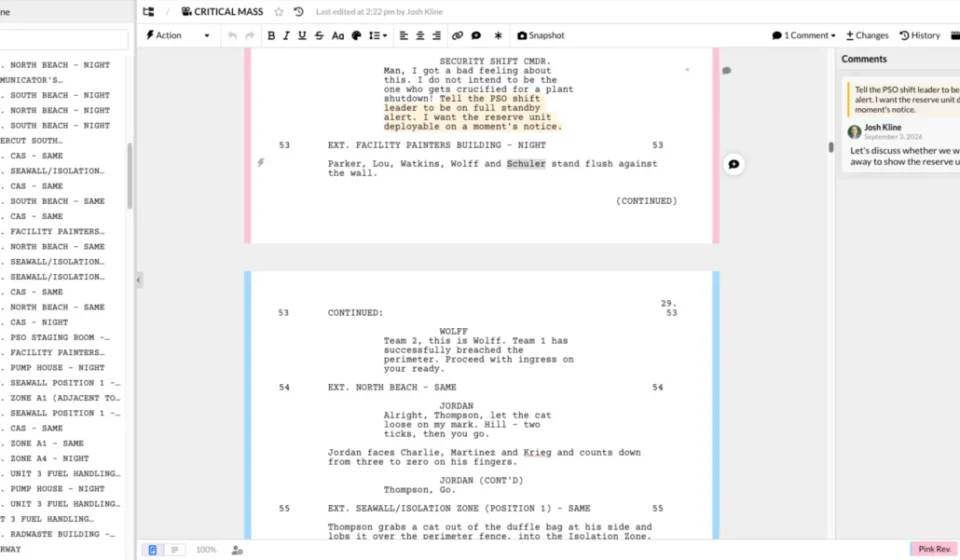
The software differentiates itself through a robust suite of features:
- Real-time Collaboration: Multiple users can edit, comment, and suggest changes simultaneously without version-control anxiety.
- Intelligent Archiving: Every version of a script is automatically saved and searchable, eliminating the risk of lost drafts.
- Integrations: Scripto bridges the gap between disparate production tools, syncing with industry stalwarts like WritersRoom Pro, Scriptflow, Filmustage, and Reve.
- Narrative Versatility: With the August launch of "Screenplay Pro," the company has introduced features like color-coded revision sets and page locking, specifically designed for narrative television and feature films rather than just sketch comedy.
The pricing model is designed for accessibility: personal use remains free, with a tiered subscription model for professional teams that require collaborative access. This low barrier to entry has allowed Scripto to expand its footprint rapidly, finding homes in awards show production (Emmys, WGA Awards), corporate streaming (Bleacher Report), and even the narrative-heavy world of AAA video game development.
Industry Feedback: The "John Oliver" Stamp of Approval
To build momentum, Scripto has leaned into the credibility of its high-profile users. For a sector that thrives on skepticism, the endorsements from industry giants serve as a powerful validation of the platform’s utility.
"While I strongly advise against trusting any tech company, Scripto has been the backbone of Last Week Tonight’s writing and production process since our inception," said John Oliver. The sentiment is echoed by Jon Stewart, who recently returned to The Daily Show desk. Stewart, with his characteristic wit, claimed that the software was a deciding factor in his return: "I have now used Scripto across multiple projects and you can quote me on this: It’s the reason I came back to The Daily Show. Election year, schmelection year, I just wanted to be back in that sweet script-writing interface."
The Implications of a "Tech Oligarch" in Hollywood
Colbert’s pivot into the tech sector is not merely a vanity project; it represents a fundamental shift in how creative labor is managed. By treating a writers’ room as a collaborative, data-driven environment, Colbert is effectively attempting to standardize a workflow that has remained largely stagnant for thirty years.
When asked about his vision for the company, Colbert remains focused on the practical rather than the abstract. "I saw what it did for my company and I want everyone to do it," he says. "It drives me crazy when I go into somebody else’s production and I’m back to PDFs being distributed and printed out on set. I’m like, ‘What is this?’"

However, this transition also highlights the changing nature of a modern celebrity’s career path. The traditional trajectory—hosting, acting, retiring—is being replaced by a model where creative leaders leverage their influence to become stakeholders in the tools of their trade. Colbert’s move into software is perhaps the most high-profile example of a "creator-founder" in the entertainment industry.
What’s Next for the Former Host?
Despite his excitement regarding Scripto, Colbert isn’t entirely turning his back on the stage. He admits to entertaining several offers for new projects, though he remains coy about the specifics. He describes himself as being "in no hurry," prioritizing quality of work and the chemistry of his team above all else.
"To be in a room full of laughter is an irreplaceable feeling," Colbert reflects. "So I’d like to get back to that. I just don’t know what that’s going to be yet."
For the moment, the man who once spent his nights dissecting the political landscape is now spending his days debugging user interfaces and scaling cloud architecture. His mission is modest in ambition—he isn’t looking to change the world, just the way the world’s stories are written. As he looks toward the future of Scripto, he remains grounded in the same philosophy he had at the Colbert Report: "Rob Dubbin and I had a little dream of trying to make our job easier, and I hope other people have the same benefit. I hope their days get easier the way our days got easier."
Whether Scripto becomes the universal standard for screenwriting remains to be seen, but one thing is certain: with the backing of Hollywood’s elite and a product born from the chaos of a live set, Stephen Colbert is proving that his most enduring punchline might just be the software that powers the industry itself.