Beyond the Lens: Tess Holliday and the Ongoing Battle Against Digital Body Policing

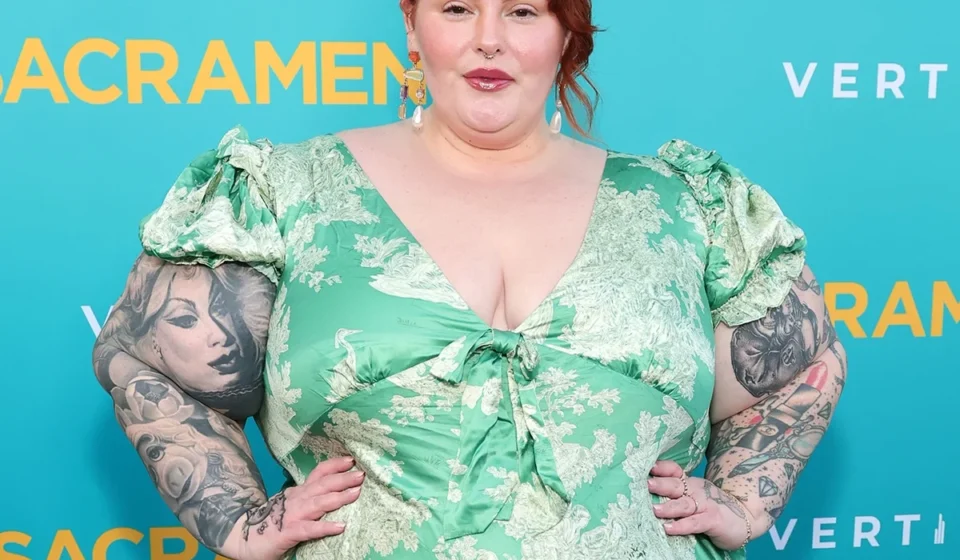
In an era where the digital landscape serves as both a stage for self-expression and a breeding ground for unsolicited scrutiny, model and activist Tess Holliday has once again become a focal point of the modern conversation regarding body image. Recently, after sharing a series of photos from an Italian vacation, the 41-year-old was met with a wave of online criticism regarding her appearance. Rather than retreat, Holliday utilized the platform to deliver a sharp, unapologetic retort that serves as a testament to her long-standing commitment to dismantling toxic beauty standards.
Her response, which included a follow-up image on a yacht in a green bikini, was more than just a social media post—it was a defiance of the persistent, invasive obsession with women’s bodies. As the industry continues to grapple with the ethics of public commentary, Holliday’s stance highlights a growing movement of celebrities who are refusing to play by the rules of the “digital jury.”
The Anatomy of an Online Backlash: A Chronological Overview
The recent controversy began on August 21, when Holliday posted images from her Mediterranean getaway on Facebook. The images, which captured the model enjoying a serene moment on a yacht, were quickly flooded with disparaging remarks from critics focused on her size.
By August 22, the model addressed the situation directly. In a follow-up post, she wrote, "Another photo of me on a yacht in Italy just because my haters loved it so much," pairing the quip with the sentiment, "Feeling blessed." This sequence of events—the initial post, the subsequent shaming, and the calculated, empowered response—has become a familiar cycle for many high-profile figures.
Holliday’s history of navigating this toxicity dates back to her early career. Since breaking into the modeling industry in 2010, she has been a lightning rod for debate. In 2018, she launched the viral hashtag #EffYourBeautyStandards, a campaign that empowered thousands of individuals to celebrate bodies that exist outside the narrow confines of mainstream fashion. By 2019, she solidified her industry standing with a landmark debut at New York Fashion Week for the brand Chromat, proving that her presence in high-fashion spaces was not merely a novelty, but a permanent shift.
Challenging the "Health" Narrative
One of the most persistent, and perhaps most insidious, forms of body shaming is the weaponization of "health." Critics often cloak their disdain in faux-concern, claiming that their comments are motivated by an interest in the target’s well-being. Holliday has been vocal in rejecting this framing.
In a 2018 interview with Self magazine, Holliday dismantled the idea that she owes the public an explanation for her biological markers. "By telling people that you see a doctor, and telling people that you’re healthy, it’s perpetuating the abuse against bigger bodies and the mindset that we owe it to people to be healthy," she stated.
She argues that the demand for proof of health is a distraction—a way to legitimize harassment. "The reality is I don’t owe you s–t and I don’t have to prove that I’m healthy or not, because it is nobody’s business," she maintained. This sentiment underscores a crucial shift in the body positivity movement: the move away from justifying one’s existence through "health" and toward the radical acceptance of bodily autonomy.
The Broader Context: A Culture of Scrutiny
Holliday is far from alone in this struggle. The phenomenon of digital body policing has affected a vast array of celebrities, spanning different industries, ages, and body types. This systemic issue suggests that the problem is not with the individuals being photographed, but with a public culture that feels entitled to dictate the physical standards of women.
Case Studies in Resilience
The industry has seen a wave of responses that mirror Holliday’s, each highlighting the psychological toll of constant evaluation:
- Ava Phillippe: The daughter of Reese Witherspoon and Ryan Phillippe recently pointed out the paradoxical nature of internet criticism. In a 2024 TikTok, she noted receiving conflicting feedback: some users accused her of being "too fat," while others simultaneously claimed she was "starving" herself. Her conclusion—that beauty exceeds superficial measures—is a sentiment shared by many Gen Z stars navigating the toxicity of comment sections.
- Bebe Rexha: Having faced years of scrutiny regarding her weight fluctuations, the singer-songwriter has been characteristically blunt. "I know I got fat," she tweeted in 2023, following up with a plea for the public to understand that human beings, particularly those on medication or dealing with health issues, are not static objects.
- Rumer Willis: When faced with accusations of being "too skinny," Willis chose to address the impropriety of the comments. She highlighted the double standard where people believe they have a "right" to offer unasked-for critiques. Her response was a masterclass in boundary-setting: "Body shaming of any kind is something I will not stand for."
The Psychological Implications of Public Commentary
The psychological impact of such widespread scrutiny cannot be overstated. When celebrities like Camila Cabello, Lizzo, and Natalie Portman are forced to defend their physical form, it sends a message to the general public that no one is immune to judgment.
Cabello, in an eloquent response to paparazzi photos, noted, "The saddest part of young girls growing up in an airbrushed world is they’re seeking a perfection that’s not real." This acknowledgment gets to the core of the issue: the proliferation of edited, filtered, and manipulated imagery has distorted the collective perception of "normal." When an actress like Christina Haack is forced to defend her weight after pregnancy, or when Ayesha Curry is subjected to invasive questions about her own health, the culture of "body checking" is reinforced.
Strategies for Resistance
How do these figures manage the relentless nature of online criticism? The strategies vary, but they share a common thread: the refusal to engage in the "justification game."
- Refusal to Explain: Many stars, including Lizzo and Celine Dion, have moved toward a stance of non-explanation. Lizzo’s declaration that her fitness journey is "none of your f–king business" is a powerful boundary.
- Cheeky Deflection: Figures like Halle Berry have utilized humor to undercut the gravity of the abuse. When a commenter criticized her for posting photos in her 50s, her response—a random, absurd fact about shrimp anatomy—effectively highlighted the irrelevance of the critic’s opinion.
- Educational Advocacy: Models like Holliday and activists like Jameela Jamil have turned their personal struggles into platforms for systemic change. By writing books like Take Up Space, Y’all and using hashtags like #EffYourBeautyStandards, they are actively changing the vocabulary around bodies.
Conclusion: Toward a More Empathetic Digital Future
The discourse surrounding Tess Holliday and her peers is indicative of a necessary cultural evolution. As society becomes more attuned to the mental health implications of digital harassment, the "right" to comment on someone else’s body is being increasingly challenged.
Holliday’s message to her critics—that they would likely be happier if they spent less time obsessing over her and more time tending to their own lives—is perhaps the most pertinent piece of advice in the digital age. The goal, as many of these women have articulated, is not to force everyone to love their own bodies immediately, but to foster a culture where the size of a person’s body is the least interesting thing about them.
As we move forward, the legacy of these celebrities will not just be their work in entertainment or fashion, but their resilience in the face of an impossible standard. By continuing to "take up space"—both literally and figuratively—they are ensuring that the next generation of women will have a different, more liberated experience in the digital world. The conversation has shifted from "How can I change to please you?" to "Why do you feel the need to control me?" And that, in itself, is a significant victory.