The Visceral Horror of Parenthood: A Deep Dive into Hanna Bergholm’s ‘Nightborn’

In the two decades since the release of the Judd Apatow-produced Knocked Up popularized the unflinching, full-frontal depiction of childbirth in mainstream cinema, audiences have grown accustomed to the "crowning" shot as a shorthand for the transformative, albeit messy, reality of labor. However, while those cinematic moments often lean into a raw, documentary-style intimacy, director Hanna Bergholm’s latest feature, Nightborn, pivots sharply away from sentimentality. Instead, it weaponizes the act of birth, transforming the miracle of life into a gore-drenched, surrealist nightmare that challenges the sanctity of the nuclear family.
Bergholm, building on the thematic foundation established in her breakout film Hatching, delivers a work that is as visually repulsive as it is psychologically profound. By blending visceral practical effects with the stifling, claustrophobic reality of early parenthood, Nightborn asserts that for many, the arrival of a child is not merely a lifestyle adjustment—it is an existential, body-horror ordeal that threatens to consume the host entirely.
The Genesis of a Nightmare: Plot and Premise
The film introduces us to Jon (played with a jarring, oblivious charm by Rupert Grint) and Saga (Seidi Haarla), a couple who decide to retreat from the modern world to the isolation of the Finnish wilderness. They move into a dilapidated, rot-ridden ancestral home, harboring an idealistic, if naive, dream: to raise three children in a secluded, fable-like idyll.
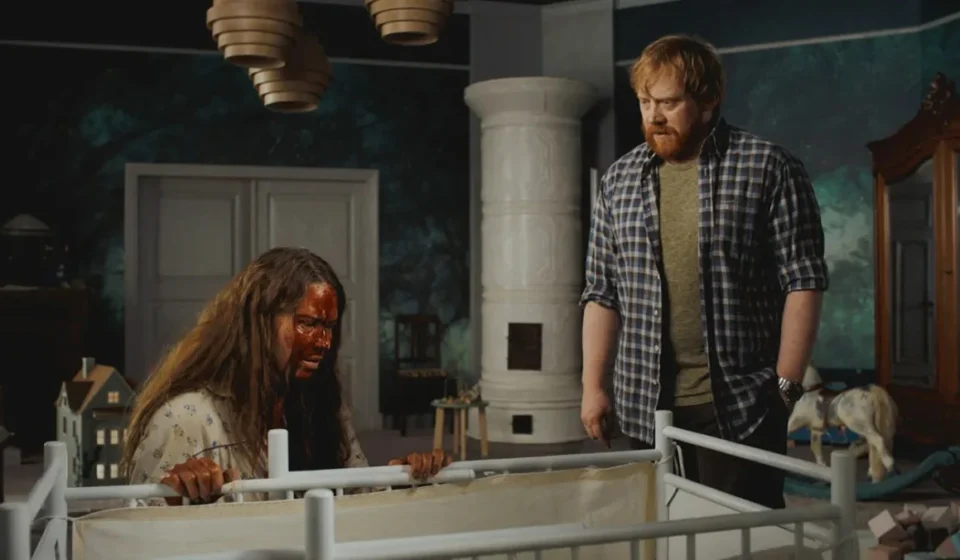
Their domestic fantasy is punctured almost immediately. The film’s first act features a birth scene that functions less like a medical event and more like an explosive, cannonball-force eruption of viscera. As the infant breaches, it sprays blood across Jon’s face, leaving him with a wide-eyed, rictus grin that lingers long after the chaos subsides. For horror aficionados, Grint’s performance is a masterclass in tonal dissonance; he maintains a sunny, Ron Weasley-esque earnestness even as his wife is being physically dismantled by the process of bringing life into the world.
As the story progresses, the reality of their "idyll" collapses. The infant—a hairy, growling, demon-like creature named Kuura—is not the angelic bundle of joy they envisioned. It feeds on Saga’s blood, quite literally chewing through her breasts and leaving her physically shattered, forced to navigate her own home with a walker.
A Chronology of Maternal Decay
The narrative of Nightborn is structured as a downward spiral. Following the initial trauma of the birth, the film follows a sequence of events that highlights the growing chasm between the parents:

- The Arrival: The move to the Finnish forest, defined by a desperate, waltzing optimism that ignores the literal decay of the house.
- The Traumatic Birth: A violent, CGI-enhanced sequence that establishes the film’s willingness to treat childbirth as a literal life-sapping event.
- The Maiming: The weeks following the birth, where Saga is subjected to the physical toll of a child that requires more than just milk—it requires her essence.
- The Denial: The involvement of family members who, despite clear evidence that the child is monstrous, insist on maintaining a veneer of domestic normalcy.
- The Reckoning: The slow realization that Saga’s "blessing" is, in fact, a parasitic drain, leading to the film’s haunting, ambiguous conclusion.
Supporting Data: The Metaphor of the Parasite
Nightborn thrives on the "yes, and" school of horror—a technique where the filmmakers take a common, metaphorical feeling of new motherhood and manifest it as physical reality. Many new mothers report feeling "sucked dry" or dehumanized by the unrelenting demands of an infant. In Bergholm’s world, this isn’t just a feeling; it is the central conflict.
The film serves as a harsh critique of the societal pressures placed on mothers to perform "radiant" parenthood. While Saga is bleeding and broken, those around her—including her sister and her own mother—refuse to acknowledge the abnormality of the situation. This gaslighting serves as a powerful commentary on the "pronatalist" culture that forces women to suppress their own suffering for the sake of an idealized image of maternal bliss.
The creature Kuura, with its allergy to purified metal and its primal, guttural cries, acts as a litmus test for the characters. Jon’s inability to grasp the danger—or his refusal to believe his wife’s deteriorating physical condition—underscores the gendered divide in parenting. He is an outsider in every sense, not just linguistically, but emotionally, incapable of translating the visceral reality of Saga’s experience into actionable care.
Official and Critical Perspectives
The film has generated significant discussion regarding its place in the modern horror landscape. Critics have noted that while the movie is "long on dream imagery and moldy skin makeup," it occasionally struggles with pacing, hovering in an airless space between metaphor and slasher-thriller.
Hanna Bergholm’s direction has been praised for its uncompromising visual language. By choosing to center the story in the Finnish wilderness, she taps into a rich history of folklore and fairy-tale horror, effectively stripping away the comforts of modern technology that might otherwise distract from the raw, biological horror at the core of the film.
Rupert Grint’s casting has been highlighted as a pivotal choice. By leaning into his established screen persona, Grint creates a sense of "wrongness" that heightens the film’s unease. His character’s refusal to acknowledge the monster in the cradle acts as a mirror for the audience’s own tendency to look away from the darker, more inconvenient truths of reproduction.

Broader Implications: The Horror of Ambivalence
The ultimate success of Nightborn lies in its refusal to offer easy answers. It is not a film about a "demon spawn" in the tradition of Rosemary’s Baby; it is a film about the internal conflict of a woman who realizes that the life she sacrificed her own for may not be the life she wanted.
Why It Matters
- Deconstruction of Tropes: Nightborn strips away the sanctity of the "mother-child bond," suggesting that it is a construct that can be deeply alienating and even harmful.
- The Physicality of Grief: By focusing on Saga’s physical injuries—the walker, the mangled breasts—Bergholm forces the viewer to contend with the often-ignored physical price of birth.
- The Failure of Communication: The film highlights how linguistic and cultural barriers (represented by Jon’s isolation in Finland) mirror the internal isolation of a mother who feels her partner cannot truly understand her pain.
In its final moments, the film arrives at a conclusion that is both bleak and strangely universal. Despite the carnage, the blood, and the literal consumption of her body, the film suggests that Saga would likely do it all over again. This isn’t necessarily a triumph of love; it is an acknowledgment of the primal, often irrational, and frequently terrifying cycle of human reproduction.
Nightborn is not a movie for the faint of heart. It is a grueling, messy, and deeply cynical piece of genre filmmaking that refuses to offer the comforting platitudes usually associated with the "miracle of life." Instead, it offers a mirror to the exhaustion, the loss of self, and the monstrous, animalistic nature of the parent-child relationship. Whether it succeeds as a horror movie is almost secondary to its success as a psychological study of the "newborn" experience—a period of time that is, in the eyes of many, the most harrowing, transformative, and terrifying period of a person’s life.
As the credits roll on this blood-spattered portrait, one is left with a single, lingering thought: motherhood, as depicted here, is a war of attrition, and it is a war that no one truly wins.
Grade: B-
‘Nightborn’ is currently available for streaming on Shudder.