The Digital Void: Harrison Atkins’ ‘Sour Minnows’ and the Erasure of the Human Soul

In the flickering light of a Los Angeles living room, the evening news broadcasts a headline that feels simultaneously momentous and hollow: "HOLLYWOOD HEARTACHE: DEATH OF AN ENIGMA." The subject is Jojo “Vacation” Monica, an eccentric performer whose mysterious passing under bizarre circumstances has captured the morbid curiosity of the city. For two roommates, Ricky (David Brown) and Tepper (Chase Williamson), this news serves as the catalyst for a surreal, disorienting journey into the heart of modern existential decay.
Harrison Atkins’ latest feature, Sour Minnows, is far more than a mere exploration of celebrity death. It is a profound, unsettling, and intentionally fragmented reflection on what it means to be a person in an era where human consciousness is increasingly treated as a data point. As the film traverses the blurred boundaries between the tangible world and the digital machinery that governs it, it asks a haunting question: In a world of infinite, looping information, what is left of the individual?
The Anatomy of an Existential Loop
The narrative structure of Sour Minnows is designed to mirror the very fragmentation it critiques. We first encounter Ricky and Tepper, a pair of slacker cinephiles who, upon hearing of Monica’s death, decide to stream one of his obscure films. However, the act of viewing becomes a recursive nightmare.
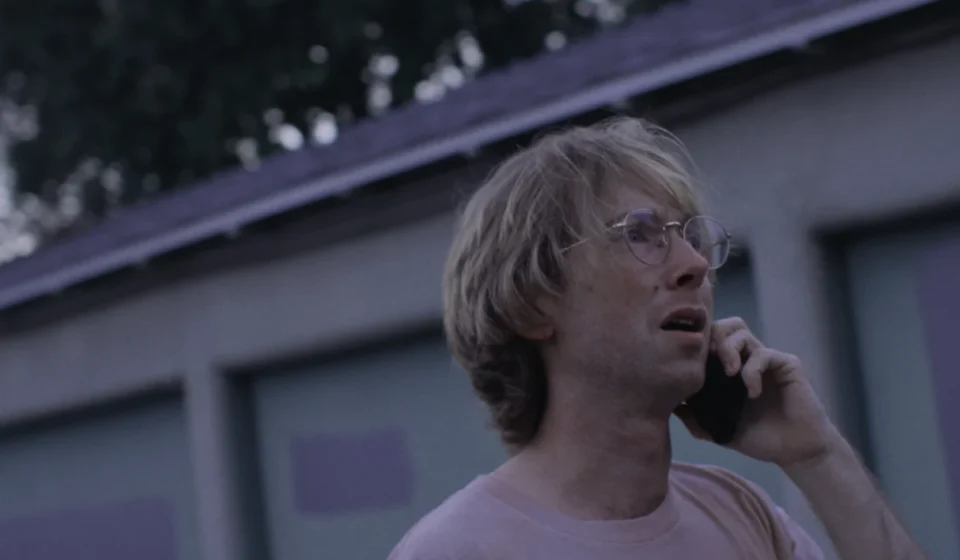
“I literally feel like we just watched it,” Tepper remarks, capturing a sentiment that transcends mere déjà vu. This is the film’s central conceit: a perpetual, grinding repetition that mirrors the instability of memory in the digital age. Ricky, who makes his living training artificial intelligence, is himself a man coming apart at the seams. He suffers from gaps in his own timeline, finding himself in places without recollection of how he arrived.
This is not merely a clever trope; it is a structural representation of the "gaping cave" described by a news anchor (Ryan Perez) early in the film. In a chilling prologue, the anchor sits behind a dilapidated building, calmly announcing the apocalypse as zombies—or perhaps something more nihilistic—begin to feast on small fish in the street. This vision of doom is not a distant threat; it is a present reality that Ricky and Tepper have already witnessed, though they struggle to integrate the experience into their waking lives.

A Chronology of Disintegration
The chronology of Sour Minnows resists linear progression, instead favoring a series of vignettes that feel like corrupted files.
- The Inciting Incident: The death of Jojo “Vacation” Monica, a performance artist who claimed to be "piloted" by a yellow, otherworldly entity. His death serves as the film’s prologue and its haunting emotional anchor.
- The Domestic Decay: The roommates, Ricky and Tepper, inhabit a world of perpetual "zone-outs." They represent a generation of amateur creators—Tepper, with his demanding, unrefined film projects, and Ricky, the AI trainer who spends his days feeding data into the systems that may eventually replace him.
- The Encounter with Aura: Ricky’s burgeoning relationship with Aura (Suzanna Son) serves as a desperate, flickering attempt at human connection. Yet, even this is poisoned by the temporal instability of their world; they struggle to remember the duration of their courtship, turning intimacy into an exercise in futility.
- The Descent: The film concludes not with a resolution, but with an acceptance of the void. As the existential rot consumes their neighborhood, the distinction between the "real" and the "simulated" becomes irrelevant.
The Privilege of Malaise: Character Dynamics
Atkins does not make it easy for the audience to sympathize with his leads. Tepper, a man who views his peers as mere raw material for his poorly conceived short films, embodies a specific type of entitlement that has long plagued the independent art scene. Ricky is slightly more sympathetic, though his apathy is a symptom of a larger, systemic malaise.
However, as the narrative progresses, their lack of likability becomes a deliberate test for the audience. By forcing us to sit with these "slackers," Atkins challenges us to interrogate our own prejudices. Is the urge to create—even in a form as fractured and desperate as Tepper’s—something worth preserving in a landscape reduced to a racket of "cosmic anxiety"?
Ricky’s attempts to leave himself "breadcrumbs"—such as noting "MEN’S ROOM" in his phone—are both pathetic and deeply human. They represent the last stand of a mind trying to anchor itself against a tide of data.
The Ghost in the Machine: The Dedication to Jeff Baena
The most devastating revelation of Sour Minnows occurs during the closing credits. The film is dedicated to the late filmmaker Jeff Baena, a longtime collaborator of Atkins who died by suicide in early 2025.

While it would be reductive to treat the dedication as a simple "decoder ring" for the film’s complex themes, it provides a vital emotional context. Baena’s passing left a void in the creative community, one that many have attempted to fill with "objective information" and digital tributes. Sour Minnows suggests that such data is fundamentally inadequate. The "wonderful weirdness" of knowing a person—the texture of their presence—cannot be captured by the algorithms that now dominate our information ecosystem.
By dedicating the film to Baena, Atkins acknowledges that the "gaping cave" of the apocalypse is, at its core, the loss of human connection. The film is a mourning process, a way to navigate the distance between the person we knew and the data that remains.
Implications: A Mirror to Our Own Reality
Sour Minnows is a formally imperfect work, occasionally collapsing under the weight of its own dense, philosophical ambitions. It is an opaque, challenging, and at times frustrating watch. However, this frustration is entirely intentional. It mimics the experience of navigating the modern world—a place where we are constantly told that we are "connected," yet we feel increasingly isolated.
The film’s reliance on "lo-fi" aesthetics, from the grainy footage of Monica’s tunnels to the shaky home-video quality of the roommates’ lives, serves as a testament to the human hand. In an era where artificial intelligence can generate slick, polished content, Atkins’ choice to show the seams is a radical act of authenticity.
The Verdict: Intellectual Ambiguity
The film concludes on a note of bittersweet comfort. It does not offer a solution to the "digital rot," nor does it provide a tidy moral lesson. Instead, it posits that we are all, in our own way, losing our minds in a system that is perpetually reshuffling the deck.

Sour Minnows is an intellectual triumph that invites the viewer to look at their own reaction to the screen. As we watch Ricky watch himself, we are forced to confront our own role as consumers of digital misery. It is a haunting, uncomfortable, and essential piece of cinema that demands we acknowledge the fragility of the human condition before it is entirely consumed by the very data we help generate.
Grade: B+
“Sour Minnows” premiered at the Fantasia Festival on July 24 and is currently seeking distribution. It remains a stark reminder that even in the face of inevitable, system-wide decay, the act of witnessing—and being witnessed—remains our only true defense.