The Monster in the Mirror: Adrian Chiarella’s Leviticus and the Resurrection of Queer Horror

In the landscape of modern cinema, the horror genre has long served as a subterranean laboratory for the anxieties of the marginalized. From the coded subtext of 1980s slashers to the contemporary "elevated" horror movement, the genre offers a unique lexicon for translating systemic trauma into visceral, onscreen manifestations. With his 2026 debut feature Leviticus, director Adrian Chiarella has not only reclaimed this tradition but sharpened it into a piercing, modern-day parable.
Set against the stark, industrial backdrop of the Australian wilderness, Leviticus is a film that functions as both a chilling supernatural thriller and a searing indictment of the structures—religious and societal—that seek to police the boundaries of identity. At its heart, the film asks a haunting question: What happens when the world convinces you that your very nature is a death sentence?
The Premise: When Desire Becomes a Death Trap
The narrative architecture of Leviticus is built upon a grim, archetypal foundation. The film opens with a sequence that sets the tone for the brutality to follow: a young lesbian lifeguard, seeking a moment of respite in a poolside shower, is seduced by an invisible entity. The entity manifests as the person she desires most, a seductive lure that ends in a visceral, violent murder.
This "little death" is the catalyst for the film’s central conceit. The entity is not merely a ghost or a slasher; it is the physical manifestation of a hex cast upon queer teenagers by a local, dogmatic church as a grotesque form of conversion therapy. The theological hook is chillingly effective: the church uses the mantra that "your desires will kill you," and in the world of Leviticus, that prophecy is literalized. The monster is a mirror, reflecting the deepest yearnings of its prey only to harvest them.
Chronology of a Crisis: The Trajectory of Naim and Ryan
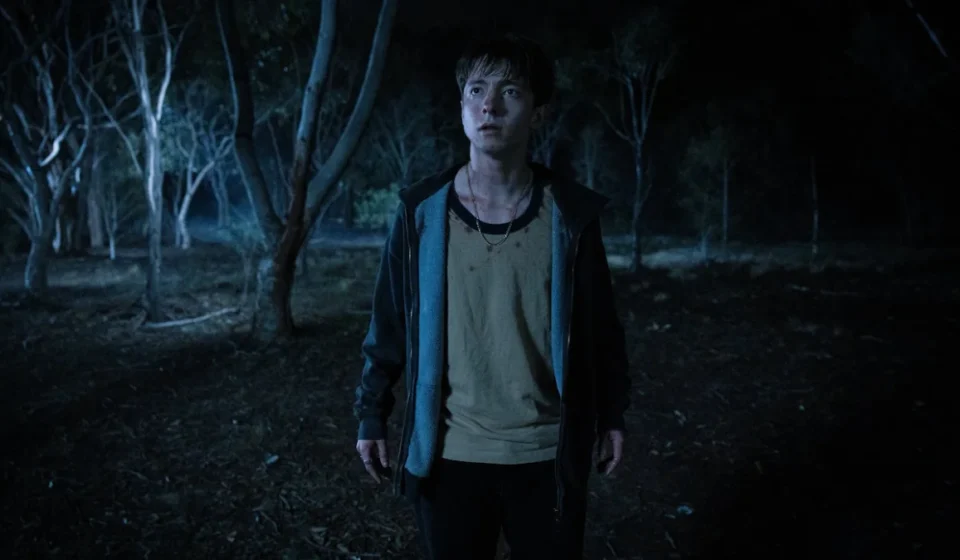
The film’s narrative focus narrows to the intimate, combustible chemistry between two classmates in a suffocating industrial town: the shy, introspective Naim (Joe Bird) and the brash, charismatic Ryan (Stacey Clausen).
- The Inciting Incident: Their budding romance is sparked in the claustrophobic confines of an abandoned building. In a scene marked by both aggression and intimacy, Ryan taunts Naim about his fears, leading to a physical skirmish that culminates in a kiss. It is a moment of profound vulnerability, immediately undercut by Naim’s own internalized shame as he recoils from his own reflection.
- The Transgression: The situation spirals when Hunter (Jeremy Blewitt), the preacher’s closeted son, inserts himself into their dynamic. A volatile, violent tryst ensues, and in a fit of jealousy and desperation, Naim exposes the encounter to the religious authorities. He believes he is seeking a manageable penance; instead, he triggers a chain reaction of isolation and spiritual violence.
- The Escalation: As the supernatural entity begins to hunt them, the boys realize that their only defense is distance. Because the monster thrives on the solitude of the closet and mimics the object of one’s affection, proximity becomes a liability. Their journey leads them to the sole survivor of a previous encounter—a woman haunting a local hospital who has learned that to survive, one must be perpetually surrounded by people, yet remains more isolated than ever.
- The Denouement: The film concludes not with a clean victory, but with a lingering, unresolved tension. The monster, like the trauma it represents, remains a persistent presence, suggesting that while the boys may have survived the night, the internal struggle is an inheritance they will carry forward.
Supporting Data: The Genre as a Mirror for the Marginalized
To understand the weight of Leviticus, one must look at the cinematic lineage Chiarella draws upon. In interviews, the director cites seminal works like A Nightmare on Elm Street 2: Freddy’s Revenge (1985) and John Carpenter’s The Thing (1982).
These films were not chosen at random. Freddy’s Revenge is widely recognized by queer scholars as an allegory for the closeted experience—a struggle against a force that invades one’s dreams and waking life. Similarly, The Thing captures the terror of being unable to trust the "other," or even one’s closest companions, a feeling of pervasive paranoia that defined the queer experience during the height of the AIDS crisis.
Chiarella notes that he was often forbidden from watching these films as a youth, a restriction that only heightened their allure. "I started thinking about what would be personal for me," he explains. "The genre has been important to the community for a very, very long time. It’s about the tension between the self and the other, not really knowing if you can trust the person in front of you."
Official Responses and Creative Vision
The production design of Leviticus is a character in its own right. By blending industrial decay with pastoral Australian landscapes, the film creates a sense of "vacant hostility." Chiarella aimed to build a "modern biblical parable" that forces the viewer to confront the friction between the natural world and the rigid, man-made edicts of the church.
Visual storytelling plays a critical role in the film’s efficacy. The supernatural threat is often glimpsed indirectly—through reflections in glass, mirrors, or the blurred peripheral vision of bystanders. This choice serves a distinct thematic purpose: those within the religious community who are "unburdened" by the curse are literally unable to see the monster. It is a visual representation of the gaslighting that queer youth face when their pain is dismissed as a performance or a phase.
The inclusion of acclaimed actress Mia Wasikowska, who plays Naim’s mother, adds a layer of tragic gravity to the film. Her performance embodies the insidious nature of "protective" homophobia, where the line between parental care and total control is permanently blurred. Her character’s refrain—"We need fear"—serves as the film’s most chilling justification for systemic oppression.
Implications: The Enduring Shadow of Trauma
As the film industry shifts toward more inclusive narratives, Leviticus arrives as a necessary, if uncomfortable, reminder of the roots of queer struggle. While much of contemporary queer media focuses on themes of self-actualization and romantic triumph, Chiarella’s work insists on a "back-to-basics" confrontation with the adversity that still plagues many communities today.
The film’s ending is a masterclass in modern horror subversion. Eschewing the easy optimism of "it gets better" narratives, it instead adopts the classic horror trope of the monster that never truly dies. "I thought about what that would mean," Chiarella reflects. "That whatever trauma these boys have been through may not go away for a very long time. It may never go away."
The implications for the audience are clear: the horror of Leviticus is not just in the monster, but in the environment that gives it life. By rooting the supernatural in the very real, very tangible harm of conversion therapy and bigotry, the film forces an empathy that is both exhausting and essential. It is a work that acknowledges that while survival is a victory, the process of healing is a lifelong, ongoing engagement with the ghosts of the past.
In Leviticus, the screen becomes a confessional. It is a visceral, haunting, and ultimately deeply human piece of cinema that proves the horror genre remains the most potent tool we have for unearthing the truths that polite society prefers to keep buried in the dark.