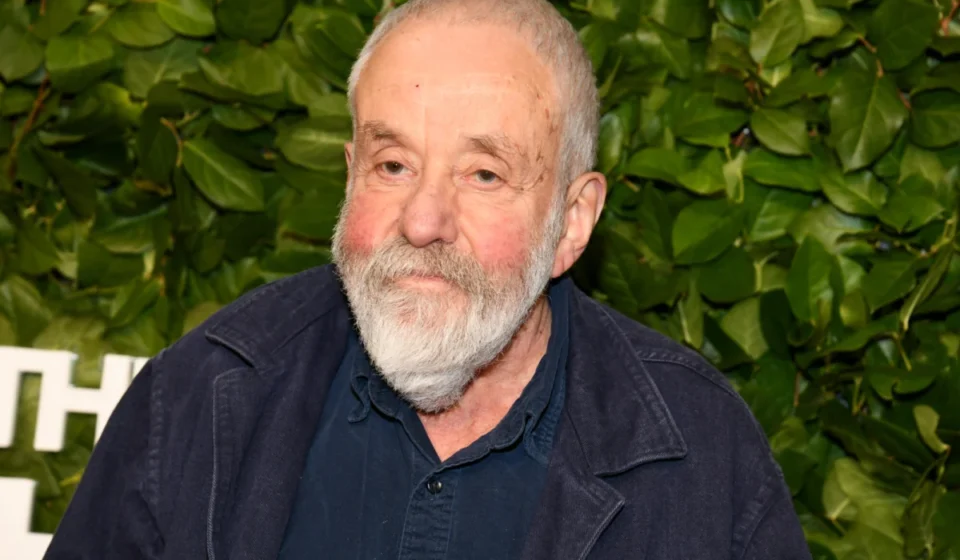

In the landscape of modern cinema, few figures command the reverence and singular authority of British auteur Mike Leigh. A master of the human condition whose trophy shelf boasts both the Venice Golden Lion and the Cannes Palme d’Or, Leigh has long been the gold standard for independent, character-driven storytelling. However, a somber realization has settled over the film community: the 83-year-old director has signaled that his upcoming feature, Tender Loving Care, will likely be his final contribution to the medium.
Speaking at a recent London roundtable hosted by the Golden Globes, Leigh addressed his future with a characteristic mix of candor and pragmatism. As he reflected on a career that has spanned decades—defining the British social-realist movement—the conversation shifted toward the physical tolls of his craft and the increasingly hostile environment for independent filmmakers. For those who have followed his journey from the gritty streets of his early works to the historical precision of his later masterpieces, the announcement marks the potential end of an era.
The Physical Toll and the Decision to Retire
The catalyst for Leigh’s retirement is, in his own words, a matter of physical necessity. The filmmaker has previously disclosed his diagnosis with myositis, a debilitating condition in which the immune system causes chronic inflammation of the muscles. This disease has significantly impeded his mobility, making the notoriously grueling process of directing a feature film an increasingly insurmountable hurdle.
"Absolutely. I think very likely, yes," Leigh responded when asked if Tender Loving Care would indeed serve as his swan song. "I mean, I know the girls don’t like to hear me say that, but I think that is the case."
Leigh detailed the physical reality of his onset presence, noting that he often relies on the support of his colleagues to navigate the daily requirements of a film set. "I was lucky in making this last film—people were very helpful. You’ll see when I get up that my two friends all helped me to stand up. So I probably can’t do much more." He further clarified that while he has considered other avenues of storytelling, the physical exertion required for theater is even more demanding. "Doing a play is even more physically demanding, strangely enough, than making a film, because on a film you can be moved around."

A Career Defined by Improvisation and Integrity
To understand the weight of Leigh’s departure, one must appreciate the unorthodox methodology that has defined his career since the 1960s. Unlike the majority of his contemporaries, Leigh does not operate from a conventional, rigid screenplay. His process is an organic, months-long evolution where he works intimately with his actors to uncover the "essence" of a character rather than merely their surface-level traits.
"It’s realism, not naturalism," he often clarifies. This approach traces back to his early exposure to the improvisational spirit of the 1960s, influenced by works like John Cassavetes’ Shadows. Leigh’s training as an actor allows him to bridge the gap between director and performer, creating a safe environment where actors can develop three-dimensional, deeply authentic lives for their characters.
This process, however, is notoriously difficult to fund in an industry obsessed with pre-written scripts and market-tested formulas. Producer Georgina Lowe, who spearheaded the financing for Tender Loving Care, spoke to the immense friction involved in securing resources for a director who cannot—and will not—provide a traditional script to investors.
"What’s awful is that the people who have the real funds and the real resources don’t really encourage," Lowe noted. "They don’t sow the seeds and reap the harvest."
The Financial Landscape: A Threat to Auteur Cinema
Leigh is acutely aware that the current cinematic landscape is drifting further away from the creative freedom he enjoyed during his early days at the BBC. In that era, he was granted the autonomy to explore, experiment, and develop projects without the constant interference of financiers seeking to mitigate "risk."

"When we make these films, there is no script to start with," Leigh explained. "Apart from the historical films, we can’t really tell anybody what it’s about. We can’t discuss anything. Just give us the money."
This lack of control is, for Leigh, a fundamental violation of the artistic process. He views filmmaking as an independent artistic practice, equivalent to the work of a novelist or a painter. When asked about the prospect of investors demanding changes to his process or content, his stance is uncompromising: "I would walk away and not do the project."
This refusal to capitulate is the hallmark of the auteur, but it is also the reason why the funding of independent cinema has become a precarious, often heroic, endeavor. As the industry consolidates under large corporate entities, the space for a director to spend months in rehearsals without a guarantee of the final product’s narrative arc is shrinking.
Collaborations and the Legacy of the "Family"
Tender Loving Care serves as a poignant closing chapter, featuring a cast that includes long-time collaborator Marion Bailey. Their professional relationship, spanning back to the late 1970s, exemplifies the trust and consistency required for Leigh’s method. Bailey, who has appeared in seminal works such as Meantime, Vera Drake, and Mr. Turner, notes that despite the shifting tides of the film industry, Leigh’s fundamental approach has remained remarkably consistent.
However, Bailey expresses a tempered outlook regarding the future of the industry and the preservation of "classical" acting. "I think in this country, we’ve never taken as much pride in the arts as France has," she remarked, highlighting a cultural discrepancy in how artistic institutions are valued. Despite this, she finds hope in the next generation, pointing to her daughter, Alice Bailey Johnson—who also appears in Tender Loving Care—as evidence that the spirit of dedicated, heartfelt performance continues to live on.

The Road to the Screen: TIFF and Beyond
The film is currently poised for its high-profile debut at the Toronto International Film Festival, with a likely stop at the Telluride Film Festival prior to its theatrical release. Distributed by Bleecker Street, Tender Loving Care has already generated significant buzz among critics who view it as a culmination of Leigh’s life’s work.
For audiences, the film will likely be viewed through the lens of a farewell. The title itself, Tender Loving Care, feels like a thematic summation of a director who has spent his career examining the tender, often painful, and profoundly loving connections between ordinary people.
Implications for the Future of Independent Film
The retirement of a director of Mike Leigh’s stature leaves a vacuum that is difficult to quantify. His departure serves as a stark reminder of the fragility of independent cinema. If a filmmaker with the pedigree of a Golden Lion and a Palme d’Or winner finds it increasingly difficult to secure financing for an organic, actor-centered process, the outlook for younger, less established auteurs is sobering.
Leigh’s insistence that "the important thing, in the end, is what’s on the screen" serves as both a manifesto and a challenge. As he prepares to step away from the chair, he leaves behind a body of work that proves that cinema, at its best, is not a product of corporate committee, but an act of profound, collaborative discovery. Whether the industry learns to "sow the seeds" as Georgina Lowe hopes, or continues to prioritize the safe, the scripted, and the sterile, remains the defining question of the decade.
As Tender Loving Care prepares for its December 4 release, the focus turns to the final frame. For Mike Leigh, it is the conclusion of a journey that began in Manchester and touched the hearts of audiences globally. It is, perhaps, the most fitting end for a career that never sought to impress with spectacle, but rather to reveal the complex, beating heart of humanity in its most authentic form.