Resilience and Retrospection: The 60th Edition of the Karlovy Vary International Film Festival

The Karlovy Vary International Film Festival (KVIFF) has long occupied a unique, almost defiant space on the global cinematic map. As it celebrates its 60th edition—marking an improbable eighty-year journey of survival, adaptation, and artistic excellence—the festival remains a testament to the enduring power of film in the face of shifting political landscapes. From its inception in 1946, just months after the cessation of Nazi rule in Czechoslovakia, to its current status as a premier European cultural pillar, KVIFF has navigated the turbulent waters of state communism, the Cold War, and the emergence of an independent Czech Republic with a rare, sophisticated grace.
A Legacy Forged in Turmoil
The history of KVIFF is not merely a timeline of premieres; it is a mirror reflecting the geopolitical evolution of Central Europe. Founded in 1946, the festival narrowly predated the inaugural Cannes Film Festival, establishing an early claim to international prestige. By 1958, despite the restrictive atmosphere of the post-coup communist era, the festival was granted “Category A” status by the International Federation of Film Producers Associations (FIAPF), placing it in the same league as Venice, Cannes, and Berlin.
However, the festival’s autonomy was frequently challenged. From 1959 until 1994, under pressure from the Soviet Union, the festival was forced into an alternating schedule with the Moscow International Film Festival. This geopolitical tethering lasted until two years after the birth of the independent Czech Republic, a period that allowed the festival to shed its ideological shackles while preserving its distinctive, intellectual DNA. Today, the "Vary Special" anniversary edition serves as both a homecoming for cinema lovers and a bold reclamation of the festival’s identity.

The Sanatorium of Cinema: Atmosphere and Ritual
Central to KVIFF’s charm is its setting: a picturesque Bohemian spa town that feels frozen in a more contemplative era. The festival’s headquarters, the Hotel Thermal, acts as a Brutalist anchor, its stark, concrete aesthetic providing a “sanatorium” vibe that invites attendees to step away from the frenetic pace of contemporary life.
The festival manages this by balancing a progressive, forward-thinking program with deeply ingrained rituals. Attendees are encouraged to slow down, with a ticket-booking cap of three films per day, a policy that discourages the "binge-watching" culture common at larger, more commercial festivals. This pacing creates a focused, intimate atmosphere where regional debuts of Sundance or Berlinale heavy-hitters sit comfortably alongside obscure, restored gems from Eastern European archives.
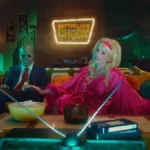
A defining KVIFF tradition remains its black-and-white festival trailers. Directed by Ivan Zachariáš, these eccentric, short-form vignettes feature Crystal Globe winners—such as Mel Gibson or Stellan Skarsgård—playing versions of themselves in absurd, humorous, and meta-textual scenarios. Furthermore, the dedication of artistic director Karel Och to the works of John Cassavetes—programming one of his films every year—acts as a multi-year masterclass, grounding the festival in the visceral, independent spirit of American cinema.

Out of the Past: The 60/80 Retrospective
The centerpiece of this year’s anniversary was the "Out of the Past – KVIFF 60/80" section. This curated retrospective functioned as a dialogue between the festival’s history and the modern era. Films like Powell and Pressburger’s A Matter of Life and Death (1946) served as a poignant reminder of the cultural bridge built between the West and a newly liberated Czechoslovakia.
The retrospective also highlighted the festival’s role in rewarding revolutionary voices during the Cold War. From Ján Kadár and Elmar Klos’s courtroom drama The Defendant (1964) to Ken Loach’s Kes (1970)—the latter winning just after the harrowing events of the Prague Spring—the selection traced the trajectory of political resistance through art. The section also courageously showcased once-suppressed works, such as Juraj Jakubisko’s Birds, Orphans and Fools (1969), which remained shelved for two decades. By pairing these historical markers with digital restorations of cult favorites like Jonathan Glazer’s Sexy Beast (2000) and Věra Chytilová’s Tainted Horseplay (1988), KVIFF demonstrated that its “repertory” is as much about healing as it is about curation.
Contemporary Visions: Time, Politics, and Memory
While the past informed the festival’s spirit, the present dominated its screens. Two standout films, both featuring "time" in their titles, captured the zeitgeist: Emmanuel Marre’s A Man of His Time and Sandra Wollner’s Everytime.

A Man of His Time is a sprawling, 155-minute exploration of the banality of evil. Set against the backdrop of the Vichy regime, the film examines how personal ambition can mutate into moral complicity. Swann Arlaud delivers a chilling, nuanced performance, balancing charisma with the quiet, terrifying emptiness of an opportunist. Olivier Boonjing’s cinematography, characterized by a static, observant camera, forces the audience to confront the protagonist’s descent into the Nazi machine without the comfort of cinematic artifice.
In contrast, Sandra Wollner’s Everytime offers a delicate, hallucinogenic meditation on grief. Though it invites comparisons to Charlotte Wells’ Aftersun, Wollner’s work stands on its own merits, utilizing a unique visual language to explore the elusiveness of memory. By juxtaposing urban realism with surrealist registers, the film captures the exact moment a family’s reality fractures, proving that fiction is often the only tool capable of articulating the deepest human wounds.
Competition and the Changing Landscape: Proxima and the Crystal Globe
KVIFF’s competitive sections continue to evolve. The Proxima section, which replaced the old "East of the West" competition, has successfully pivoted to a borderless format that highlights emerging global voices. The Grand Prix winner, Lover, Not a Fighter by Slovak director Martina Buchelová, was a masterclass in modern storytelling. Utilizing a fragmented, frantic montage of vertical phone footage and reflexive subtitles, Buchelová captured the volatile, self-destructive romance of a generation defined by digital mediation.

The main Crystal Globe competition, meanwhile, leaned into a more mature, global perspective. While Aung Phyoe’s Fruit Gathering took home the top prize for its tender portrayal of life in Myanmar, the most discussed entry was arguably the Bulgarian drama Black Money for White Nights by Kristina Grozeva and Petar Valchanov.
Implications: The Karmic Debt of the Past
Black Money for White Nights serves as a perfect microcosm for the current state of European cinema. The story of an elderly couple attempting to purchase a dream trip to St. Petersburg even as the invasion of Ukraine unfolds is a harrowing examination of denial. The film functions as a fable, exploring the "karmic debt" of living in a post-Soviet reality while clinging to a romanticized, birch-forested past.
Some critics attempted to frame the film as a blunt critique of Bulgarian corruption, but such a reading feels reductive. The film is, at its core, a tragicomedy about the failure of political escapism. Its vibrant, almost garish aesthetic—replete with living rooms papered in forest murals—highlights the disconnect between the couple’s internal dreamscapes and the collapsing reality outside their windows. That the film did not take home a major prize suggests that its themes may have hit too close to home, reflecting the very context that birthed the festival itself.

Conclusion: A Future Reconsidered
As the 60th edition draws to a close, it is clear that KVIFF is not simply celebrating its longevity; it is asserting its continued necessity. By daring to look at its own communist inheritance—not with shame, but with the critical eye of a mature institution—the festival has found a way to remain relevant.
The success of the "Out of the Past" retrospective, paired with the provocative, contemporary energy of the Proxima and Crystal Globe competitions, suggests that KVIFF has successfully navigated the transition from a state-sponsored tool to a vital, independent space for global discourse. Whether through the lens of a historical drama or a contemporary exploration of grief, the Karlovy Vary International Film Festival proves that history is not a static object, but a living narrative—one that, much like the best films, requires constant revision and an unwavering commitment to the truth.