The Resurrection of a Cult Classic: How ‘English, August’ Was Saved from the Brink of Oblivion

When Dev Benegal’s 1994 directorial debut, English, August, arrived on the Indian cinematic landscape, it didn’t just make waves—it shattered the mold. Adapted from Upamanyu Chatterjee’s celebrated 1988 novel, the film captured the existential drift of a generation caught between the remnants of colonial bureaucracy and the encroaching winds of a globalized future.
However, for nearly three decades, the film itself faced a silent, slow-motion catastrophe. Its original camera negatives had melted into an irreparable mass of celluloid, and its dupe masters were long gone. What remained was a fragmented puzzle that seemed destined to vanish. That it has now been painstakingly resurrected for a premiere at the Venice Film Festival is not merely a triumph of technical skill; it is a miracle of archival detective work and an unlikely testament to one director’s foresight.
The Anatomy of a Restoration: From Decay to Digital
The recovery mission was spearheaded by the Film Heritage Foundation (FHF), a premier organization dedicated to preserving India’s cinematic legacy. Shivendra Singh Dungarpur, the foundation’s founder, vividly recalls the initial assessment of the materials.
"It’s really sad that when I saw the original camera negative, it had melted. It was in terrible condition," says Dungarpur. Faced with the total loss of the master elements, the FHF was forced to rely on two surviving 35mm release prints: one personally preserved and donated by Benegal, and the other housed within the vaults of the NFDC-National Film Archive of India.
The process of restoration, conducted at the world-renowned L’Immagine Ritrovata laboratory in Bologna, Italy, became a daily collaborative ritual. Benegal, working from New York, engaged in a constant dialogue with the restoration team. The workflow was granular and exhaustive—spanning color grading, grain management, and the reconstruction of subtitles—with cinematographer Anoop Jotwani setting the visual palette by testing reels to ensure the final product honored the film’s original, evocative aesthetic.
The Unlikely Savior: A Box of DAT Tapes
While the visual restoration was a logistical feat, the true hero of this story is a box of Digital Audio Tape (DAT) cassettes that Benegal had held onto for thirty years. In 1994, the production lacked the budget for a high-end stereo mix, forcing the team to settle for a flat mono mix on outdated equipment.
"Back in 1994, DATs were the cutting-edge digital recording medium," Benegal explains. "I kept them in my personal archive purely out of my obsession with audio—never imagining they would save the film three decades later when the original 35mm sound negatives vanished."
Bringing these tapes to sound recordist Vikram Joglekar and sound engineer Satish P.M. was, in Benegal’s words, "like opening a time capsule." Because these tapes contained the original "unmixes"—the raw, high-fidelity audio tracks—the team was able to rebuild a soundscape that had been lost to history. This archival serendipity allowed the FHF to deliver a sonic experience far superior to the original theatrical release.
A Portrait of Alienation: Agastya Sen’s Timeless Journey
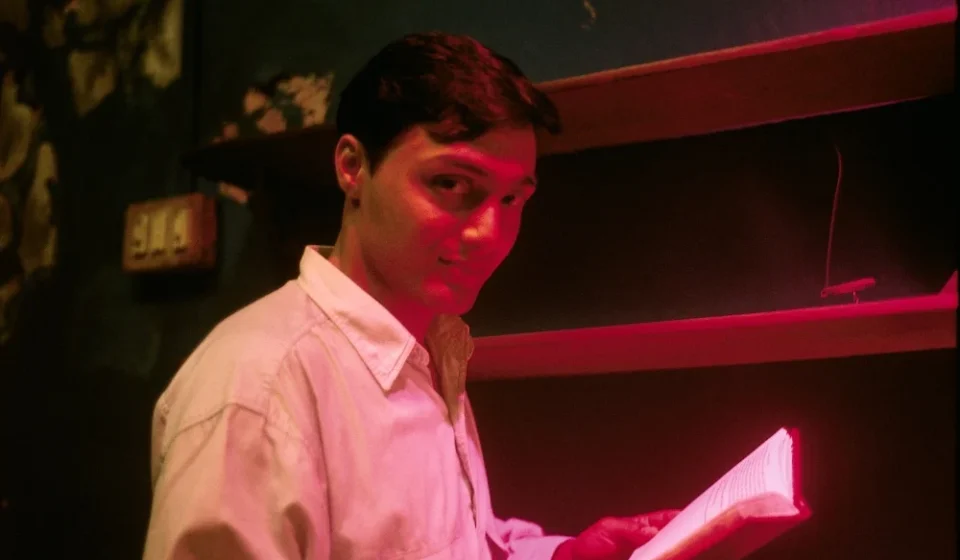
At its core, English, August is a meditation on the outsider. It follows Agastya Sen—"August" to his peers—a Westernized trainee sent to the provincial town of Madna for his civil service induction. Surrounded by Bob Dylan records, Marcus Aurelius, and a stagnant, suffocating bureaucracy, Agastya represents the archetypal "stranger in his own land."
Rahul Bose, who made his feature film debut as the disaffected protagonist, became the face of a generation. Benegal recalls that Bose’s brilliance lay in his refusal to play to the gallery. "Rahul Bose understood that Agastya wasn’t someone the audience needed to like; he needed to be truthful," Benegal notes. "He wasn’t trying to perform alienation—he simply inhabited the character with remarkable honesty. He also had the confidence to do very little. That’s much harder than it sounds."
The Folklore of Lost Music
The restoration process also highlighted the unique, often haphazard nature of 1990s independent filmmaking in India. The production team famously went to great lengths to clear music rights—a rarity in the Indian industry at the time. However, even with that foresight, some losses were inevitable.
"The paperwork documenting the Miles Davis ‘Round Midnight’ clearance was lost in a torrential monsoon flood," Benegal reveals. This missing piece has since become part of the film’s mythology. Fans often claim to remember specific tracks that were never actually in the theatrical mix, highlighting the subjectivity of cinematic memory. "Some people have made a mixtape in their minds," Benegal muses. "Memory has a curious way of creating its own version of a film."
Implications: Cinema in the Age of Algorithms
As English, August prepares to reach new audiences, its director reflects on how the film’s themes have shifted in the digital era. In 1994, Agastya’s isolation was physical and absolute; he was truly "off the grid." Today, Benegal observes, that isolation has been replaced by a different, more pervasive strain of alienation.
"The modern Agastyas aren’t just urban civil servants reading Marcus Aurelius in small towns—they are scrolling through curated, globalized lives on their phones from anywhere," says Benegal. "The absurdity hasn’t disappeared; it’s just been upgraded to high-speed internet."
Furthermore, Benegal is critical of the modern cinematic landscape, which he believes has become increasingly hostile to the kind of "unclassifiable" storytelling that defined his debut. "Everything gets filtered through target demographics, pitch decks, and comparative commercial comps," he says. The film’s original struggle—when Indian censors were baffled by a script featuring five different languages—stands in stark contrast to a contemporary environment where artistic risk is often stifled by algorithmic certainty.
The Road Ahead: FHF and the Future of Indian Heritage
The restoration of English, August marks the third consecutive year that the Film Heritage Foundation has premiered a major restoration at the Venice Film Festival, following Girish Kasaravalli’s Ghatashraddha (2024) and Bimal Roy’s Do Bigha Zamin (2025).
For the FHF, this work is about more than nostalgia. It is about placing vital pieces of cultural history into a "different time," ensuring that future generations can engage with the intellectual and emotional questions that defined the post-colonial Indian experience.
As for Benegal, his gaze is already fixed on the horizon. He is currently developing A Love Supreme, a contemporary re-imagining of the Sanskrit epic Shakuntala. Yet, the thematic thread remains constant: a fascination with the humor, absurdity, and profound humanity found in those who feel fundamentally out of place.
When asked what a 20-year-old might glean from English, August today, Benegal remains optimistic. He hopes that audiences will move past the generational markers—the lack of smartphones or the specific political climate of the 90s—and connect with the deeper, more universal inquiry of the film: the struggle to align one’s inner life with the rigid expectations of society.
In its restored form, English, August is no longer just a relic of the early 90s; it is a mirror held up to the present, proving that while the technologies of our isolation may change, the search for meaning remains as urgent and as elusive as ever.