
The cinematic landscape feels decidedly emptier following the passing of Sam Neill at the age of 78. A performer of immense range, profound intelligence, and disarming humility, Neill occupied a unique space in the cultural consciousness. To the masses, he was the face of the Jurassic Park franchise, the rationalist paleontologist forced to confront the impossible. To the cinephile, he was a chameleonic force who moved with equal grace between the surreal, nightmarish corridors of Andrzej Żuławski’s Possession (1981) and the tender, understated intimacy of Gillian Armstrong’s My Brilliant Career (1979).
However, to those who followed him beyond the screen, Sam Neill was something even more rare: a man who lived as authentically as he performed. Whether through his celebrated organic vineyard in Central Otago, New Zealand—the heart of his "Two Paddocks" brand—or his candid, witty presence on social media, Neill was a grounded, pastoral figure who stood in stark contrast to the hollowed-out archetypes of modern celebrity.
Chronology of a Career: From the Antipodes to the World Stage
Sam Neill’s career was not a straight line toward fame; it was a winding path defined by intellectual curiosity and a refusal to be pigeonholed. Born in Northern Ireland and raised in New Zealand, he carried a certain stoicism that would become the hallmark of his screen presence.
The Formative Years (1970s – 1981)
Neill’s breakthrough arrived with the 1979 Australian arthouse classic My Brilliant Career. Opposite Judy Davis, he projected a rugged, romantic charisma that caught the attention of international casting directors. This led to his American debut in The Omen III: The Final Conflict (1981), where he played the Antichrist. While the film received a lukewarm critical reception, it solidified Neill as an actor capable of carrying high-concept, genre-defying material. That same year, he delivered a career-defining performance in Possession, a harrowing, visceral exploration of psychological disintegration that remains a cult masterpiece today.

The Leading Man and the Near-Misses (1982 – 1992)
Throughout the 1980s, Neill navigated a diverse filmography. He was considered a frontrunner for the role of James Bond, a "mortifying" audition process that he later confessed was far removed from his sensibilities. He chose instead to lean into projects that favored character-driven tension, such as Phillip Noyce’s Dead Calm (1988), which showcased his ability to play the stoic protector—a template he would later refine for global audiences.
The Blockbuster Era (1993 – 2000)
1993 marked a tectonic shift in Neill’s trajectory with Steven Spielberg’s Jurassic Park. As Dr. Alan Grant, Neill became the vessel through which audiences experienced the wonder and terror of a prehistoric revival. He was the perfect "rationalist coming unglued," a role he would revisit with varying degrees of success in subsequent sequels. During this period, he also solidified his partnership with horror auteur John Carpenter, most notably in In the Mouth of Madness (1994) and Event Horizon (1997), films that leveraged his ability to anchor absurd or terrifying premises with genuine human pathos.
Supporting Data: The Craft of the Everyman
Neill’s success as an actor was rooted in a specific technique: he refused to condescend to the material. Whether he was playing a high-stakes adventurer or a man possessed by cosmic entities, he approached every scene as if it were a Shakespearean drama.
His collaborative spirit was perhaps his greatest asset. Throughout his career, Neill shared the screen with some of the most formidable actresses of his generation, including Meryl Streep in A Cry in the Dark (1988) and Holly Hunter in The Piano (1993). Critics often noted that Neill had a "chameleonic" ability to elevate his co-stars. He didn’t dominate the frame; he facilitated the narrative, allowing the emotional truth of the scene to breathe.

His dedication to his craft was matched by his commitment to his homeland. His documentary work, including Cinema of Unease (1995), showcased a man deeply invested in the intellectual and cultural identity of New Zealand. He used his platform to critique the colonial and religious structures that influenced his upbringing, proving that his interests extended far beyond the soundstage.
Official Responses and Public Sentiment
The outpouring of grief following the news of his passing reflects a legacy built on genuine, earned affection. John Carpenter, with whom Neill shared a profound creative kinship, took to Facebook to express his heartbreak, noting that "the world has lost a remarkable actor, father, farmer, and friend."
The industry’s response has been marked by a lack of the usual hyperbole. Instead, colleagues and friends have highlighted his role as a "proverbial good guy"—an environmental activist and philanthropist who championed sustainable agriculture through his Two Paddocks estate. His social media presence, which famously featured his "yoga partners" (a motley crew of farm animals), provided a window into a man who found as much joy in the company of ducks as he did in the glitz of Hollywood premieres.
His decision to step away from Twitter following its acquisition by Elon Musk was emblematic of his character. He cited his discomfort with the platform’s increasingly "angry and divisive" nature, opting to "walk quietly away" rather than participate in a digital culture he found antithetical to his values.
Implications: A Legacy of Resilience
Sam Neill’s life and career serve as a masterclass in navigating the pressures of fame without losing one’s moral center. His public battle with non-Hodgkin lymphoma in his later years was met with the same candor and pragmatic wit that characterized his life. "I’m not afraid of dying," he told the BBC in 2023. "What I don’t want to do is to stop living, because I really enjoy living."
The "Trent" Effect: Reality vs. Performance
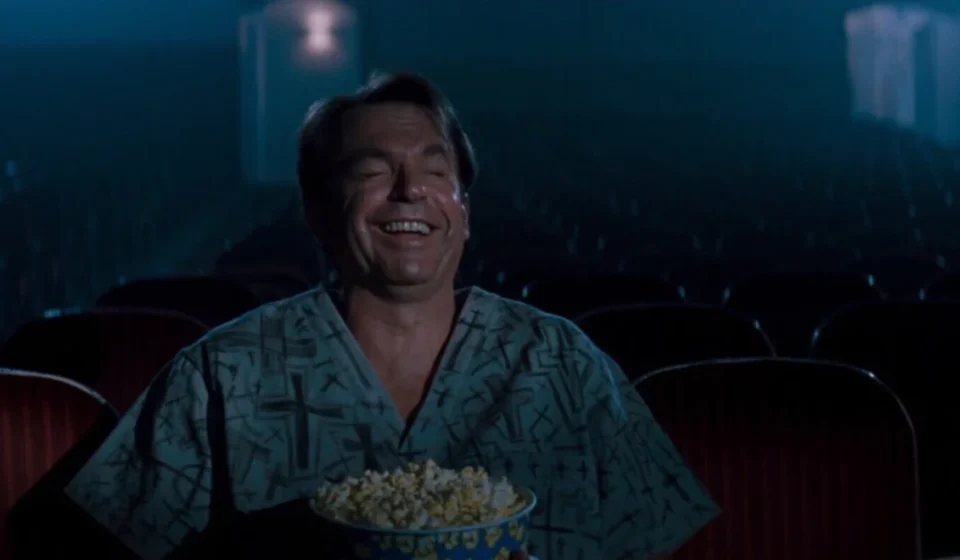
The image of Neill as John Trent at the end of In the Mouth of Madness—a man watching the end of the world with a bag of popcorn in his lap—has become a poignant, unintended symbol of his passing. It captures the essence of the actor: the ability to find humor in the abyss, to treat the grand, terrifying, and mundane aspects of existence with the same level of bemused curiosity.
His legacy is not merely one of box office receipts or critical accolades. It is a legacy of intentional living. He leaves behind a body of work that spans from the avant-garde to the blockbuster, yet he never allowed his identity to be consumed by either. He remained, until the end, a farmer who happened to act—a man who preferred the honest labor of his vineyard to the artifice of the red carpet.
In an industry often defined by fleeting trends and manufactured personas, Sam Neill was an anchor. He proved that an actor could be both a global superstar and a deeply private, thoughtful human being. As the screen fades to black, the memory of his performance remains—not just as the scientist, the spy, or the survivor, but as a man who invited us all to look at the world, however "pear-shaped" it might seem, and find a reason to smile.